




Trust Planning Attorney: Building a Secure Future for Your Heirs
Most people put off trust planning because they think it’s only for the wealthy. That’s a costly mistake.
A trust planning attorney helps you protect your assets, avoid probate delays, and control exactly how your wealth reaches your heirs. We at Law Offices of Roshni T. Desai have seen families struggle through preventable problems-unclear documents, missed deadlines, and disputes that drain both time and money.
The right plan stops these problems before they start.
Why Your Family Needs a Trust Plan Now
Probate costs your family time and money
Probate is expensive and slow. When someone dies without a proper trust, their estate enters probate court-a public process that typically takes 9 to 12 months and costs 3 to 7 percent of the estate’s value in fees and court costs. During this time, your heirs wait to access their inheritance while attorneys, executors, and courts handle paperwork. A funded revocable living trust bypasses probate entirely. Assets transfer directly to your beneficiaries within weeks, not years, and the process stays private. Your family avoids the emotional burden of court proceedings and keeps sensitive financial details out of public records.
Irrevocable trusts shield wealth from creditors
Without proper asset protection, creditors can pursue your estate during probate, and lawsuits against heirs can target inherited assets. An irrevocable trust shields wealth from creditors and legal judgments in ways a will never can. The grantor transfers assets into the trust, removing them from personal liability. Spendthrift trusts add another layer by protecting beneficiaries from their own creditors and poor financial decisions-a safeguard especially valuable if you’re leaving money to someone who struggles with debt or spending. This structure means your hard-earned wealth stays within the family instead of disappearing into legal disputes. Many high-net-worth families use irrevocable trusts specifically to preserve assets across generations while minimizing exposure to creditors.
A trust lets you set the rules, not state law
Without a trust, state intestacy laws determine who gets your assets-and those laws rarely match what families actually want. A trust lets you specify exactly when and how heirs receive money. You can delay distributions until a child reaches 25, fund education expenses directly, or provide ongoing income to a surviving spouse while protecting principal for children. You can name specific people to manage decisions and remove someone who proves irresponsible. You can direct assets to charitable causes that matter to you. A will gives you some control, but it only covers assets in your name at death; retirement accounts, life insurance, and jointly owned property pass outside a will based on beneficiary designations. A comprehensive trust plan coordinates all asset types (including real estate, investments, and business interests) so everything flows according to your actual wishes, not default rules.
How a Trust Planning Attorney Protects Your Wealth
Understanding Your Specific Situation
A trust planning attorney does far more than draft documents. We build customized strategies that control exactly how your assets flow to heirs while eliminating delays and tax exposure. The process starts with understanding your family structure, financial situation, and specific goals-not a one-size-fits-all template. During the initial consultation, an attorney reviews your current assets, identifies gaps in your plan, and explains which trust structure works best for your circumstances.
Selecting the Right Trust Structure
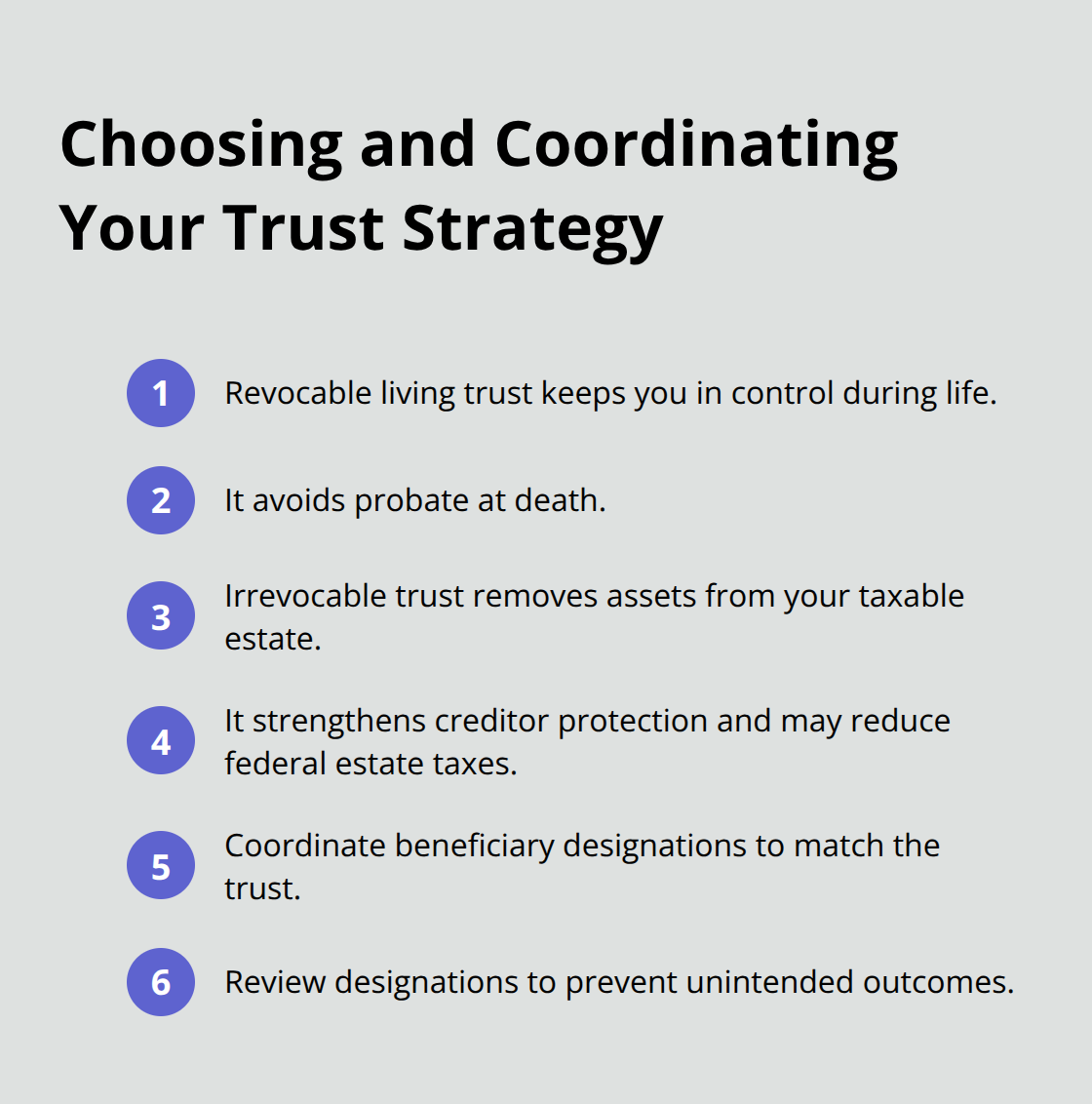
A revocable living trust gives you complete control during your lifetime and avoids probate at death. An irrevocable trust, by contrast, removes assets from your taxable estate permanently, offering stronger creditor protection and potential federal estate tax savings-important for families with assets exceeding the $15 million federal exemption in 2026. The attorney then coordinates beneficiary designations on retirement accounts, life insurance, and investment accounts to align them with your trust instructions. Many families discover that their existing designations contradict their actual wishes, creating unintended outcomes.
Establishing Powers of Attorney and Healthcare Directives
A trust planning attorney establishes durable financial powers of attorney and healthcare directives, documents that take effect immediately if you become incapacitated. Without these, courts may appoint a conservator to manage your finances or medical decisions-a process that costs thousands of dollars and strips you of decision-making authority. The attorney names trusted individuals to serve as trustee, successor trustee, and healthcare agent, discussing their responsibilities and capacity to handle the role.
Managing Trust Administration and Asset Transfers
The attorney handles trust administration after death, managing asset transfers, tax filings, and distributions to beneficiaries. This work typically spans several months and requires attention to state law, accounting details, and family communication. Your plan adapts when you marry, divorce, have children, acquire property, or experience significant wealth changes-which is why the relationship with your attorney continues beyond the initial documents.
Common Mistakes People Make Without Professional Guidance
Outdated Documents Create Unintended Consequences
Most people create a trust and assume the work is done. They file the documents away and forget about them for a decade. Then life happens-they remarry, have grandchildren, buy investment property, or experience a significant change in wealth-and their old trust no longer reflects reality. Courts see this constantly. A trust drafted in 2015 that names an ex-spouse as trustee, fails to account for a child born in 2018, or doesn’t address cryptocurrency acquired in 2023 creates chaos and conflict.
State law changes matter too. The federal estate tax exemption was $15 million in 2026, but Congress can adjust it downward, potentially affecting families who assumed their irrevocable trust strategy would remain optimal. Without periodic reviews-ideally every three to five years or after major life events-your plan becomes a liability instead of protection.
Life Events Demand Immediate Action
Schedule a review whenever you experience marriage, divorce, the birth of children or grandchildren, a significant inheritance, a business sale, or substantial property acquisition. These events often require trust amendments or entirely new strategies to prevent unintended consequences. A trust that worked perfectly for a single person fails to protect a blended family. A distribution strategy designed for one child becomes unfair when you have three. Assets acquired after the trust was created sit outside the trust structure, exposing them to probate anyway.
Empty Trusts and Misaligned Assets Defeat Your Purpose
The second critical failure happens when people create trusts that sound good on paper but don’t actually accomplish their goals. Someone establishes a revocable living trust to avoid probate but forgets to retitle assets into the trust’s name-the trust sits empty and probate happens anyway. Another person creates an irrevocable trust for tax benefits without understanding that they permanently lose control and access to those assets. A parent establishes a trust naming an irresponsible adult child as trustee, only to discover later that the child makes poor decisions with family wealth.
Coordination failures also occur when beneficiary designations on retirement accounts, life insurance policies, and investment accounts contradict trust instructions. These designations override your trust entirely, sending assets to unintended recipients and creating family conflict.
Vague Instructions Lead to Disputes and Litigation
A third mistake occurs when trust instructions are vague or contradictory. Instructions that say “distribute assets to heirs when they are ready,” “provide for my family’s needs,” or “take care of my grandchildren” create confusion and often lead to disputes. Trustees face legal liability for misinterpreting ambiguous language. Beneficiaries disagree about what the grantor intended. Litigation becomes necessary to clarify terms, draining thousands of dollars from the estate.
Clear, specific instructions prevent this entirely. A well-drafted trust specifies exact distribution ages, defines what constitutes a legitimate expense, names successor trustees in order of preference, and addresses potential conflicts directly. Precise language eliminates guesswork and protects both trustees and beneficiaries from costly disputes.
Final Thoughts
The difference between a solid estate plan and a failing one often comes down to professional guidance and ongoing attention. A trust planning attorney builds a strategy tailored to your family’s actual situation, not a generic template that misses critical details. We at Law Offices of Roshni T. Desai understand that every family has different priorities, different assets, and different concerns about how wealth flows to the next generation.
Schedule a consultation to review where you stand today. During this meeting, a trust planning attorney identifies gaps in your current plan, explains which trust structures fit your goals, and answers questions about costs and timelines. Many families discover that their existing documents contradict their actual wishes or that major life changes have made their old plans obsolete.
Work with an attorney to create a tailored plan that selects the right trust type, coordinates beneficiary designations across all asset types, establishes powers of attorney and healthcare directives, and aligns every document with your intentions. Law Offices of Roshni T. Desai provides personalized estate planning and trust administration across Southern California and offers free consultations with flexible home or office visits to help you start building your secure future.