




Probate Attorney Consultation Tips: Get the Most from Your Free Session
A free probate attorney consultation is one of the best decisions you can make when planning your estate. Most people walk into these meetings unprepared, missing chances to ask critical questions and understand their options.
We at Law Offices of Roshni T. Desai have seen firsthand how preparation transforms a consultation from basic to genuinely useful. This guide covers the probate attorney consultation tips that will help you get real answers and move your estate planning forward.
What Documents Should You Bring to Your Probate Consultation
Walking into a probate attorney consultation without your financial records is like showing up to a doctor’s appointment without describing your symptoms. You’ll waste time on basic questions instead of receiving actionable advice. Start by collecting every estate document available, including the original will, any trust documents, powers of attorney, and healthcare directives. If the person has already passed away, locate the death certificate and any preliminary probate paperwork filed with the court. These documents provide your attorney with the foundation needed to assess your situation quickly and offer real guidance on timelines and costs specific to your estate.
Compile Your Financial Inventory
Next, assemble a complete financial picture. Collect recent bank statements from all checking and savings accounts, property deeds for real estate holdings, brokerage statements for stocks and bonds, and statements for retirement accounts like IRAs and 401(k)s. Don’t overlook insurance policies, including life insurance and any coverage tied to business interests. Create a simple spreadsheet listing each asset with its estimated value and how it’s titled (solely, jointly, in trust, etc.). Include a separate section for debts: mortgage balances, credit cards, loans, and any outstanding taxes.
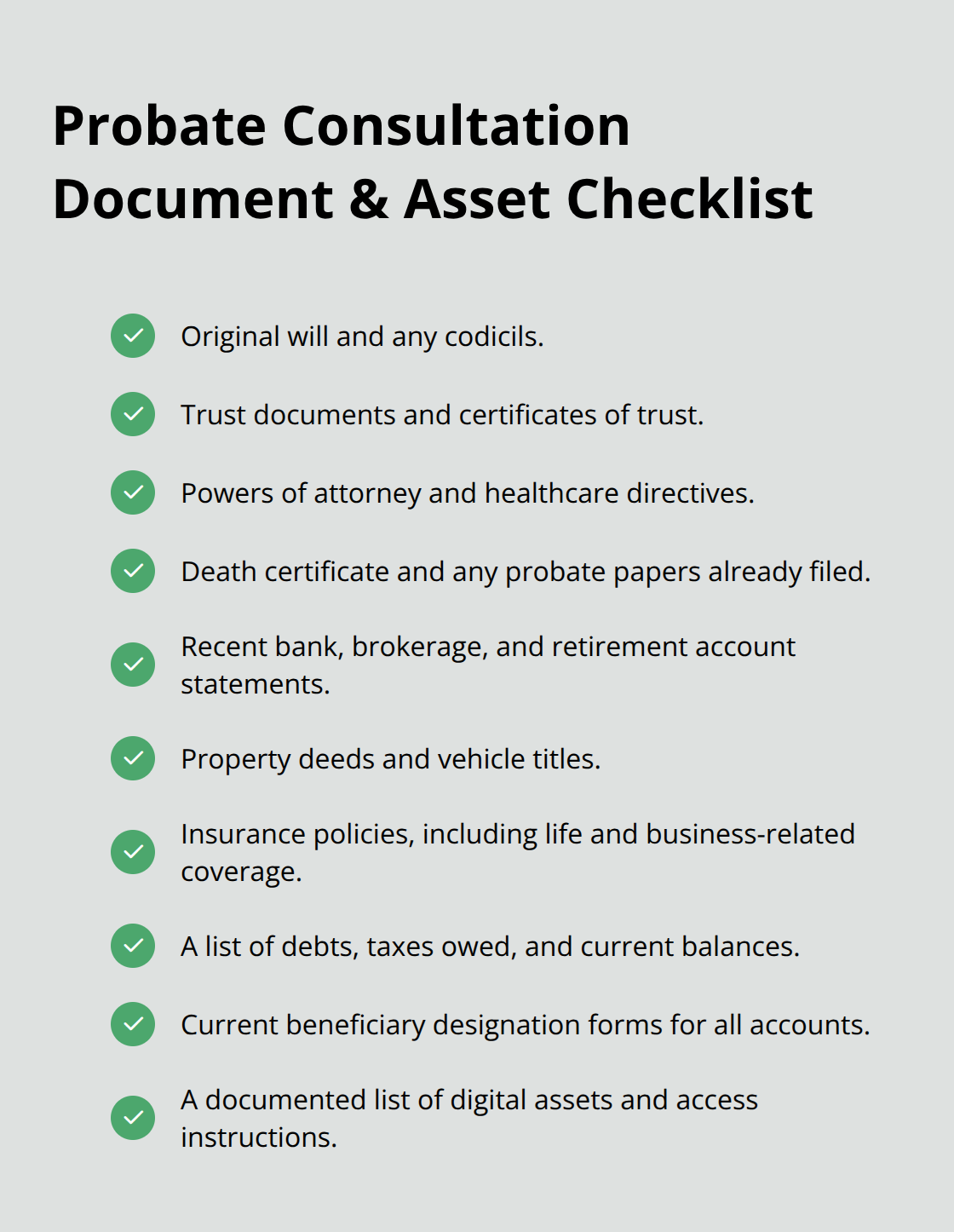
This inventory prevents surprises during probate and helps your attorney identify assets that might avoid probate through beneficiary designations or transfer-on-death provisions. Many people discover during consultation that significant assets were never properly titled or lack named beneficiaries-catching this early saves thousands in unnecessary probate costs and delays.
List Your Beneficiaries and Succession Details
Create a clear list of all beneficiaries named in wills or trusts, along with their contact information and relationship to the deceased. Include any minor children, which triggers special court protections and guardianship considerations. If the estate includes a business or rental properties, note who currently manages these assets and whether succession plans exist. Bring information about any ongoing business obligations, lease agreements, or property-related income streams. This context helps your attorney understand whether your situation requires straightforward probate administration or more complex planning involving business continuation, tax strategy, or trust management.
Identify Potential Complications Early
Your attorney will spot issues faster when you present organized information upfront. Assets titled incorrectly, missing beneficiary designations, or unclear ownership structures often create delays and additional costs. Digital assets-email accounts, cryptocurrency, online banking, and social media-frequently get overlooked in estate planning, yet they hold real value and require specific instructions for access and transfer. Bring a list of any online accounts, usernames, and password storage locations so your attorney can advise on how to address these in your plan. When you arrive prepared with these details, your attorney can immediately identify the most efficient path forward and recommend whether your situation needs straightforward probate administration or more sophisticated planning strategies.
Questions That Reveal Your Attorney’s Real Probate Knowledge
The quality of your attorney’s answers separates someone who handles probate occasionally from someone who understands the specific costs and timelines your estate will face. When you ask about probate duration, demand numbers tied to your situation, not generic statements. Probate in California typically spans 12 to 18 months, but this timeline shifts dramatically based on estate complexity, court backlogs, and whether disputes arise. Your attorney should walk you through your exact scenario: if your estate includes real property, multiple beneficiaries, or outstanding debts, expect the longer end or beyond. Ask specifically how many similar cases they’ve handled in your county court and what their average timeline was.
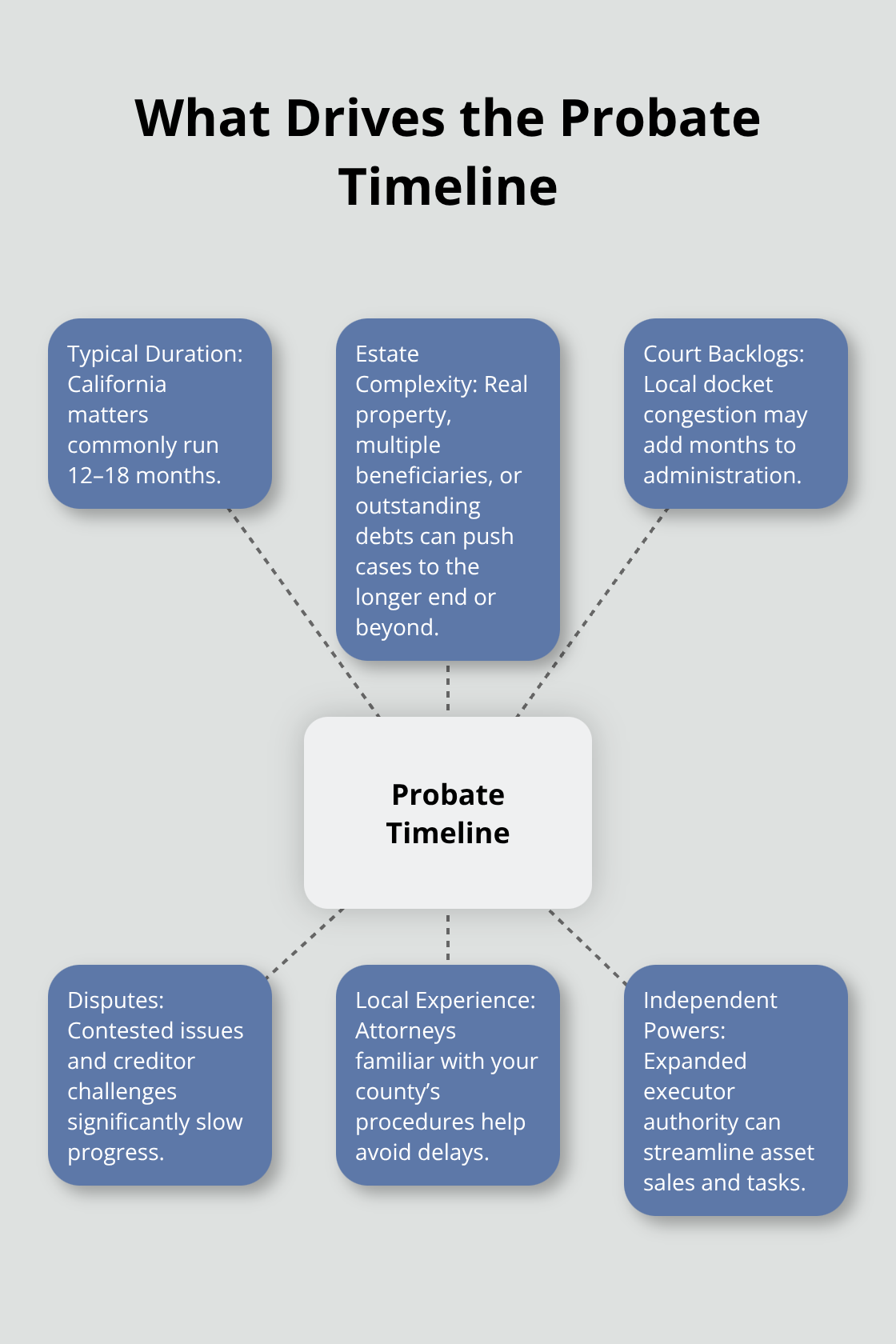
This matters because court procedures vary between counties, and an attorney unfamiliar with your local probate division will cost you months in delays.
Push for Transparent Fee Structures
On costs, push for transparency about fee structure upfront. Some attorneys charge hourly rates that balloon unexpectedly, while others offer flat fees for straightforward estates. Ask whether the fee covers court filings, property appraisals, and accounting services or if these get billed separately. A skilled probate attorney will itemize potential costs and explain which expenses are court-mandated versus discretionary.
Tax Planning Requires Specific Strategy
Tax planning deserves serious attention during your consultation. California probate doesn’t impose a state probate tax, but federal estate taxes apply to estates exceeding $13.61 million in 2024. However, income taxes on inherited assets, capital gains taxes on appreciated property, and fiduciary income taxes during probate administration create real liability. Your attorney should outline which taxes apply to your specific estate and suggest strategies like stepped-up basis treatment on inherited real estate or trust structures that minimize tax exposure. Ask whether they coordinate with a CPA or tax professional, because probate and tax planning require alignment.
Succession Planning Goes Beyond the Will
Succession planning for family and business assets demands more than naming beneficiaries in a will. If your estate includes rental properties, a small business, or significant investment accounts, your attorney should recommend whether a revocable living trust, irrevocable trust, or other structures better protect these assets and streamline transfers. A revocable living trust avoids probate entirely for assets properly titled in the trust, saving months and keeping your estate private (probate records are public). Ask your attorney whether your family situation warrants a trust-based plan instead of will-based probate.
For business succession, the stakes are higher. If you own a business and want it to continue operating smoothly after your death, your attorney must address who manages the business, how ownership transfers, and whether buy-sell agreements exist with business partners. Probate can freeze business operations for months while courts approve asset distributions, potentially destroying client relationships and revenue. A succession plan inside a trust or through structured buy-sell agreements keeps the business running. Ask your attorney about their experience handling business succession specifically, not just general probate administration.
Real Estate Requires Specialized Handling
For real estate, understand that property can sell during probate if the executor obtains independent powers from the court, but this requires additional court approval in many situations. When estates include significant real property, the transaction process becomes complex. We at Law Offices of Roshni T. Desai benefit from Ms. Desai’s dual licensure as an attorney and real estate professional, which streamlines property sales and transactions to reduce costs, delays, and communication friction. During your consultation, confirm whether your attorney can handle property-related issues efficiently or whether you’ll coordinate with a separate real estate agent, adding time and expense to the process.
Your attorney’s answers to these questions will reveal whether they understand your specific situation or offer only surface-level guidance. The next step involves identifying which common mistakes could derail your estate plan before probate even begins.
Estate Planning Mistakes That Cost Thousands During Probate
Beneficiary Designations Override Your Will
Most people discover too late that beneficiary designations on retirement accounts and insurance policies override what their will specifies. If you name your spouse as the beneficiary on a life insurance policy but your will directs that asset to your children, the insurance company pays your spouse directly-the will has no authority over it. This mismatch creates family conflict and wastes assets on litigation to sort out intent.
The same applies to 401(k)s, IRAs, and transfer-on-death accounts. During your probate attorney consultation, bring all beneficiary designation forms and compare them against your will and trust. If they conflict, your attorney can help you correct them before death eliminates the option. California law does not automatically revoke beneficiary designations after divorce, meaning your ex-spouse could still inherit if you haven’t updated the paperwork.
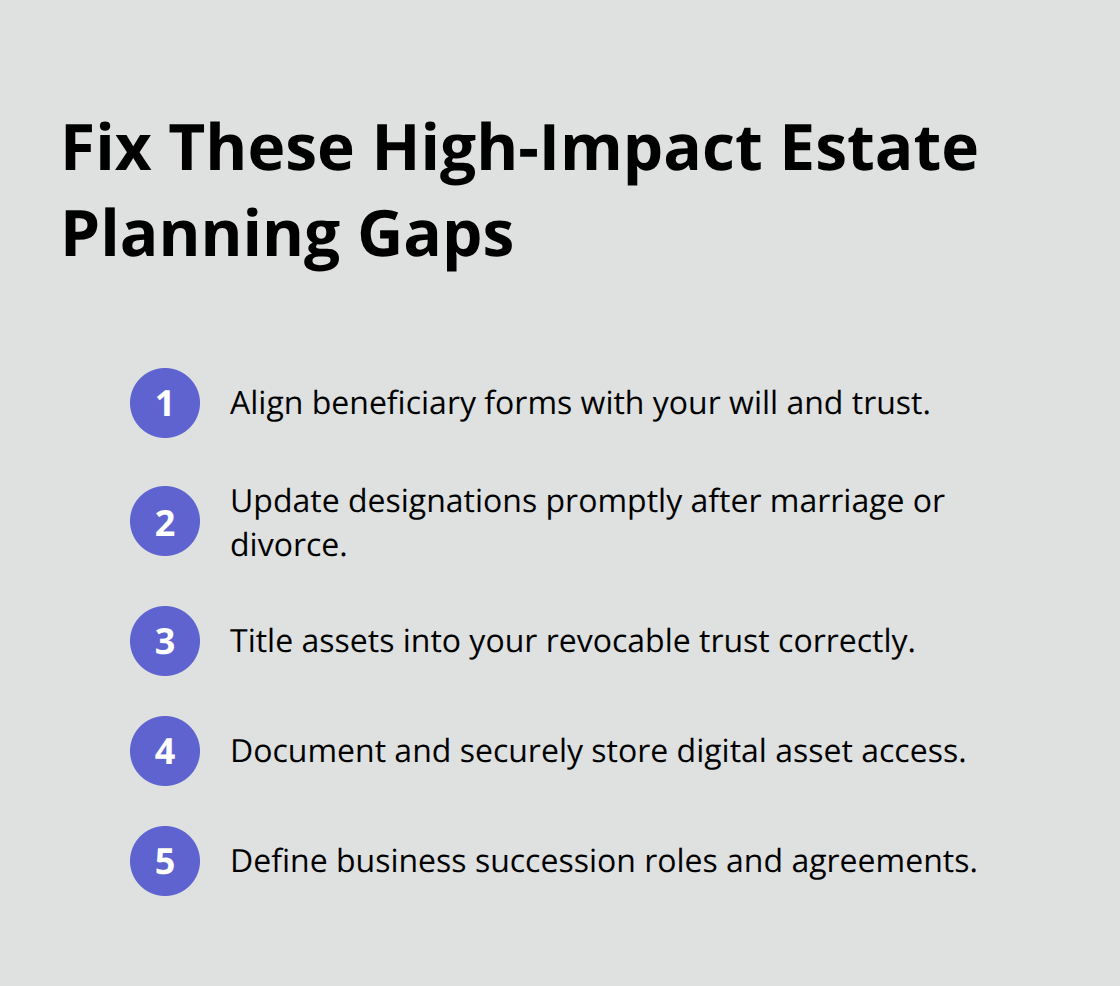
This oversight alone has cost families tens of thousands in probate disputes and forced distributions to unintended recipients.
Trust Structures Protect Assets That Wills Cannot
Trust structures protect property in ways wills cannot, yet people routinely skip this step because they assume probate is unavoidable or costs are too high. A revocable living trust keeps your estate private, avoids probate delays, and continues managing assets if you become incapacitated-all without court involvement. Assets not titled in the trust go through probate anyway, which defeats the purpose, so your attorney must help you transfer property titles correctly.
The difference matters significantly. Probate records become public documents, exposing your family’s financial details to anyone who requests them. A trust-based plan eliminates this exposure and accelerates distributions to beneficiaries by months. Your attorney should walk you through whether a revocable living trust makes sense for your situation and what property transfers require immediate attention.
Digital Assets Disappear Without Documentation
Digital assets create a blind spot that derails even carefully planned estates. Online banking accounts, cryptocurrency wallets, social media profiles, email accounts, and digital photos hold real value and require specific access instructions or they become inaccessible to your family. Without a documented list of digital asset locations and login procedures stored securely, your executor cannot locate or transfer these assets, and some accounts disappear entirely.
During your consultation, discuss how to inventory digital assets and where to store access information safely. Your attorney should recommend a secure method for maintaining this list-whether through a password manager, a sealed envelope with your attorney, or another approach that protects privacy while allowing your executor to act after your death. This step prevents your family from losing access to accounts that hold money, sentimental value, or both.
Final Thoughts
Your preparation before the consultation transforms how much value you extract from the meeting. You’ve gathered your documents, identified your financial picture, and compiled a list of beneficiaries and potential complications-this means your attorney can answer strategic questions instead of hunting for basic information. These probate attorney consultation tips separate sessions that produce real guidance from those that waste your time and delay your planning.
After your consultation, your attorney should provide a clear action plan that outlines which documents need updating, which assets require retitling into a trust, and which beneficiary designations conflict with your overall plan. Life changes-marriages, divorces, births, business sales-shift your planning needs, so you should treat estate planning as an ongoing process rather than a one-time event. Schedule a follow-up meeting to review completed changes and address any new circumstances that affect your plan.
We at Law Offices of Roshni T. Desai offer free consultations with flexible home or office visits across Southern California, and Ms. Desai’s dual licensure as an attorney and real estate professional means property-related issues get handled efficiently without coordinating separate professionals. Whether you need a straightforward will, a trust-based plan, or complex probate administration, our team can guide you through the process. Your consultation is an opportunity to ask questions, understand your options, and take control of your family’s financial future.