




California Durable Power of Attorney: Planning Ahead for Incapacity Decisions
California durable power of attorney planning is one of the clearest ways to keep bills paid, accounts managed, and property decisions moving if illness or injury leaves you unable to act for yourself. Without a durable document in place, families across Orange County and the rest of Southern California often face delay while a court decides who can step in.
At Law Offices of Roshni T. Desai, we help Southern California homeowners, adult children of aging parents, and small-business owners put practical incapacity tools in place so you can move forward with confidence. This guide explains what a durable power of attorney actually is under California Probate Code, how a valid document is created, and the mistakes that commonly leave people without a workable plan.
What a California Durable Power of Attorney Actually Does
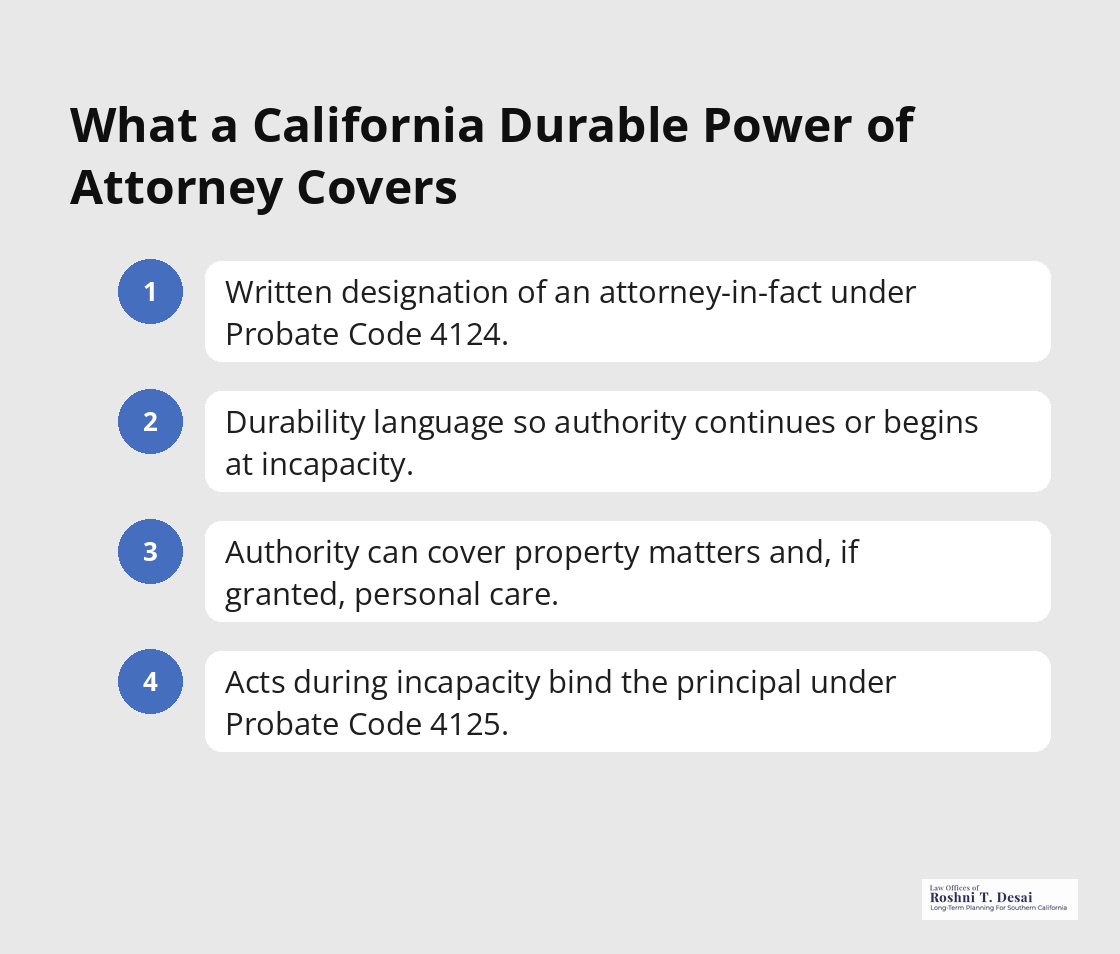
Under California Probate Code section 4124, a durable power of attorney is a written power of attorney in which a principal designates another person as attorney-in-fact and the document contains language showing that the authority continues despite the principal’s later incapacity, becomes effective upon incapacity, or uses similar words expressing that intent. The durability language is what separates this tool from an ordinary power of attorney that can stop working when the principal needs it most.
Probate Code section 4120 says a natural person who has the capacity to contract may execute a power of attorney. Probate Code section 4125 adds that acts done by an attorney-in-fact under a durable power of attorney during any period of the principal’s incapacity have the same effect, and bind the principal and the principal’s successors in interest, as if the principal had capacity. For Orange County and Southern California families, that continuity is often the difference between a smooth handoff of bill paying and property management and a scramble to petition a court for a conservatorship.
Immediate Authority Versus Springing Authority
Section 4124 recognizes two common timing choices. One statement provides that the power of attorney shall not be affected by subsequent incapacity of the principal, which allows an agent to act while the principal still has capacity and to continue after incapacity. Another provides that the power of attorney shall become effective upon the incapacity of the principal, often called a springing power. Similar words that show the principal’s intent that authority remain exercisable despite later incapacity also satisfy the statute. The choice affects when banks and other third parties can rely on the agent, so the wording should match how you actually want help to begin.
Property Decisions and Personal Care Authority
Probate Code section 4123 allows a principal to grant authority over all lawful subjects and purposes or over one or more express subjects, including property matters and personal care. Property authority can cover real and personal property the principal owns then or later acquires, without describing every item. Personal-care authority can cover decisions relating to the principal’s personal care. Many people keep financial durable powers of attorney separate from advance health care directives, because different statutes and different practical audiences apply. Clarity about what the agent may and may not do reduces later conflict among family members.
Why Durability Matters When Capacity Changes
Illness, cognitive decline, and sudden injury do not wait for paperwork. Without durability language that meets section 4124, an agent’s authority can fail exactly when the principal can no longer sign a replacement. Section 4125 then becomes the practical payoff of getting the document right: third parties dealing with the agent during incapacity can treat properly authorized acts as the principal’s own. Southern California families who wait until a crisis often discover that a missing durability clause leaves them with fewer private options.
How a Valid California Durable Power of Attorney Is Actually Created
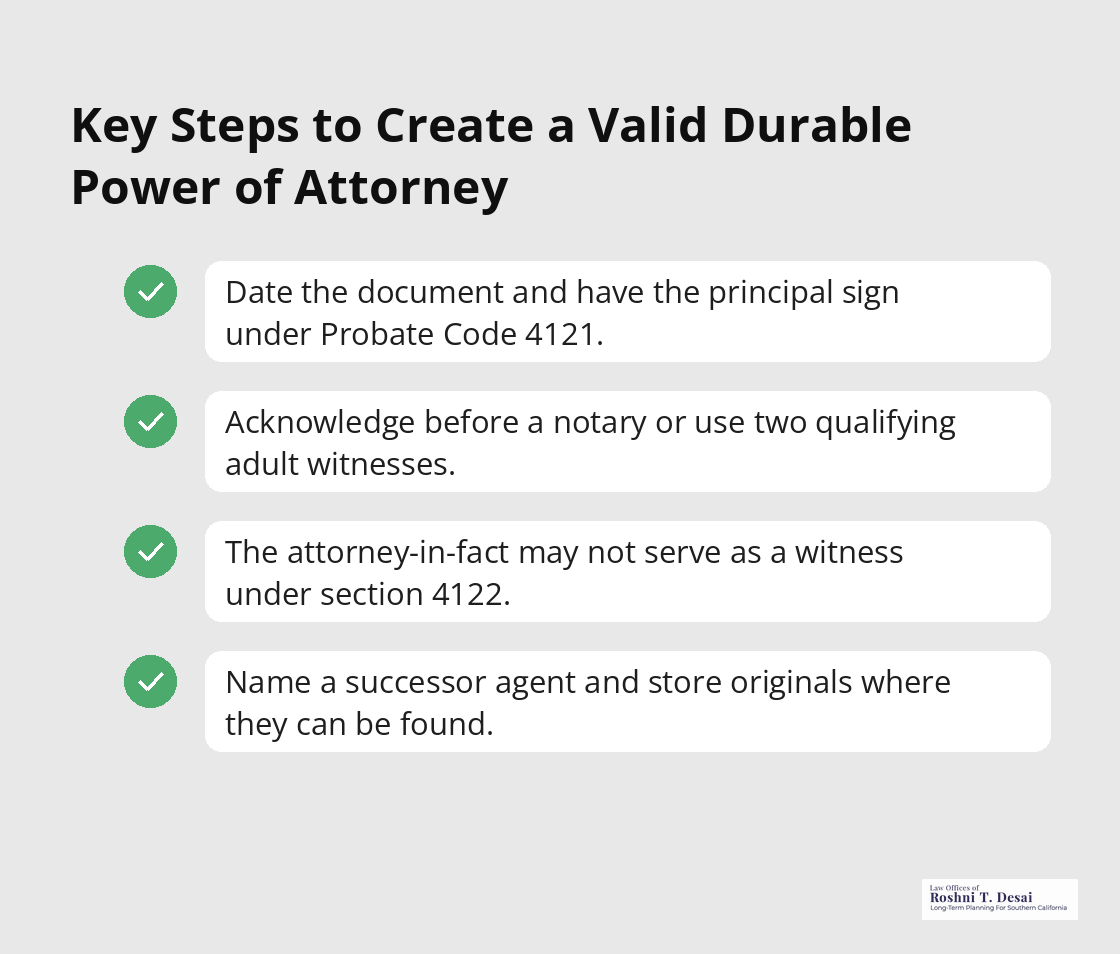
California sets formal requirements that decide whether a power of attorney is legally sufficient. Probate Code section 4121 requires a date of execution, the principal’s signature or a signature made in the principal’s name by another adult in the principal’s presence and at the principal’s direction, and either acknowledgment before a notary public or signature by at least two witnesses who meet section 4122. Those formalities protect both the principal and the people who later rely on the document.
Dating, Signing, and Notary or Witness Formalities
Section 4121(a) and (b) make the execution date and a proper signature non-negotiable. Section 4121(c) then offers two paths for validation: notarization or two qualifying witnesses. Under section 4122, witnesses must be adults, the attorney-in-fact may not act as a witness, and each witness must witness either the principal’s signing or the principal’s acknowledgment of the signature or the power of attorney. Skipping these steps can leave a carefully written plan open to challenge when a bank, title company, or family member questions whether the document was properly made.
Choosing an Attorney-in-Fact You Can Trust
The attorney-in-fact holds significant practical power over finances and, if granted, personal-care decisions. California law expects that person to be someone the principal is willing to entrust with sensitive authority. Many Orange County clients name a spouse, adult child, or close friend as primary agent and then name a successor if the first choice cannot serve. The document should also address how incapacity of the agent is handled, because Probate Code section 4152 terminates or suspends authority when listed events occur, including the agent’s incapacity, resignation, or removal.
Keeping the Document Usable With Banks and Title Companies
A durable power of attorney only helps if institutions will accept it. Clear durability language, a clean notarization when that path is chosen, and agent identification that matches identification documents reduce friction. Some institutions ask for recent certifications or their own affidavit forms even when the statute is satisfied. Planning for those practical requests, and storing originals where a trusted person can find them, is part of creating a usable California durable power of attorney rather than a document that sits unread in a drawer.
What Commonly Derails California Durable Power of Attorney Plans
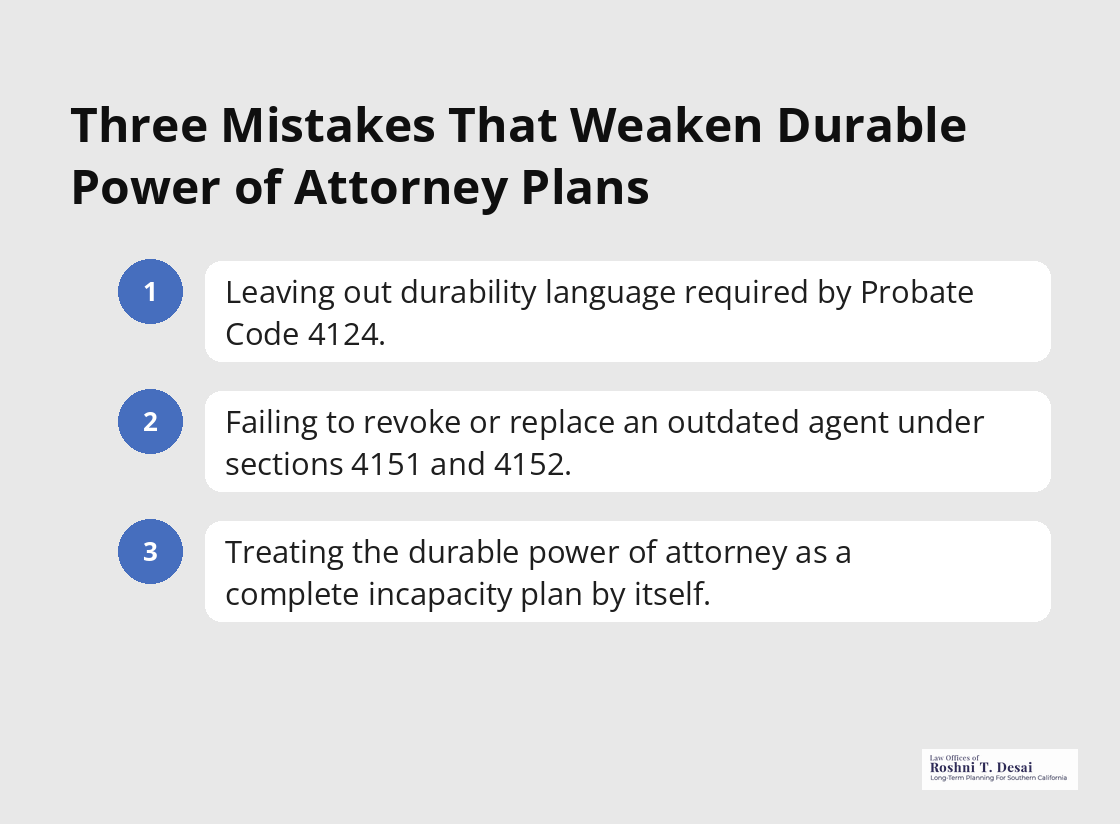
Most failures are predictable. People use a form without durability language, name an agent who later cannot serve and leave no successor, forget to revoke an outdated document, or assume a financial power of attorney covers medical decisions. Probate Code sections 4151 and 4152 give principals tools to revoke and describe when authority ends, but those tools only help if someone reviews the plan before a crisis.
Missing Durability Language or Incomplete Formalities
Section 4124’s durability statements are short, but they are essential. A power of attorney that never says authority continues after incapacity, becomes effective upon incapacity, or uses similar intent language may not give the family the continuity they expected. Equally serious are unsigned, undated, or improperly witnessed documents that fail section 4121. Southern California families sometimes discover these gaps only after a hospital admission or a declined bank transaction.
Outdated Agents and Forgotten Revocations
Relationships change. Probate Code section 4151 allows a principal to revoke a power of attorney according to its terms or by a writing, and that writing-based revocation path is not subject to limitation in the power of attorney. Section 4152 lists events that terminate authority, including revocation of the attorney-in-fact’s authority, death of the principal except for limited post-death authority permitted by statute, resignation or removal of the agent, and dissolution or annulment of the marriage between the principal and the attorney-in-fact as further described in the statute. Leaving an ex-spouse or unavailable relative named as agent without a clean revocation and replacement creates confusion for every institution that later sees the old document.
Treating One Document as a Complete Incapacity Plan
A durable power of attorney is powerful, but it is not a will, a trust, or a complete health-care package by itself. Property titled in a trust, beneficiary designations, and advance health care directives often need coordinated review. People who treat the durable power of attorney as the only incapacity document may still face gaps when medical providers, trustees, or title companies ask for different authority. Coordinating those tools while the principal has capacity is far easier than rebuilding authority after a crisis in Orange County or elsewhere in Southern California.
Final Thoughts
A California durable power of attorney, drafted with the durability language in Probate Code section 4124 and the formalities in sections 4121 and 4122, gives a trusted attorney-in-fact continuing authority when incapacity arrives. Section 4125 confirms that properly authorized acts during incapacity bind the principal, while sections 4151 and 4152 explain how revocation and termination events keep the plan current. Getting those pieces right before a crisis protects both the principal and the family members who must act.
If you live in Orange County, Los Angeles County, Riverside County, San Diego County, or elsewhere in Southern California and want help putting a durable power of attorney in place, contact Law Offices of Roshni T. Desai to speak with our team. We will review your situation, explain how California’s power-of-attorney rules fit with your broader estate plan, and help you take a practical next step.