




Spousal Property Petition California: Passing Assets Without Full Probate
A spousal property petition in California can spare a grieving spouse months of unnecessary court administration. When a husband or wife dies and leaves property to the survivor, California law often allows that property to pass without a full probate, but banks, title companies, and transfer agents frequently want a court order before they will move anything into the surviving spouse’s name.
At Law Offices of Roshni T. Desai, we help surviving spouses and their families throughout Orange County and Southern California settle a loved one’s affairs with clarity and care, so you can move forward with confidence. This guide explains what California’s spousal property rules actually provide, how the petition process works, and the mistakes that most often slow a surviving spouse down.
What California’s Spousal Property Rules Actually Provide
The starting point is Probate Code section 13500. It provides that, except as stated in that chapter, when a spouse dies intestate leaving property that passes to the surviving spouse under section 6401, or dies with a will that gives all or part of the property to the surviving spouse, the property passes to the survivor and no administration is necessary. That property remains subject to the rules on the survivor’s power to deal with it and the survivor’s responsibility for certain debts. In other words, the law recognizes that a transfer from one spouse to the other does not always need a full probate estate to be opened and supervised.
How Community Property Is Divided at Death
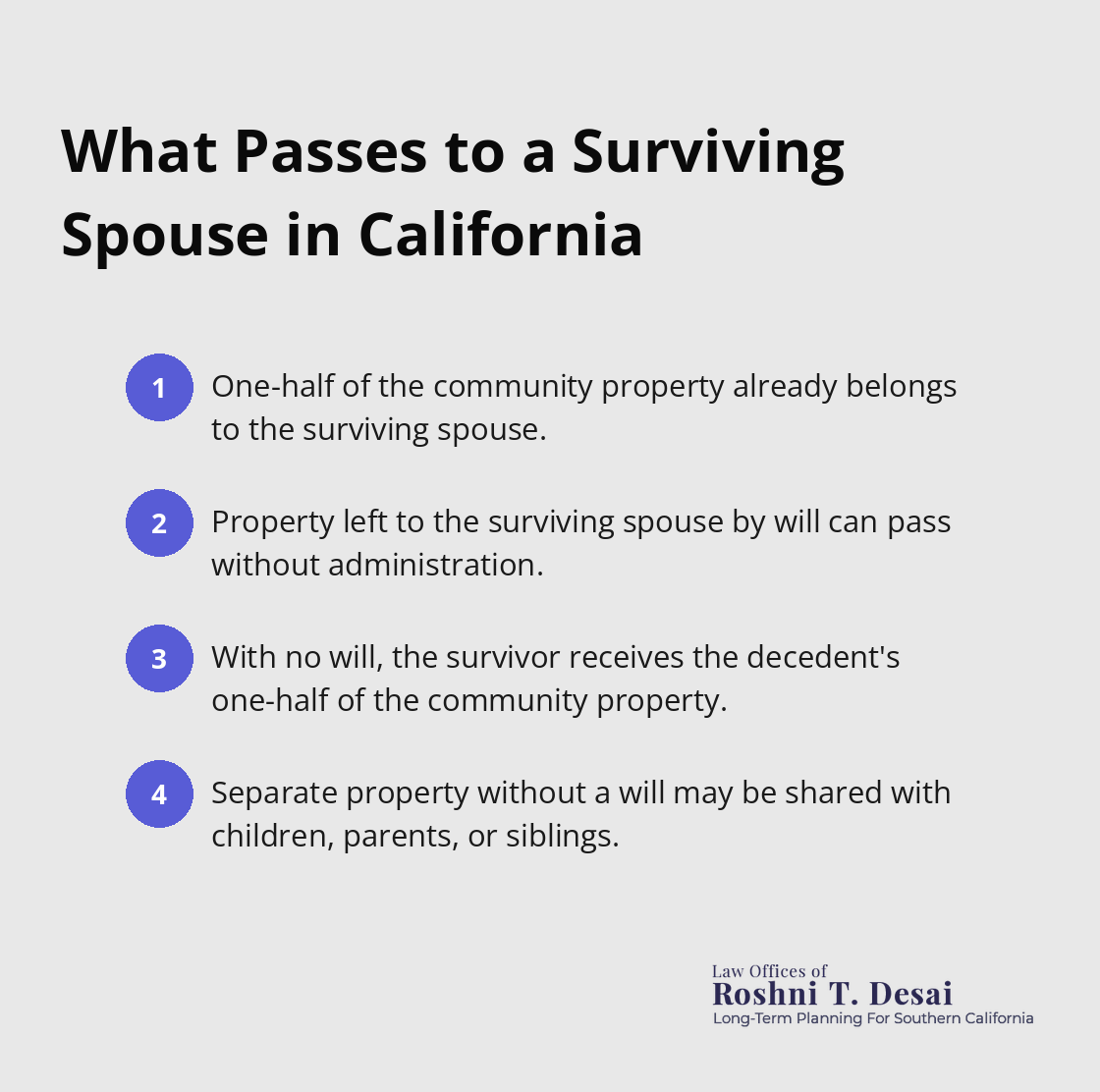
Understanding who owns what is essential before any petition is filed. Probate Code section 100 states that upon the death of a married person, one-half of the community property belongs to the surviving spouse and the other one-half belongs to the decedent. The survivor’s half is already the survivor’s own property. The question for the petition is what happens to the decedent’s half and to any separate property. Section 100 also allows spouses to agree in writing to divide community property on a non pro rata basis, and any such agreement must be disclosed in a spousal property petition.
When There Is No Will
If the deceased spouse left no will, intestate succession rules decide where the property goes. Under Probate Code section 6401, the surviving spouse’s intestate share of community property is the one-half of the community property that belongs to the decedent under section 100, and the same rule applies to quasi-community property. For separate property, the survivor’s share depends on which other relatives survive. The survivor takes the entire intestate separate property only if the decedent left no surviving issue, parent, brother, sister, or issue of a deceased brother or sister, and otherwise takes one-half or one-third depending on the family. This is why separate property often requires more careful analysis than community property.
Property That Still Requires Administration
Not everything qualifies for the shortcut. Probate Code section 13501 lists property that remains subject to administration, including property passing to someone other than the surviving spouse under the will or by intestate succession, property placed in trust under the decedent’s will, and property in which the will limits the surviving spouse to a qualified ownership. Section 13502 also allows the surviving spouse to elect to have some or all of the property administered, by a written election filed in the estate proceeding within four months after letters issue, or within further time the court allows for good cause, and before an order under section 13656 is entered. Separately, section 13504 provides that community property held in a revocable trust described in Family Code section 761 follows the trust’s own terms on death.
How the Spousal Property Petition Process Works
When the survivor needs written proof that property passed without administration, Chapter 5 of this part of the Probate Code, beginning at section 13650, provides the procedure. The petition asks the court to confirm what already happened under the law, giving financial institutions and title companies an order they can rely on.
Who Files and Where
Under Probate Code section 13650, a surviving spouse, or the personal representative, guardian of the estate, or conservator of the estate of the surviving spouse, may file a petition in the superior court of the county in which the deceased spouse’s estate may be administered. The petition requests an order that administration of all or part of the estate is not necessary because the property is passing to the surviving spouse. It may also request an order confirming the surviving spouse’s ownership of the survivor’s own half of community and quasi-community property. Under Probate Code section 7051, when the decedent was domiciled in California, the proper county is the county of domicile regardless of where the death occurred, so a spouse who was domiciled in Orange County would ordinarily file in the Orange County Superior Court. When no estate proceeding is pending, section 13651 requires the petition to set out the facts that determine the proper county.
What the Petition Must Include
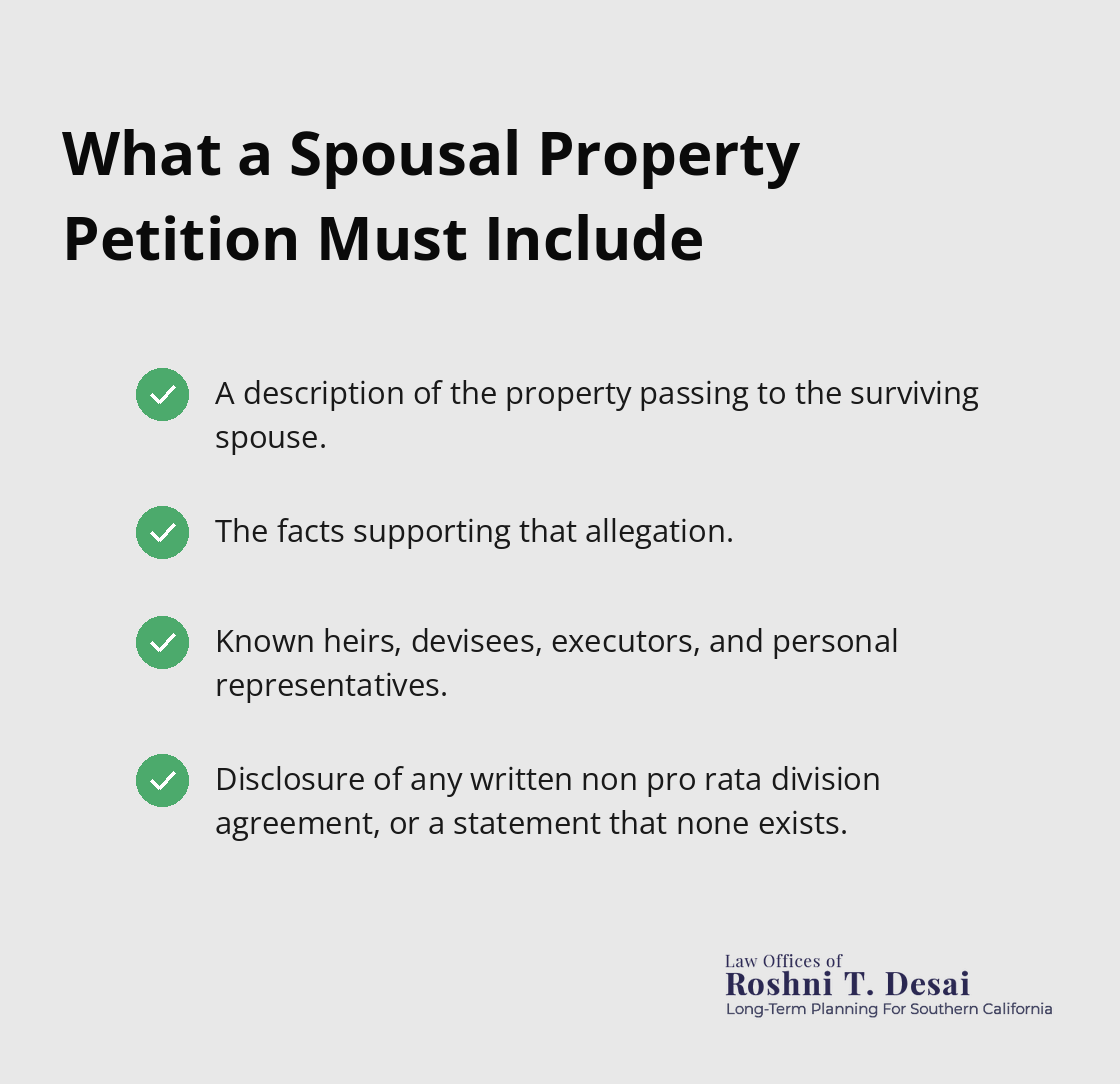
Section 13651 sets out the required contents. The petition must describe the property the petitioner says is passing to the surviving spouse, state the facts supporting that allegation, and describe any community or quasi-community property interest the petitioner asks the court to confirm. It must list the name, age, address, and relationship of each known heir and devisee, along with known executors and personal representatives. It must disclose any written agreement between the spouses for a non pro rata division of community property, or affirmatively state that none exists. If the claim rests on the will, a copy of the will must be attached, and if it rests on a written division agreement, that agreement must be attached as well.
Notice, Hearing, and the Court’s Order
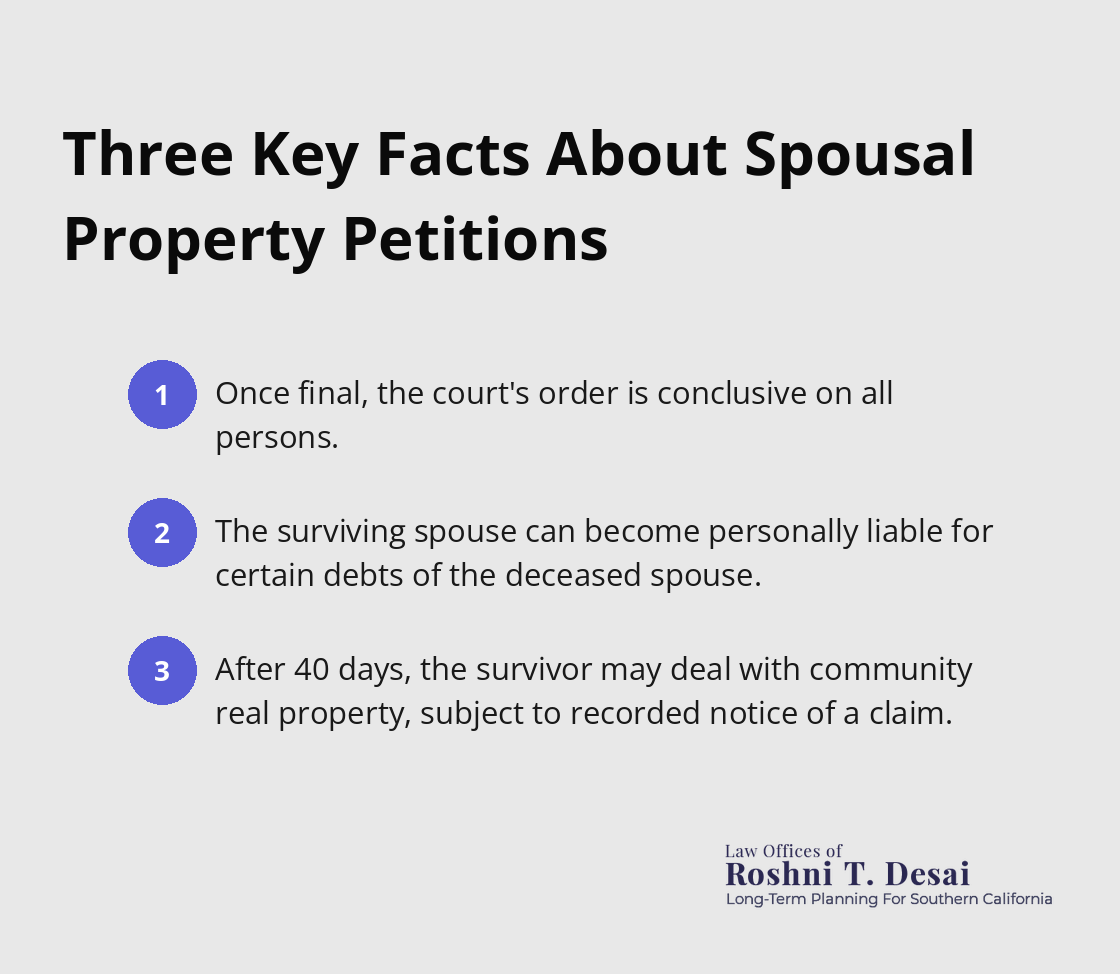
Section 13655 requires notice of the hearing to be given under section 1220 to the persons that section lists, to each person named as executor in any will, and to all devisees and known heirs, with additional notice to the Attorney General in certain charitable situations. At the hearing, section 13656 directs the court to issue an order describing the property, determining that it passes to the surviving spouse, and determining that no administration is necessary, along with any further orders needed to deliver the property. When part of the estate does not pass to the survivor, the order identifies that property as subject to administration. Under section 13657, once the order becomes final it is conclusive on all persons, which is what gives banks and title insurers the confidence to act.
Mistakes That Slow Down a Surviving Spouse
Spousal property petitions are designed to be simpler than probate, but simple does not mean automatic. These are some of the most common problems families encounter.
Assuming Everything Is Community Property
Couples often think of everything they own as shared, yet assets acquired before marriage, inherited property, and gifts may be separate property with different rules. Because section 6401 can give part of the decedent’s separate property to children, parents, or siblings when there is no will, labeling an asset incorrectly can lead to a petition the court will not grant as filed. Review deeds, account records, and any marital agreements before deciding how each asset should be described.
Overlooking the Surviving Spouse’s Responsibility for Debts
Receiving property without administration carries a responsibility that many survivors do not expect. Probate Code section 13550 provides that, except as stated in related sections, the surviving spouse is personally liable for the debts of the deceased spouse chargeable against certain property, to the extent provided in section 13551, which places a statutory limit on that liability. Under section 13553, the surviving spouse is not liable under that chapter if all of the property described in section 13502 is administered. Weighing this exposure is an important part of deciding whether a spousal property petition or a formal administration is the better path.
Selling Real Estate Too Soon or Without the Right Paperwork
Survivors sometimes need to sell or refinance a home quickly. Probate Code section 13540 provides that, after 40 days from the death of a spouse and subject to section 13541, the surviving spouse has full power to sell, convey, lease, mortgage, or otherwise deal with community or quasi-community real property, and may record an affidavit of the facts establishing that right. That power does not apply to a disposition made after a qualifying notice of a claimed interest under the will has been recorded under section 13541. Title companies may still prefer a court order, so planning the petition around a sale timeline avoids last-minute surprises.
Final Thoughts
A spousal property petition in California gives a surviving spouse a practical way to confirm ownership and collect property without opening a full probate estate when the law allows it. Sections 13500 through 13506 explain what passes without administration, sections 13650 through 13660 supply the petition procedure, and the debt rules in sections 13550 through 13554 explain what responsibility comes with the property.
Every family’s situation is different, and the right choice between a petition and formal administration depends on how assets are titled, whether there is a will or trust, and what debts remain. Taking time to sort those questions out early can make the process far smoother.
If you have recently lost a spouse in Orange County or elsewhere in Southern California and want help transferring property, contact Law Offices of Roshni T. Desai to speak with our team. We will review the estate, explain whether a spousal property petition fits your situation, and help you take a practical next step.