




Co-Trustees California: How Shared Trustees Make Decisions and Share Responsibility
Co-trustees in California share one of the most important jobs in an estate plan, and many families do not realize how differently that job works when two or more people hold it at the same time. Parents often name two adult children, a surviving spouse and a child, or a family member and a trusted advisor to serve together, hoping the arrangement will feel fair and add a layer of oversight. In practice, serving as a co-trustee comes with its own rules about how decisions are made, what happens when one trustee is unavailable, and when one trustee can be held responsible for the actions of another. Understanding those rules gives you real control over a trust administration that might otherwise stall or spiral into conflict.
At the Law Offices of Roshni T. Desai, we help co-trustees and beneficiaries throughout Southern California understand their roles and carry out trust administration in the right order, so you can move forward with confidence. This guide explains how co-trusteeship actually works under the California Probate Code, the duties each co-trustee owes to the beneficiaries, and the common situations that derail shared trust administration.
How Co-Trusteeship Actually Works in California
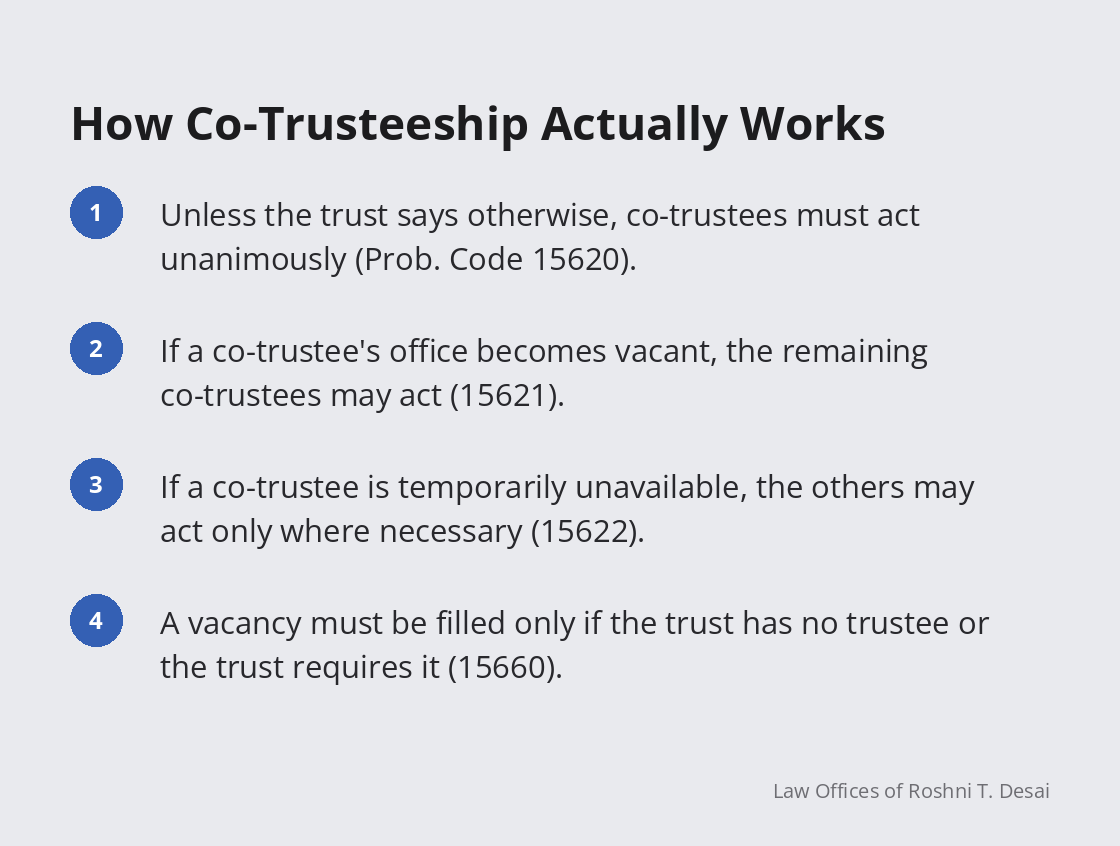
A trust can name a single trustee, or it can name two or more people to serve together. When more than one trustee holds office at the same time, California law treats them as cotrustees who share the powers given to the trustee by the trust instrument and by statute. That sounds simple, but the starting rule surprises many families. Section 15620 of the California Probate Code provides that, unless otherwise provided in the trust instrument, a power vested in two or more trustees may only be exercised by their unanimous action. In other words, the default is not majority rule and not “whoever gets there first.” Every co-trustee must agree before a trust power is used.
The Unanimity Rule and Why It Matters
The unanimity rule is designed to protect beneficiaries. When a settlor names two people to act together, the law assumes the settlor wanted both of them to weigh in on decisions that affect the trust property. That protection has a practical side, however. Selling a home, opening or closing a trust account, making a distribution, or hiring a property manager can all require the agreement of every co-trustee unless the trust says otherwise. If one co-trustee is slow to respond, travels frequently, or simply disagrees, the trust can grind to a halt. Banks, title companies, and brokerage firms frequently ask for the signatures or written consent of all co-trustees before they will act, because they know the default rule.
When the Trust Instrument Changes the Default
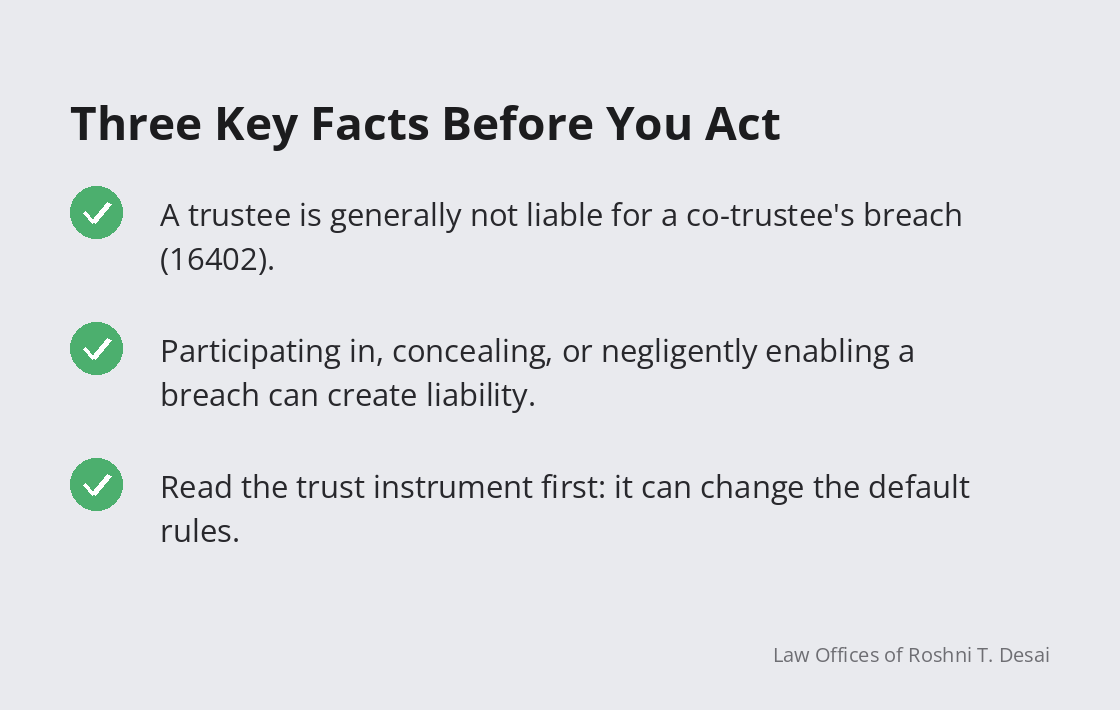
The phrase “unless otherwise provided in the trust instrument” is one of the most important parts of Section 15620. Many well-drafted trusts change the default. A trust might allow either co-trustee to act alone on routine matters, allow a majority to act when there are three or more trustees, assign certain tasks such as investments or bookkeeping to one co-trustee, or name a tiebreaker. Because the trust document controls, the very first step for any co-trustee is to read the trust carefully, including every amendment and restatement, before taking action. What the trust says about decision making will shape almost everything that follows.
Vacancies and Temporary Unavailability
California law also addresses what happens when one co-trustee can no longer serve or is temporarily unable to act. Under Section 15621, unless the trust instrument provides otherwise, if a vacancy occurs in the office of a cotrustee, the remaining cotrustee or cotrustees may act for the trust as if they are the only trustees. Section 15622 covers a different situation: when a cotrustee is unavailable because of absence, illness, or other temporary incapacity, the remaining cotrustee or cotrustees may act as if they are the only trustees, but only where necessary to accomplish the purposes of the trust or to avoid irreparable injury to the trust property. That second rule is narrower. It permits action when it is truly needed, not as a routine way to bypass a co-trustee who is hard to reach.
Filling a Co-Trustee Vacancy
A vacancy in a cotrusteeship does not always need to be filled. Section 15660 provides that the statutory procedure applies if the trust has no trustee or if the trust instrument requires a vacancy in the office of a cotrustee to be filled. When filling is required, the trust’s own method or named successor controls first. If that does not work, the statute allows certain beneficiaries to agree on a trust company that has agreed to accept the trust, and if the vacancy still is not filled, any interested person may petition the court to appoint a trustee. When the trust provides for more than one trustee, the court may appoint the original number or any lesser number, and it must give consideration to any nomination by beneficiaries who are 14 years of age or older.
The Duties Each Co-Trustee Owes
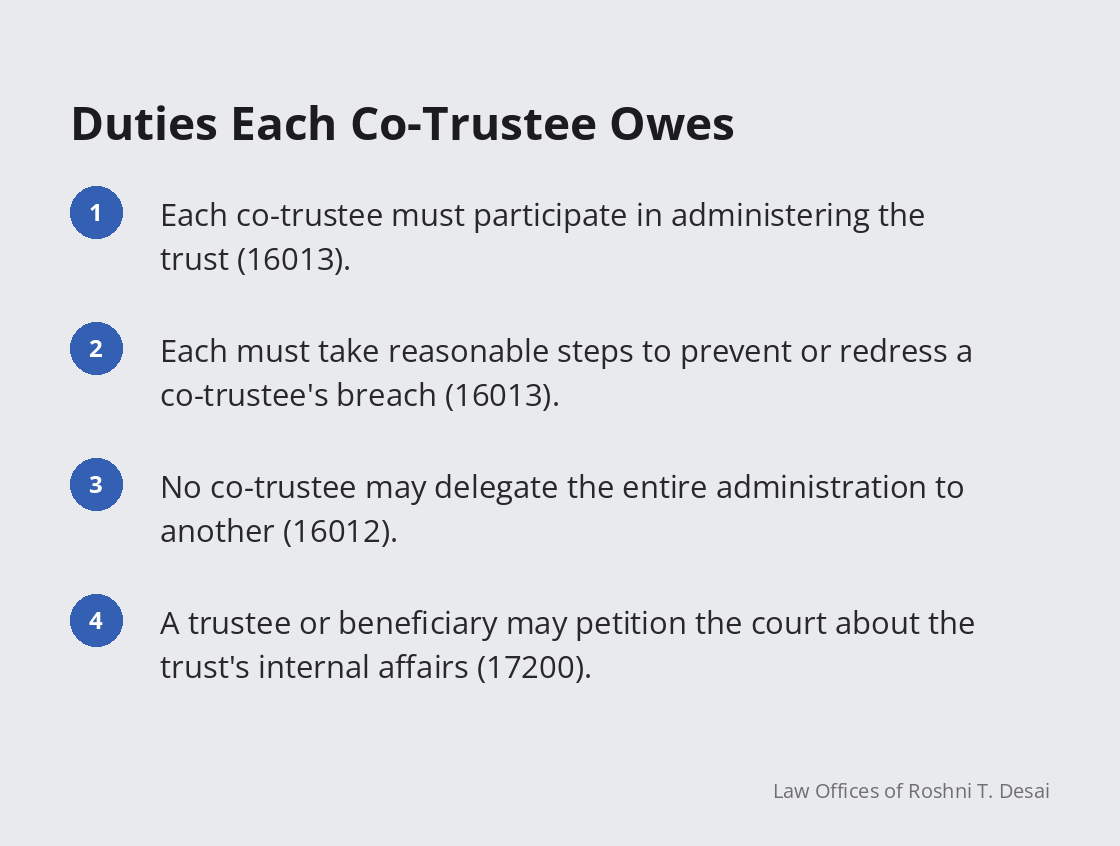
Serving alongside someone else does not cut a co-trustee’s responsibilities in half. California law places duties on each trustee individually, and some of those duties exist specifically because there is more than one trustee. Section 16013 of the Probate Code provides that, if a trust has more than one trustee, each trustee has a duty to participate in the administration of the trust and to take reasonable steps to prevent a cotrustee from committing a breach of trust or to compel a cotrustee to redress a breach of trust. A co-trustee who stays on the sidelines is not neutral in the eyes of the law.
The Duty to Participate
The duty to participate means each co-trustee should stay informed and involved. That includes reviewing account statements, understanding what assets the trust holds, joining in major decisions, and reading the communications that go to beneficiaries. A co-trustee who signs whatever is placed in front of them without asking questions, or who never looks at the trust records, risks falling short of this duty. Participation does not require every co-trustee to do every task personally, but it does require genuine engagement with how the trust is being run.
Limits on Delegating to a Co-Trustee
It is common for one co-trustee to take the lead on day-to-day tasks, particularly when that person lives closer to the property or has more time available. The law allows some sharing of work, but it draws a line. Section 16012 provides that a trustee has a duty not to delegate to others the performance of acts that the trustee can reasonably be required personally to perform, and may not transfer the office of trustee to another person nor delegate the entire administration of the trust to a cotrustee or other person. When a trustee has properly delegated a matter to an agent, cotrustee, or other person, the trustee still has a duty to exercise general supervision over the person performing the delegated matter. Handing everything to a sibling and walking away is exactly the kind of arrangement the statute is meant to prevent.
Preventing and Redressing a Co-Trustee’s Breach
If a co-trustee begins mixing trust funds with personal accounts, favoring one beneficiary over others in ways the trust does not allow, or refusing to share information, the other co-trustee cannot simply look away. The duty under Section 16013 to take reasonable steps to prevent or compel redress of a breach means raising concerns, documenting them, and, when necessary, seeking help from the court. Section 17200 allows a trustee or beneficiary to petition the court concerning the internal affairs of a trust, including proceedings for instructing the trustee, compelling redress of a breach of the trust by any available remedy, and appointing or removing a trustee.
When One Co-Trustee Can Be Responsible for Another
California generally does not make one trustee answer for another’s misconduct. Section 16402 provides that, except in listed circumstances, a trustee is not liable to the beneficiary for a breach of trust committed by a cotrustee. Those listed circumstances matter, though. A trustee can be liable for a cotrustee’s breach where the trustee participates in the breach, improperly delegates the administration of the trust to the cotrustee, approves, knowingly acquiesces in, or conceals the breach, negligently enables the cotrustee to commit it, or neglects to take reasonable steps to compel the cotrustee to redress a breach the trustee knew or reasonably should have known about. In short, staying engaged is not only good practice; it is also the best protection a co-trustee has.
What Derails Co-Trustee Administration
Most co-trustee arrangements begin with good intentions. Problems usually develop gradually, when communication breaks down, roles are never clarified, or the trustees discover that they see the settlor’s wishes differently. Recognizing the common pressure points early can keep an administration on track and protect the relationships that matter most to your family.
Deadlock Between Co-Trustees
Because the default rule requires unanimous action, a genuine disagreement between two co-trustees can freeze the trust. One may want to sell a rental property while the other wants to keep it, or one may want to make a distribution that the other believes the trust does not permit. When the trust instrument does not supply a tiebreaker or majority rule, the co-trustees may need to work through mediation or ask the court for direction. A petition concerning the internal affairs of the trust, including a request for instructions under Section 17200, gives the court a way to resolve the question so administration can continue.
One Co-Trustee Doing Everything
The opposite problem is just as common. One co-trustee takes over every task, while the other assumes everything is fine. Over time, records may become incomplete, decisions may be made without consultation, and beneficiaries may start asking questions that the passive co-trustee cannot answer. Because of the duty to participate and the limits on delegation, the less active co-trustee may face exposure if something goes wrong. Regular check-ins, shared access to account information, and written agreement on major decisions help both co-trustees meet their obligations.
Poor Communication With Beneficiaries
Beneficiaries often grow anxious when they hear different answers from different co-trustees, or when no one seems to be in charge. Inconsistent messages can create the impression that something is being hidden, even when it is not. Co-trustees generally do better when they agree on who will communicate with beneficiaries, keep each other copied on correspondence, and coordinate on the information that goes out. A unified approach reduces confusion and builds trust with the people the trust is meant to benefit.
Ignoring the Trust Document
Finally, many disputes arise because co-trustees act on assumptions instead of reading the trust closely. The trust may allow one co-trustee to act alone on certain matters, require both to sign for others, name a successor if one co-trustee steps down, or set specific distribution standards. Acting without checking the document can lead to decisions that are later challenged. Returning to the trust instrument whenever a question arises is one of the simplest ways to avoid mistakes.
Final Thoughts
Serving as a co-trustee in California means sharing authority, but not sharing away responsibility. The Probate Code generally requires co-trustees to act unanimously unless the trust says otherwise, expects each of them to participate in the administration, and limits how much one can hand off to the other. It also explains what happens when a co-trustee is unavailable or the office becomes vacant, and when one trustee can be held responsible for another’s breach.
With clear roles, steady communication, and a careful reading of the trust, most co-trustees can work together successfully and honor the wishes of the person who placed this trust in their hands. When disagreements or concerns arise, addressing them early is far better than letting them grow.
If you have been named a co-trustee or are a beneficiary of a trust with more than one trustee, contact the Law Offices of Roshni T. Desai to speak with our team in Southern California. We will help you understand your role, work through disagreements, and take the next step with confidence.