




Trust Decanting California: How a Trustee Can Update an Irrevocable Trust
Trust decanting in California gives trustees a way to update an irrevocable trust that no longer fits the family it was written for. A trust signed years ago may contain outdated administrative terms, awkward distribution provisions, or rules that make it hard to care for a beneficiary whose needs have changed. California’s decanting statute lets a qualified trustee pour the trust’s assets into a new trust, or modify the existing one, under a defined process with built-in protections for beneficiaries.
We at Law Offices of Roshni T. Desai help trustees and families navigate trust administration decisions like this one so you can move forward with confidence. This guide explains what decanting means under California law, which trusts and trustees qualify, how the notice process works, and the mistakes that most often cause a decanting to be challenged.
What Trust Decanting Actually Means in California
The word decanting comes from the image of pouring wine from one container into another. In trust law, the idea is similar. Property moves from an existing trust, called the first trust, into a second trust with updated terms, or the first trust itself is modified. California placed these rules in a dedicated part of the Probate Code so that trustees, beneficiaries, and courts would have a common framework.
The Uniform Trust Decanting Act
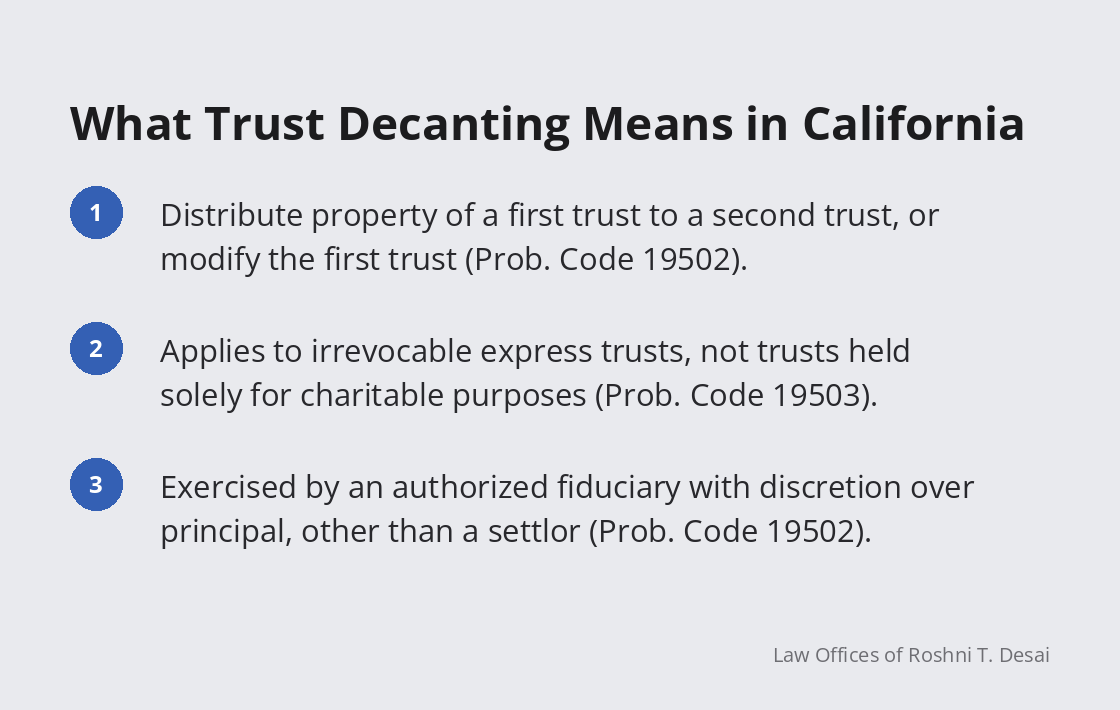
California’s rules appear in Part 9 of Division 9 of the Probate Code, beginning with Section 19501, which states that the part may be cited as the Uniform Trust Decanting Act. Probate Code Section 19502 defines the decanting power as the power of an authorized fiduciary to distribute property of a first trust to one or more second trusts or to modify the terms of the first trust. That definition matters because it confirms decanting can work either by moving assets into a new trust or by changing the existing trust document.
Which Trusts Qualify
Under Probate Code Section 19503, the act applies to an express trust that is irrevocable, or that is revocable by the settlor only with the consent of the trustee or a person holding an adverse interest. It does not apply to a trust held solely for charitable purposes. In practice, this means decanting is most often discussed after a living trust has become irrevocable at the settlor’s death, or for irrevocable trusts created during life for children, grandchildren, or a beneficiary with special needs. An ordinary revocable living trust that the settlor can still amend is generally changed through its own amendment process instead.
Who Holds the Decanting Power
Section 19502 defines an authorized fiduciary as a trustee or other fiduciary, other than a settlor, that has discretion to distribute or direct a trustee to distribute part or all of the principal of the first trust to one or more current beneficiaries. The definition also includes a special fiduciary appointed by the court under Section 19509 and a special-needs fiduciary under Section 19513. Section 19504 adds that, unless the first trust instrument provides otherwise, the terms of the first trust are deemed to include the decanting power. A trustee who has discretion over principal may therefore have this power even if the trust document never mentions decanting.
How the Decanting Process Works in California
The scope of what a trustee may change depends on how much discretion the trust gives over principal. Once the trustee knows which category applies, the statute sets out a notice procedure that gives beneficiaries and other interested people time to review the proposal and, if needed, ask a court to step in.
Expanded Distributive Discretion
Probate Code Section 19511 applies when the trustee has expanded distributive discretion, meaning a discretionary power of distribution not limited to an ascertainable standard or a reasonably definite standard. A trustee with that broad discretion over principal may decant that principal. Even so, except as the statute allows for certain powers of appointment, the second trust may not include as a current beneficiary a person who is not a current beneficiary of the first trust, may not add remainder or successor beneficiaries who were not already beneficiaries, and may not reduce or eliminate a vested interest, subject to the special-needs rules in Section 19513.
Limited Distributive Discretion
Section 19512 covers a trustee whose discretion is limited to an ascertainable standard, such as health, education, support, or maintenance, or to a reasonably definite standard. A trustee in this position may still decant, but the second trusts, in the aggregate, must grant each beneficiary of the first trust beneficial interests that are substantially similar to the interests that beneficiary held in the first trust. The statute explains that substantially similar means there is no material change in a beneficiary’s beneficial interests. Limited discretion is therefore best suited to administrative improvements rather than changes in who benefits or how much.
The Notice Requirement
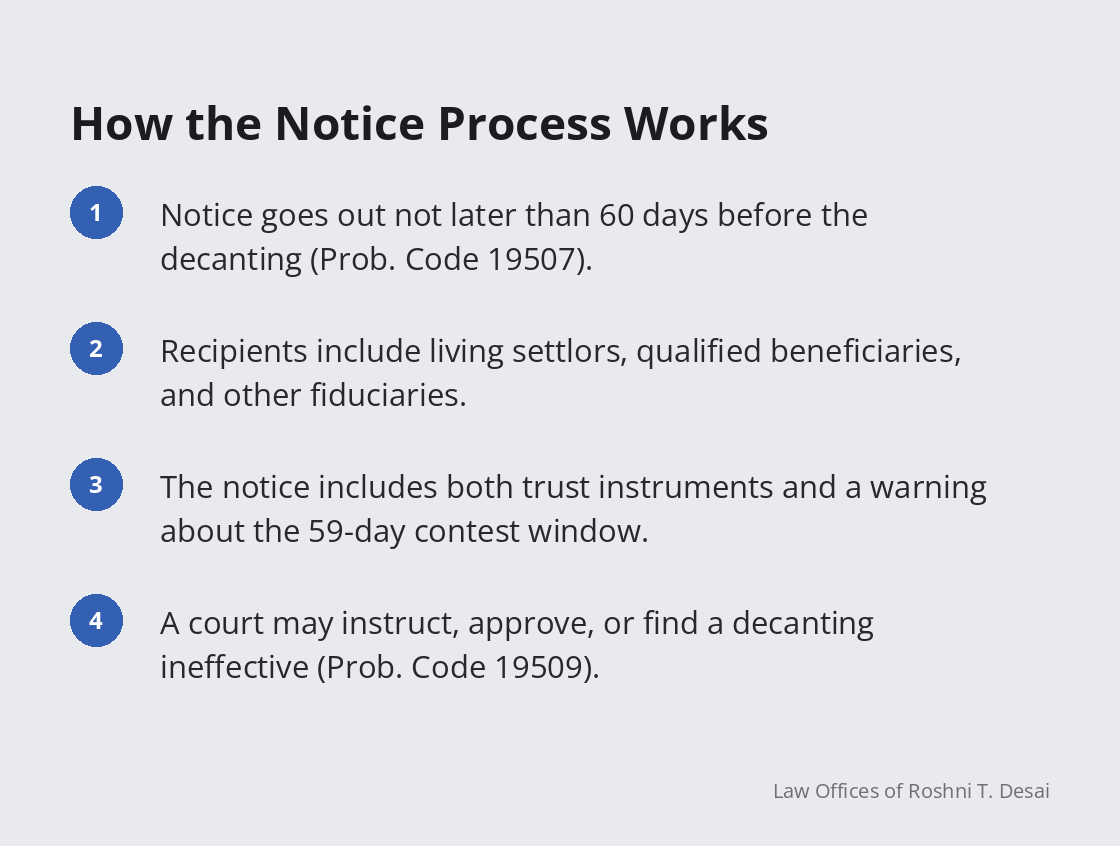
Probate Code Section 19507 allows an authorized fiduciary to exercise the decanting power without the consent of any person and without court approval, as long as the trustee complies with the statute. The trustee must give notice of the intended exercise not later than 60 days before the exercise to each living settlor, each qualified beneficiary, each holder of a presently exercisable power of appointment, each person with a current right to remove or replace the fiduciary, each other fiduciary of the first trust, each fiduciary of the second trust, and the Attorney General when Section 19514 applies. The notice must describe the proposed decanting and the reasons for it, state the proposed effective date, include copies of the first and second trust instruments, and contain a warning that a person who does not bring a court action to contest the proposed decanting within 59 days of the notice will lose the right to contest it. All persons entitled to notice may waive the notice period in a signed waiver.
When the Court Gets Involved
Under Section 19509, the trustee, a person entitled to notice, or a beneficiary may apply to the court. The court may provide instructions about whether a proposed decanting is permitted, appoint a special fiduciary, approve a decanting, or determine that a proposed or attempted decanting is ineffective because it does not comply with the act or would be an abuse of discretion or a breach of fiduciary duty. If an application is made, the burden is on the trustee to establish that notice was given as required and that the trustee may exercise the decanting power.
What Can Derail a Decanting
Decanting is a flexible tool, but it is not a shortcut around the settlor’s plan or the beneficiaries’ rights. Most problems come from moving too quickly, misreading the trust document, or treating the notice as a formality. Each of the following issues can lead to a court challenge.
A Trust Instrument That Restricts Decanting
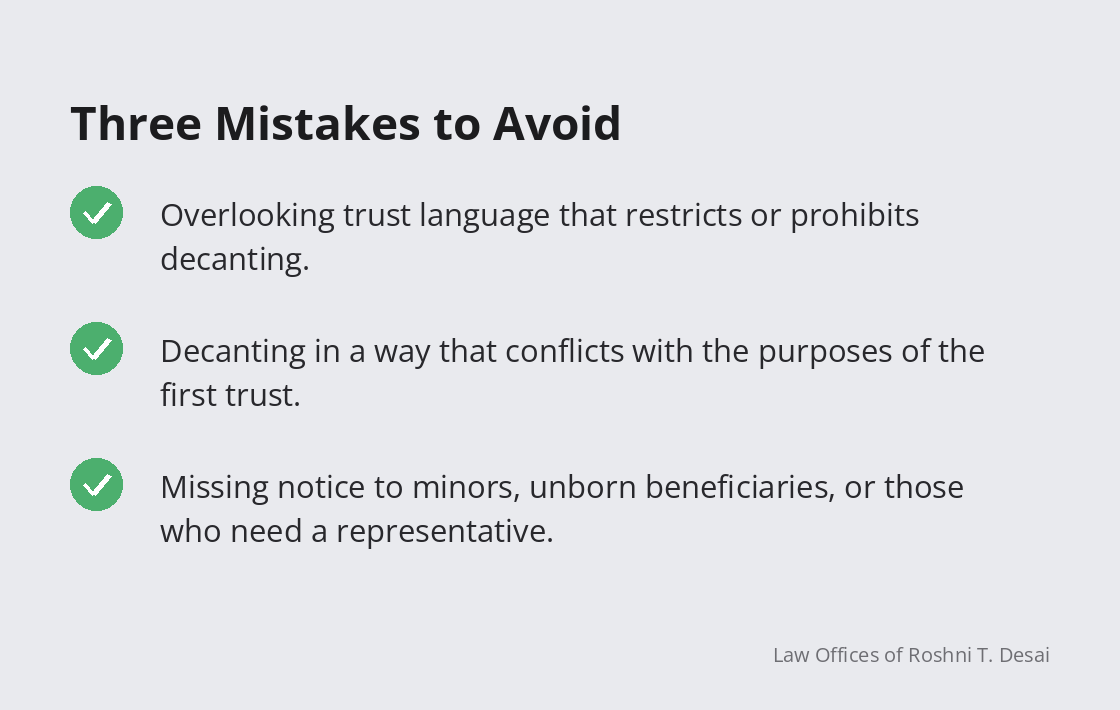
Section 19503 allows a trust instrument to restrict or prohibit the exercise of the decanting power, subject to Section 19515. Before planning a decanting, read the entire trust for language that limits the trustee’s authority. The same section also makes clear that the act does not limit other ways of changing a trust, such as powers granted in the trust instrument, other California law, or a court order. Sometimes another route fits the situation better.
Ignoring Fiduciary Duties
Section 19504 requires an authorized fiduciary exercising the decanting power to act in accordance with its fiduciary duties, including the duty to act in accordance with the purposes of the first trust. The same section states that the act does not create or imply a duty to exercise the decanting power. A trustee who decants to favor one beneficiary over another, or to escape terms the settlor deliberately chose, risks a finding of abuse of discretion or breach of fiduciary duty.
Missing Beneficiaries Who Need Special Notice
Section 19507 contains rules that are easy to overlook. Unless the trust instrument provides otherwise, notice must go to the guardian ad litem for a qualified beneficiary who is a minor with no representative, or who is unascertained or unborn, and the trustee must seek an appointment if none exists. If the trustee knows or has reason to know that a person entitled to notice is substantially unable to manage his or her own financial resources or resist fraud or undue influence, notice must also go to the individual appointed to act for that person. The notice must be served by mail to the last known address under Section 1215 or by personal delivery.
Overlooking Special Needs Planning
Probate Code Section 19513 allows a special needs fiduciary to decant for a beneficiary with a disability into a special needs trust, if the fiduciary determines that the decanting will further the purposes of the first trust. This can protect a beneficiary’s eligibility for governmental benefits, but the rules are technical, and other beneficiaries must still receive substantially similar interests.
Final Thoughts
Trust decanting in California gives a trustee a structured way to modernize an irrevocable trust without starting over. The Uniform Trust Decanting Act defines who may decant, limits what a trustee with limited discretion may change, protects vested interests, and requires detailed notice at least 60 days before the decanting takes effect. The notice itself warns that the time to bring a court action to contest the decanting is limited, so reading it promptly matters.
If you are a trustee considering decanting, or a beneficiary who has received a decanting notice, contact Law Offices of Roshni T. Desai to discuss your situation. We will review the trust, explain your options, and help you move forward with confidence.