




Understanding Probate Administration in Orange County, California: A Practical Guide
Probate administration in California can feel overwhelming when you’re managing a loved one’s estate. The process involves court filings, asset inventories, creditor notifications, and family coordination-all with strict deadlines.
We at Law Offices of Roshni T. Desai help Orange County families navigate these requirements with clarity. This guide breaks down what you need to know and do to move through probate efficiently.
What Probate Really Does
Probate is the court process that transfers money and property from a deceased person to the rightful heirs. In Orange County, this happens at the Costa Mesa Justice Complex, where the Probate Clerk’s Office processes filings and manages case administration. The court inventories all assets the deceased owned, pays valid debts and taxes, and distributes what remains according to the will or California’s intestacy laws if no will exists. The process typically takes nine to eighteen months, depending on estate complexity and whether beneficiaries dispute the terms.

Orange County probate examiners review petitions roughly three to four weeks before hearings to check for completeness and legal compliance, then prepare probate notes detailing any missing documents or deficiencies. You can view these notes online three to four weeks before your hearing through the Superior Court of Orange County’s Online Services portal, which gives you time to gather what the court needs. This timeline matters because every delay costs money in court fees and professional time, so getting documents right the first time saves both.
When Probate Isn’t the Answer
Not every estate needs probate, and that’s the first practical decision you face. If the deceased held assets in joint tenancy, those pass automatically to the surviving owner without court involvement. The same applies to payable-on-death bank accounts and retirement benefits with named beneficiaries-the financial institution handles the transfer directly.
California’s Shortcuts for Smaller Estates
California offers several shortcuts for smaller estates that avoid formal probate. If personal property totals $100,000 or less, you can file a Section 13100 declaration and distribute assets after waiting forty days. Real property under $50,000 can transfer via a DE-310 petition to determine succession, filed with the court and recorded with the County Recorder. For estates under $20,000 going to a spouse, domestic partner, or minor children, a set-aside order accelerates access to funds.
Living Trusts and Tax Consequences
Living trusts funded during the deceased’s lifetime also avoid probate completely, though establishing and funding a trust requires careful attention to property tax consequences. Transferring real estate into a trust without proper forms can trigger reassessment and increase property taxes from roughly $2,000 annually to $6,000 or more as values rise. This tax impact makes the decision between probate and non-probate transfers critical before you file anything with the court.
The choice you make here shapes everything that follows, which is why understanding these options matters before taking your next step. A professional attorney specializing in estate planning and probate administration can guide you through these decisions.
What Makes Orange County Probate Cases Difficult
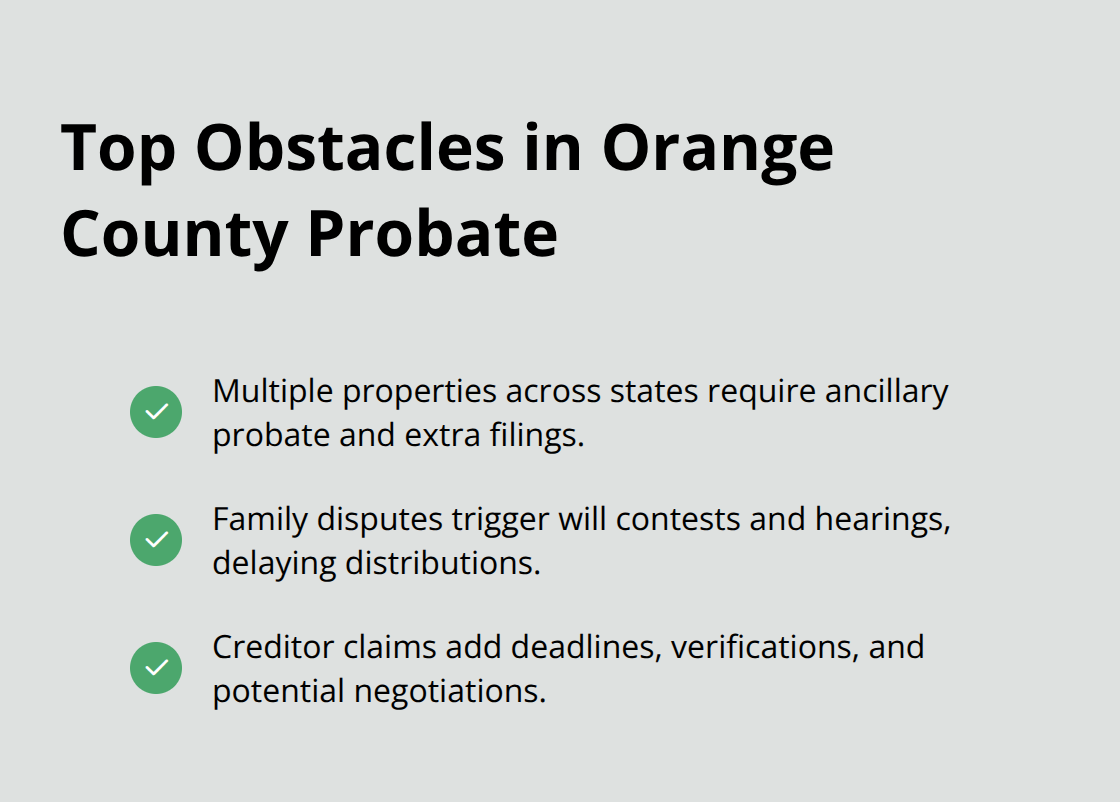
Probate administration in Orange County becomes complicated fast when the estate contains multiple properties, family members disagree about the will, or creditors file claims against the estate. These three problems overlap and compound each other, creating delays that can stretch your timeline from twelve months to two years or longer. Understanding what causes friction helps you prepare and avoid costly mistakes.
Managing Multiple Properties and Assets
Real estate adds serious complexity because property transfers require title verification, appraisals, and sometimes probate referee reports to establish fair market value. When an estate holds rental properties in Orange County plus a vacation home in another state, you manage different court systems, tax jurisdictions, and recording requirements simultaneously. The Orange County Probate Clerk processes filings at the Costa Mesa Justice Complex, but out-of-state property requires ancillary probate in that state’s courts, which means additional petitions, hearings, and professional fees. Investment accounts, business interests, and collectibles each need separate valuations and handling instructions.
Estates face delays of six months or more when executors fail to inventory assets completely before filing the initial petition. Start with a detailed property list and contact all financial institutions where the deceased held accounts. Request updated statements showing values as of the date of death. Banks and brokerages need this documentation anyway for probate, so gathering it upfront prevents the court from issuing probate notes asking for missing information.
When Family Members Fight Over the Will
Contested wills destroy timelines and drain estate funds through attorney fees. California courts handle will contests through formal objections filed before the probate petition receives approval, or through litigation after approval if someone claims fraud, undue influence, or lack of capacity. The Superior Court of Orange County requires that any objector file a written response and attend a hearing, which typically occurs four to eight weeks after the petition is filed.
If a beneficiary contests the will based on undue influence, the burden shifts to whoever drafted the will to prove the deceased acted of their own free will. These disputes cost thousands in legal fees and expert witness testimony, and they halt all asset distributions until the court rules. Preventing contests before they start produces better outcomes. If the deceased left a clear, properly executed will with detailed explanations for unequal distributions, contests become harder to sustain. Handwritten notes or video recordings explaining the testator’s reasoning provide powerful evidence. If you anticipate conflict among beneficiaries, file the will with the court immediately after death and notify all heirs in writing, which starts the clock on any challenges and prevents surprise objections later.
Creditor Claims and Debt Settlement
Creditors have strict deadlines to file claims against the probate estate, but missing these deadlines does not eliminate the debt-it just shifts liability to beneficiaries. California Probate Code sections 9050 through 9054 require the executor to publish notice of the estate in a newspaper, which gives creditors four months to file claims. Credit card companies, medical providers, and mortgage lenders regularly file claims in Orange County probate cases.
If the estate has insufficient assets to pay all claims, secured creditors like mortgage holders receive payment first, then priority claims like funeral expenses and administration costs, then unsecured creditors receive partial payment or nothing. The executor must track every claim, verify amounts, and object to inflated or fraudulent claims. This process requires detailed accounting and often involves negotiating payment plans with creditors.
Create a spreadsheet listing all known debts, the creditor contact information, account numbers, and amounts before filing the probate petition. Request death notices from the three major credit reporting agencies, which helps identify accounts you might otherwise miss. When creditors file claims, review them carefully against original documents and object to any claim that appears incorrect or duplicative. The estate’s final accounting must show every claim received and how it was handled, which the probate court examines before approving distributions to beneficiaries. These three obstacles-multiple properties, family disputes, and creditor claims-shape how you file petitions and manage court motions in Orange County, which we address next.
Moving Through Orange County Probate Step by Step
The probate process in Orange County succeeds or fails based on how thoroughly you prepare before filing the first petition. Start by creating a complete inventory of all assets the deceased owned, including real estate, bank accounts, investment portfolios, vehicles, and personal property with significant value. Contact every financial institution where the deceased held accounts and request statements dated to the date of death. The probate court requires these valuations to determine estate size and filing fees, and probate examiners will reject incomplete petitions, forcing you to refile and delay your timeline by weeks.
Assembling Documents Before Filing
Most executors underestimate the time needed for document preparation, typically assuming one week when the actual work takes three to four weeks. Request certified death certificates from the vital records office immediately, as you’ll need multiple copies for banks, brokerages, and the probate court. Orange County requires that you file the original will with the Superior Court of Orange County at the Costa Mesa Justice Complex along with your petition, so locate that document first and verify its signature page matches California Probate Code requirements for valid execution.
Filing Your Initial Petition
Once you’ve assembled documents, file your petition using either state judicial council forms or locally approved Orange County forms available through the court’s website. The Master Calendar Trial Setting Statement for Probate form L-3041 and Settlement Conference Statement for Probate form L-3040 are your primary case management tools, and the court requires these filed alongside your initial petition to set hearing dates and deadlines. Probate examiners will review your petition three to four weeks before your scheduled hearing and prepare probate notes identifying any missing documents or legal deficiencies.
Responding to Probate Notes
View these notes online through the Superior Court of Orange County’s Online Services portal at least two weeks before your hearing, then gather whatever additional documentation the examiners request. Common deficiencies include missing property appraisals, incomplete creditor lists, and inadequate proof of heirs’ identities. File corrections immediately after receiving probate notes to prevent continuances that delay your case by another month.

Tracking Distributions and Final Accounting
Once the court approves your petition, your job shifts to tracking distributions carefully. The Report of Status of Administration form L-3012 documents all assets, debts paid, and amounts distributed to each beneficiary. This accounting must be precise because the probate court reviews it before signing your final order, and any discrepancies force additional filings and delays. Create a spreadsheet tracking every deposit received, every bill paid, and every distribution made to beneficiaries, updating it monthly. This prevents the scramble to reconstruct six months of transactions when you’re ready to close the estate. The final accounting shows the court that you’ve paid all valid creditor claims, resolved all tax obligations, and distributed remaining assets correctly according to the will or intestacy laws. Most estates in Orange County take twelve to fifteen months from initial filing to final distribution when the executor stays organized and responds promptly to court requests.
Final Thoughts
Orange County probate administration requires careful planning, thorough documentation, and prompt responses to court requests. The process takes nine to eighteen months on average, but staying organized from day one cuts delays and prevents costly mistakes. Your three biggest challenges-managing multiple properties, resolving family disputes, and handling creditor claims-become manageable when you understand what the court expects and prepare accordingly.
California probate administration also offers shortcuts for smaller estates that save months and thousands in fees. If the deceased’s personal property totals $100,000 or less, a Section 13100 declaration avoids formal probate entirely, while real property under $50,000 transfers through a DE-310 petition. Living trusts funded during the deceased’s lifetime bypass probate completely, though property tax consequences require careful planning before you transfer real estate into a trust.
Handling probate alone works if your estate is small and uncomplicated, but most families benefit from professional guidance when contested wills, multiple properties across state lines, significant creditor claims, or complex tax situations arise. We at Law Offices of Roshni T. Desai provide personalized estate planning and probate services across Southern California, and our dual licensure as an attorney and real estate professional streamlines estate-related property sales to reduce costs and delays. Contact Law Offices of Roshni T. Desai to explore how we can guide your family through probate or help you plan your estate to avoid probate altogether.