




Probate Administration in SoCal: A Neighborhood Guide
Probate administration in Southern California involves navigating court filings, asset inventories, and debt settlements-a process that varies significantly by county. Missing even one deadline or filing requirement can add months to your case and drain your estate’s resources.
We at Law Offices of Roshni T. Desai have guided families through this process and seen firsthand how local differences between SoCal counties create confusion. This guide breaks down what you actually need to do, where mistakes happen most often, and how to move forward efficiently.
What Probate Administration Actually Requires
The Three Core Tasks You Cannot Skip
Probate administration in California demands three tasks that most people underestimate: filing court documents within strict deadlines, appraising every asset the deceased owned, and settling all debts before anyone receives money. The personal representative you appoint or the court selects must file an Inventory and Appraisal within four months after receiving letters testamentary or letters of administration. This form, filed with the Judicial Council as DE-160 and DE-161, splits assets into two categories-cash and readily appraised items in one section, and real property or stocks in another-because the probate referee charges 0.1% of the value they appraise, with a $75 minimum and $10,000 maximum fee.
Tax Filings and Creditor Notification
You must file the decedent’s final tax return and, if the estate grosses more than $600, file Form 1041 with the IRS and Form 541 with California if income exceeds $8,000 or net income tops $1,000. The estate’s tax year starts the day after death and can run as a fiscal year ending up to 12 months later, which gives you flexibility on filing deadlines.
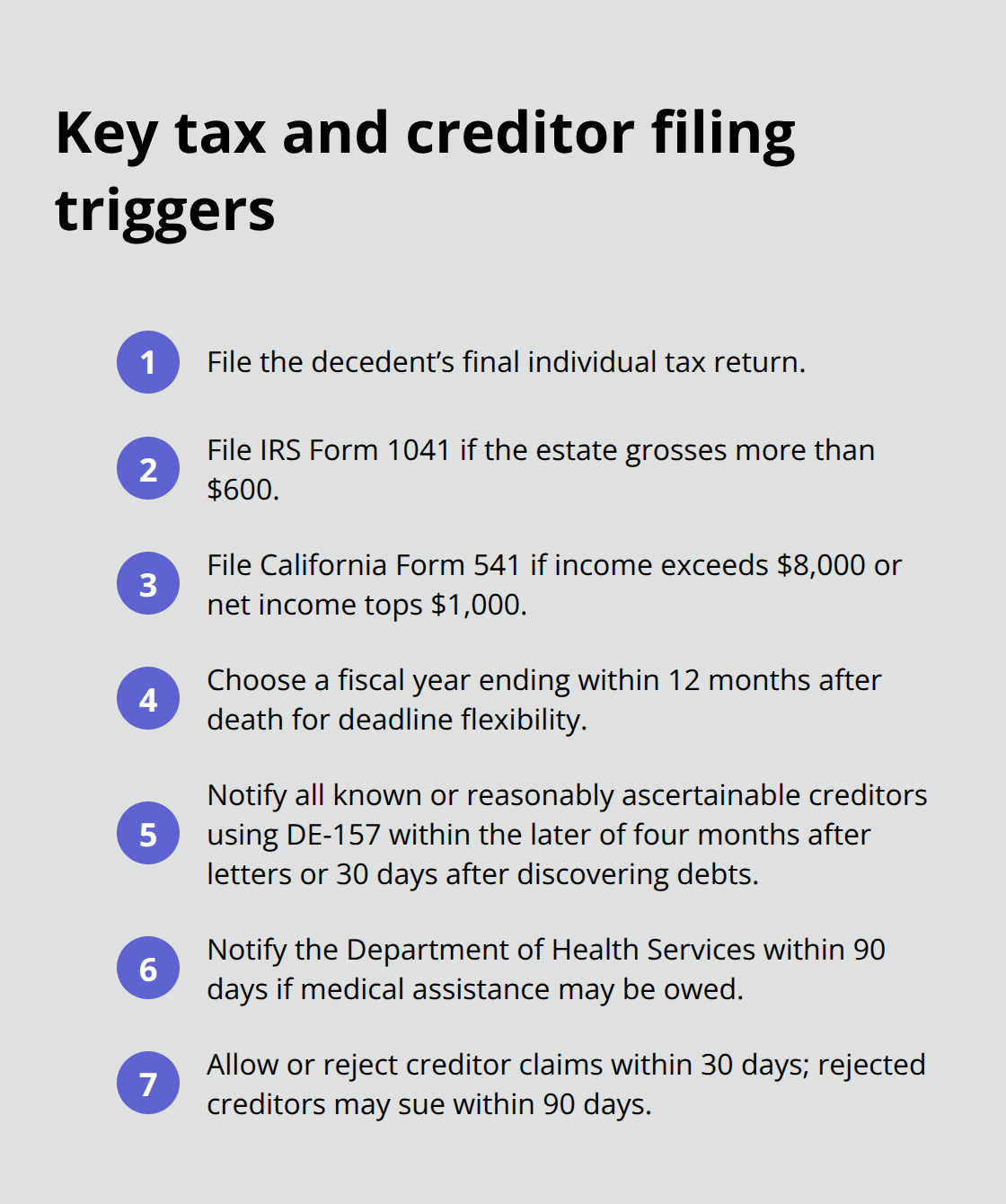
Within the later of four months after letters or 30 days after discovering debts, you must notify all known or reasonably ascertainable creditors using the Notice of Administration to Creditors form DE-157. You also must notify the Department of Health Services within 90 days with a copy of the death certificate if the estate might owe medical assistance. When a creditor files a claim, you have 30 days to allow or reject it using Form DE-174; if rejected, the creditor can sue within 90 days.
Why Personal Representatives Fail at These Tasks
The biggest mistake personal representatives make is treating these tasks as optional or delayable. Orange County courts see cases stall for months because someone filed the inventory late or failed to notify a creditor properly, forcing the court to issue orders and reset timelines. If the estate owns real property, notify the county assessor immediately-for Orange County properties, file the Preliminary Change of Ownership Report to address property tax and title status, which does not require a deed transfer but clarifies ownership for tax purposes. Obtain an Estate Tax Identification Number by filing IRS Form SS-4 and notify the IRS of your fiduciary relationship with Form 56. If federal estate tax applies because the gross estate exceeds the exemption threshold, Form 706 must be filed within nine months of death unless you request an extension. California has no state inheritance tax, but failure to file required fiduciary returns creates personal liability for the representative. Start these filings immediately rather than waiting until deadlines approach, because compressed timelines breed errors and missing even one deadline extends probate by months.
What Comes Next: Regional Variations
Each SoCal county handles probate differently, and understanding these local variations prevents costly delays and missteps.
How SoCal County Courts Actually Handle Probate
Orange County, Los Angeles, San Diego, and Riverside: Four Different Systems
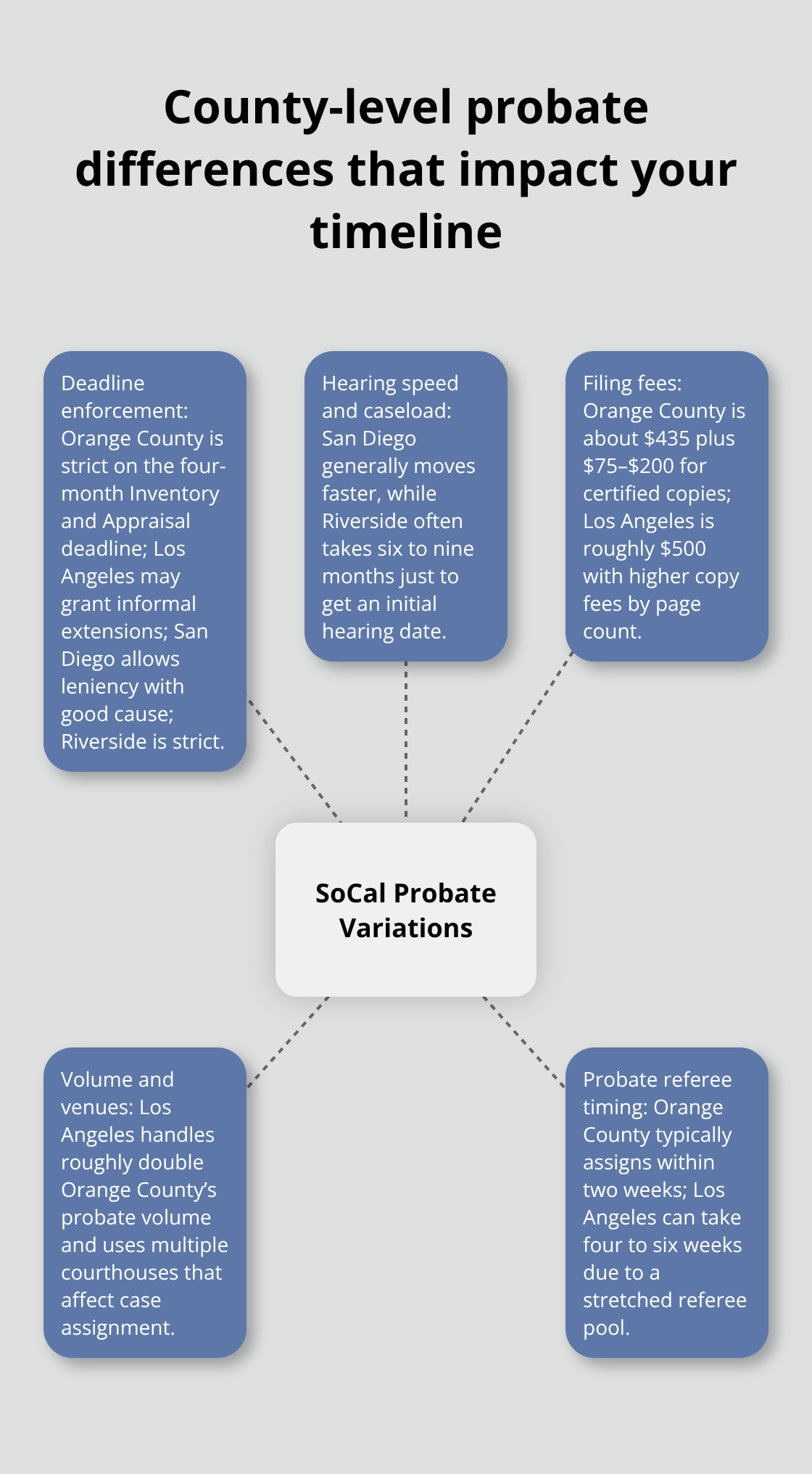
Orange County, Los Angeles County, San Diego County, and Riverside County each operate their probate divisions differently, and these differences directly affect your timeline and costs. Orange County Superior Court processes probate filings through its probate department in Santa Ana, with separate hearing calendars for contested and uncontested matters. Los Angeles County, handling roughly double the probate volume of Orange County, maintains multiple courthouses across the county, which means your case gets assigned to downtown LA, Pasadena, or Compton depending on where the estate property sits. San Diego County courts move faster on average than their northern counterparts, partly because caseload pressure is lower and judges can schedule hearings more quickly. Riverside County operates the slowest probate division in Southern California, with some personal representatives reporting six to nine months just to obtain an initial hearing date.
How Deadlines and Flexibility Differ by County
The Judicial Council of California sets uniform probate forms and deadlines statewide, but individual counties interpret deadlines differently. Orange County requires Inventory and Appraisal filings within exactly four months of letters issuance, with zero flexibility, while Los Angeles County sometimes grants informal extensions if you file a request before the deadline passes. San Diego courts penalize late filings less severely if you show good cause, whereas Riverside judges enforce deadlines strictly. These variations matter: missing a deadline in Orange County triggers immediate court action, while the same miss in San Diego might result in a warning and a chance to cure.
Filing Fees and Probate Referee Assignment Timelines
Filing fees vary across counties. Orange County charges approximately $435 for the initial petition filing, plus $75 to $200 for certified copies of court orders, while Los Angeles County charges roughly $500 for the same petition and higher certified copy fees depending on page count. Probate referee fees remain constant statewide at 0.1% of appraised value (with minimums and maximums), but the time it takes to get a probate referee assigned differs by county. Orange County typically assigns a referee within two weeks; Los Angeles County can take four to six weeks because the probate referee pool is stretched thin.
Multi-County Properties and Ancillary Probate
If your estate includes real property in multiple counties, you must file ancillary probate in each county where property exists, multiplying your filing fees and court appearances. A property in Orange County and another in Riverside County means two separate probate cases, two sets of filing fees, and two court schedules to manage. This complexity alone can extend administration by six to twelve months if you do not plan for it from the start.
What These Differences Mean for Your Case
County differences alone can add or subtract three to six months from your total administration period. Do not assume your neighbor’s probate timeline applies to your case, because the court system your estate enters determines how quickly you move through each stage. Understanding which county handles your case and what that county’s specific practices are prevents costly surprises and allows you to file strategically. The next section covers the mistakes that most often derail probate cases, regardless of which SoCal county you navigate.
Common Probate Mistakes That Delay Your Case
Incomplete Asset Documentation Triggers Rejections
Personal representatives fail in probate administration not because the process is complex, but because they skip steps or mishandle documentation early on. The most expensive delays stem from three specific areas: incomplete asset records when filing the Inventory and Appraisal, poor creditor and beneficiary notification, and missed court filing deadlines. Orange County courts stall cases for months because someone listed a property address incorrectly on DE-160, forcing the probate referee to reject the filing and restart the appraisal process.
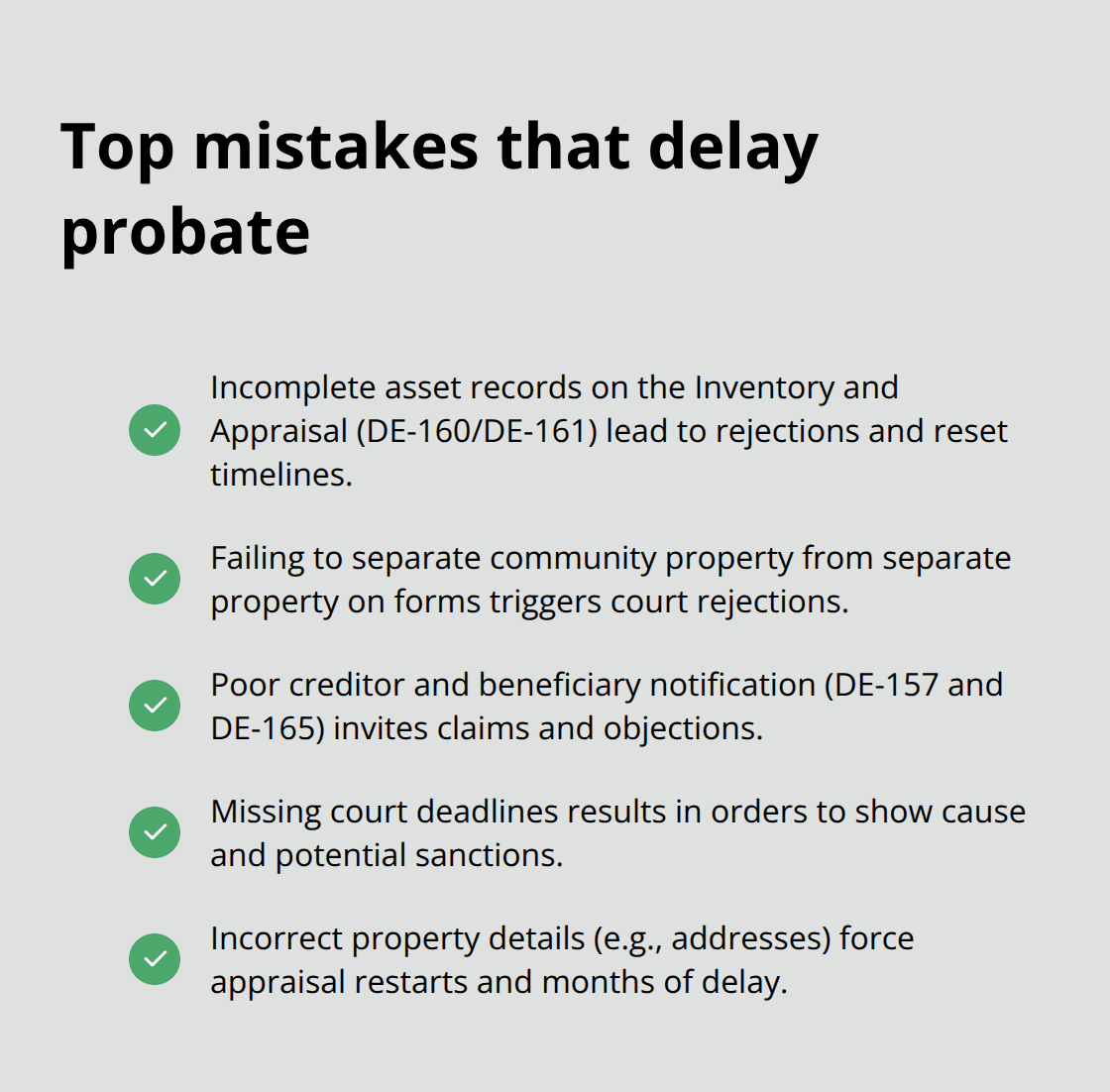
Los Angeles County judges reject Inventory and Appraisal forms because personal representatives fail to separate community property from separate property, a distinction the Judicial Council requires on the form itself. These rejections do not simply cost filing fees-they reset your four-month deadline, meaning you lose months of progress.
When you gather assets initially, document everything with deeds, bank statements, investment account statements, and property tax assessments. Do not rely on memory or assume you know what the deceased owned. Many estates uncover hidden accounts or properties months into administration because no one conducted a thorough search at the beginning.
Creditor Notification Failures Reopen Settled Estates
Creditor notification failures create even larger problems because missed creditors can file claims years later, reopening settled estates. The law requires you to notify all known or reasonably ascertainable creditors using Form DE-157 within the later of four months after letters or 30 days after discovering debts. What trips up most personal representatives is the phrase reasonably ascertainable-you cannot simply notify obvious creditors and call it done. You must search the decedent’s mail, contact utility companies, check credit reports, and ask family members about any debts or obligations. If you miss a creditor and that creditor files a claim after you have already distributed assets to beneficiaries, you may personally owe money to satisfy that claim.
Beneficiary notification carries equal weight. The Judicial Council requires Notice of Proposed Action (Form DE-165) mailed at least 15 days before taking major actions like selling property or making distributions. Many personal representatives skip this step, believing they can act independently under the Independent Administration of Estates Act. That assumption costs them. If a beneficiary objects to a proposed action you did not properly notify them about, the court can void your action and force you to start over.
Court Deadlines Demand Early Filing
Missing court filing deadlines compounds these mistakes. Orange County enforces the four-month Inventory and Appraisal deadline strictly-file one day late and the court issues an order to show cause why sanctions should not apply. Riverside County operates similarly but with longer backlogs, meaning you face delays even if you file on time. The practical solution is to file all major documents 10 days before the deadline, giving yourself a buffer for corrections or missing information.
Coordinate with the probate referee immediately after receiving letters so they can schedule the appraisal early rather than waiting until month three. Contact all known creditors within 30 days of letters, not 120 days. Notify all beneficiaries of every proposed action in writing, keeping copies for your court file. Consider whether a well-structured trust might have prevented these delays in the first place, as proper planning stops many probate complications before they start. Create a probate administration checklist on day one, with columns for each task, the deadline, the responsible party, and the date completed. This simple tool prevents oversights that cost months and thousands in estate resources.
Final Thoughts
Probate administration in SoCal demands attention to detail, strict adherence to county-specific deadlines, and coordination across multiple moving parts. The mistakes outlined in this guide-incomplete documentation, failed creditor notification, and missed filing deadlines-are entirely preventable with proper planning and early action. Most personal representatives navigate these challenges alone, learning through costly errors that could have been avoided.
Probate administration varies enough across Orange County, Los Angeles, San Diego, and Riverside that what works in one jurisdiction fails in another. A four-month deadline in Orange County operates differently than the same deadline in Los Angeles County, and filing fees, probate referee assignment timelines, and court scheduling practices differ by location. Without understanding these regional variations, you risk delays that extend administration by months and drain thousands from your estate.
Professional guidance matters most when you face decisions early in the process. Whether to file ancillary probate for multi-county properties, how to structure asset documentation to pass probate referee review on the first submission, or which county court procedures apply to your specific situation-these decisions shape your entire timeline. Contact Law Offices of Roshni T. Desai for a free consultation to discuss your specific situation, county-specific timelines, and the best path forward for your estate.