




San Diego Estate Planning: Local Guidance for Your Family
San Diego’s real estate market and California’s tax laws create unique challenges that generic estate plans simply don’t address. Your family’s financial security depends on a strategy built specifically for your local situation.
We at Law Offices of Roshni T. Desai help San Diego families navigate these complexities with customized plans that protect what matters most. This guide walks you through the documents you need, the mistakes to avoid, and how to move forward with confidence.
Why San Diego’s Real Estate Market Demands a Different Approach
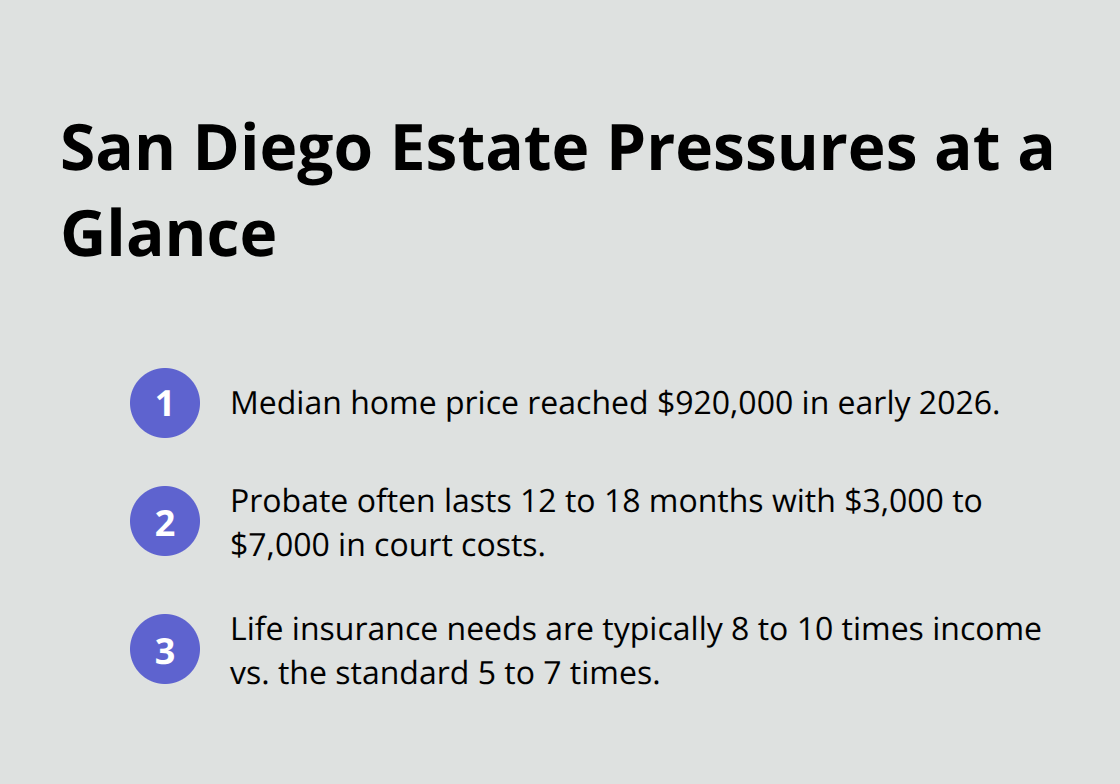
San Diego’s median home price reached $920,000 in early 2026, making property your family’s largest asset by far. When real estate dominates your estate, a generic plan fails because it doesn’t account for how California handles property transfer, capital gains tax, and probate timelines specific to San Diego County. The median probate timeline in California stretches 12 to 18 months, during which courts freeze your property and your family faces court costs averaging $3,000 to $7,000 depending on estate complexity. Your customized plan must address whether a revocable living trust makes sense for your situation, how to structure joint ownership to avoid unintended consequences, and whether a transfer-on-death deed works for your goals. San Diego’s high cost of living also means life insurance needs are substantially higher here than in other regions-families typically need 8 to 10 times annual income rather than the standard 5 to 7 times-because your children’s education, healthcare, and housing will cost more if you’re no longer there to provide.
California’s Tax Environment and Your Bottom Line
California imposes no state estate tax, but federal estate tax applies to estates exceeding $13.61 million in 2026, and this threshold drops to approximately $7 million in 2026 unless Congress acts. More immediately, California’s capital gains tax hits your heirs when they inherit appreciated assets. If your home increased $400,000 in value and you pass it to your children without proper planning, they face immediate capital gains tax on that appreciation unless they receive a stepped-up basis at death-a benefit that requires the right ownership structure and documentation. Probate also triggers costs: San Diego County charges filing fees, and attorney fees typically run 3 to 7 percent of your estate’s gross value, not net value. A customized plan identifies whether a living trust bypasses probate for your situation, which beneficiary designations eliminate probate for certain assets, and whether a qualified personal residence trust or charitable remainder trust fits your long-term goals. These decisions save your family tens of thousands of dollars and months of delay.
Multi-State Assets and Family Complexity
If you own property outside California-a vacation home in Arizona, rental real estate in Nevada, or investment accounts managed by an out-of-state trustee-your estate plan must comply with multiple states’ laws simultaneously. Each state has different probate rules, guardianship standards for minor children, and power of attorney requirements. A will valid in California may not transfer your Nevada property efficiently, forcing your family through probate in two states. A revocable living trust works across state lines because it’s a private document that doesn’t require court involvement, but only if structured correctly from the start. If you’ve remarried or have adult children from prior relationships, your plan must clearly specify who receives what and prevent unintended disinheritance. San Diego families with blended households, adult children managing their own finances, or aging parents requiring care need plans that address succession in trusts, alternate trustees when primary trustees cannot serve, and healthcare directives that your actual medical providers will follow. These overlapping circumstances make the next step-selecting the right documents for your family-far more complex than most families realize.
Essential Estate Planning Documents for San Diego Families
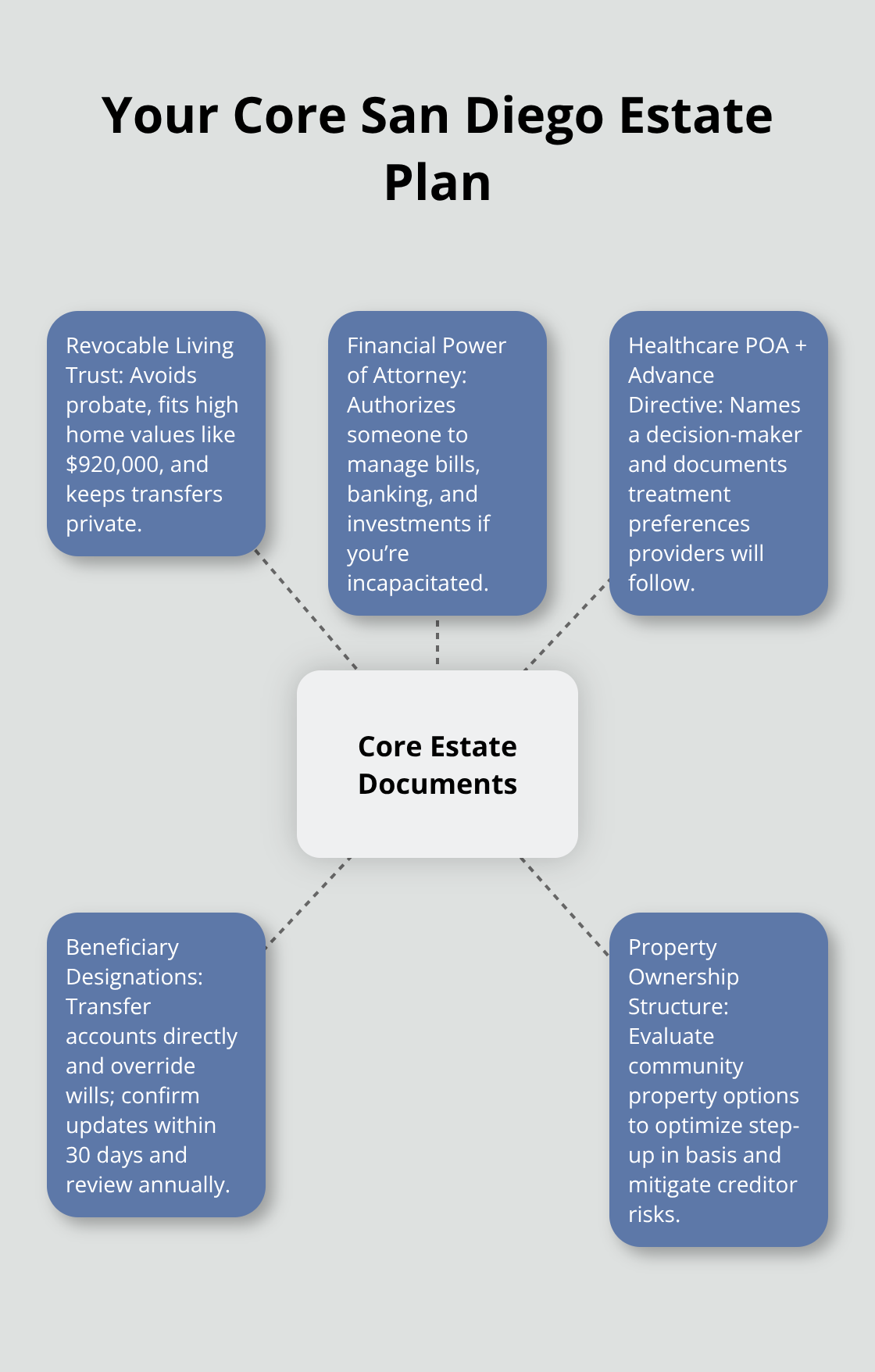
A will alone won’t protect your family in San Diego because it only addresses what happens after you die-it says nothing about who manages your finances if you become incapacitated, and it forces your estate through probate, which in San Diego County typically takes 12 to 18 months. A revocable living trust serves as your foundation document, especially given San Diego’s median home price of $920,000. A revocable living trust holds title to your property during your lifetime and passes assets to your beneficiaries without probate when you die, saving your family $3,000 to $7,000 in court costs and months of delay. You retain complete control while living-you can buy, sell, or refinance property in the trust’s name, change beneficiaries, or dissolve the trust entirely. California law requires the trust to be in writing and properly executed, so generic online templates often fail because they don’t account for San Diego County’s specific recording requirements or how the trust interacts with your property’s title. The trust must also clearly name successor trustees who step in if you die or become unable to manage assets, which prevents family conflict and ensures continuity.
Financial Powers of Attorney Keep Your Accounts Accessible
Beyond the trust, you need a financial power of attorney naming someone to pay your bills, manage investments, and handle banking if you’re hospitalized or mentally incapacitated-without this document, your family cannot access accounts or pay mortgage payments even if you’re still alive. California Probate Code Section 4401 allows financial powers of attorney to remain valid after incapacity, which is essential because an ordinary power of attorney becomes worthless the moment you need it most.
Healthcare Decisions Require Separate Legal Documents
Healthcare decisions require separate documents because California law prohibits your financial power of attorney from making medical choices. A healthcare power of attorney (also called a healthcare proxy) names the person who will authorize surgery, consent to medication, or decide on life support if you cannot communicate your wishes. Paired with an advance healthcare directive, this document outlines your specific preferences-whether you want resuscitation, artificial nutrition, hospice care, or organ donation-so your family and doctors know your values without guessing. California hospitals require these documents to be on file before emergencies happen, and providers often reject outdated or improperly executed directives, leaving your family powerless.
Beneficiary Designations Override Your Will
Beneficiary designations on retirement accounts, life insurance policies, and investment accounts bypass probate entirely and transfer directly to named beneficiaries, but they override your will if designations conflict. Many San Diego families fail to update beneficiaries after divorce, remarriage, or the birth of children, accidentally disinheriting spouses or children while former partners receive accounts meant for the current family. Financial institutions require you to contact them directly to name or change beneficiaries-a simple phone call to your bank or insurance company-but you must verify the changes appear on the account within 30 days.
Property Ownership Structures Shape Your Tax Outcome
Property ownership structures matter enormously in San Diego because joint tenancy with right of survivorship automatically transfers property to the surviving joint owner outside probate, but it creates unintended tax consequences and exposes property to creditors of either owner. Community property agreements or community property with right of survivorship provide a stepped-up basis for both spouses’ shares at death, meaning your heirs inherit appreciated property at current market value rather than your original purchase price, saving substantial capital gains taxes. San Diego couples with high-value homes should evaluate whether community property ownership aligns with their tax situation, but this requires reviewing your current deed and consulting someone who understands both property law and tax implications. These overlapping ownership rules and tax implications mean that selecting the right documents demands attention to your specific circumstances-which is why the next step involves identifying which documents fit your family’s situation and timeline.
Common Estate Planning Mistakes San Diego Families Make
Life Changes Demand Immediate Document Updates
Most San Diego families create an estate plan and never touch it again, a costly mistake because life shifts constantly. When you divorce, remarry, have children, acquire investment property, or experience substantial income changes, your existing documents become outdated and often work against your intentions. If you named your ex-spouse as executor or trustee before the divorce finalized, California law does not automatically remove them-you must file paperwork to change the designation, and many families discover this problem only when they need the executor to act.
A will from 2015 that names a former spouse as primary beneficiary remains valid unless formally updated, meaning your ex could inherit your $920,000 San Diego home if you die without revising the document. California Probate Code Section 2803 provides some protection by automatically revoking certain spousal provisions upon divorce, but this protection does not cover all situations and does not apply to trusts, making manual updates essential. Life insurance beneficiary designations suffer the same problem-if you bought a $500,000 policy during your first marriage and never updated the beneficiary after remarriage, your new spouse receives nothing while your ex-spouse or adult children from the first marriage collect the full amount.
The cost of updating documents is minimal compared to the cost of fixing mistakes after death, yet San Diego families routinely skip annual reviews and only contact an attorney years later when circumstances have shifted dramatically.
Probate Costs and Tax Liabilities Hit Harder Than Expected
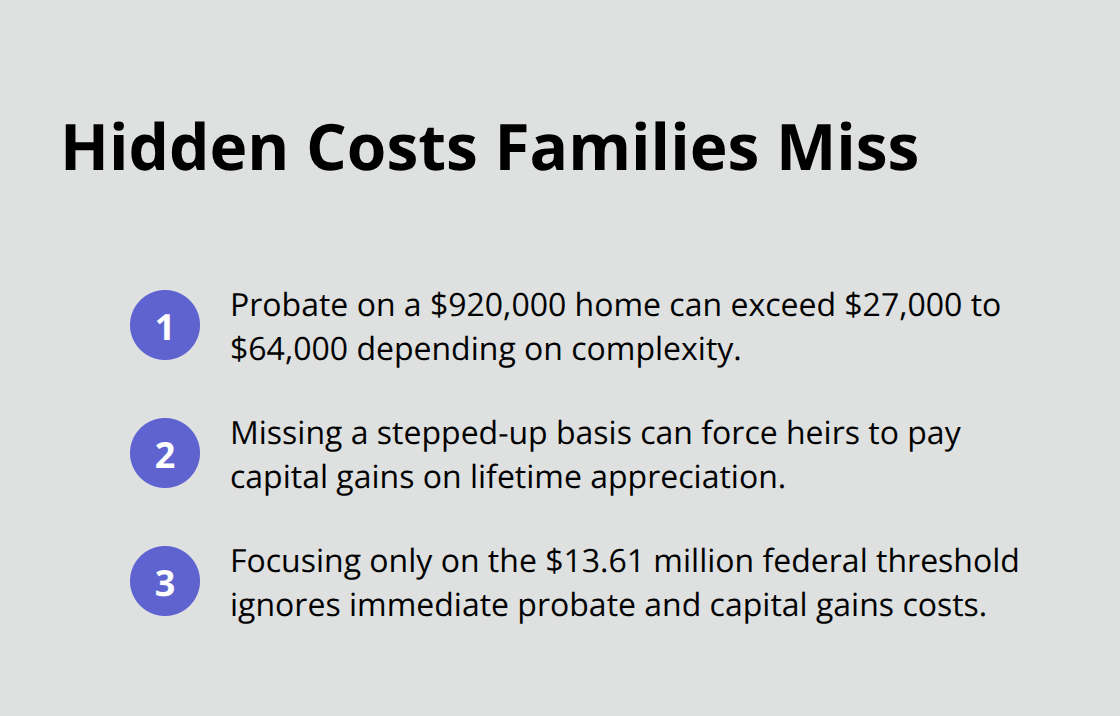
The second major mistake is underestimating the true cost of probate and taxes, which leads families to believe they cannot afford proper planning when they actually cannot afford to skip it. San Diego’s median home price of $920,000 means probate costs alone-filing fees, bond premiums, and attorney fees ranging from 3 to 7 percent of gross estate value-can easily exceed $27,000 to $64,000 depending on complexity.
If your estate includes appreciated rental properties or investment accounts, California’s capital gains tax applies to your heirs’ inheritance, and without a stepped-up basis strategy, your children pay tax on appreciation that occurred during your lifetime, not just their holding period. A $1.2 million estate with $400,000 in unrealized gains triggers substantial capital gains liability for your heirs if the property structure does not support a stepped-up basis at death. Most San Diego families focus only on federal estate tax, which applies only above $13.61 million in 2026, and miss the more immediate probate costs and capital gains consequences that affect estates of all sizes.
The Wrong Trustee or Executor Creates Conflict and Waste
The third mistake-selecting the wrong trustee or executor-creates family conflict and financial waste because you need someone organized, financially responsible, and willing to invest time managing assets for months or years after your death. Many families name the oldest adult child or a trusted friend without considering whether that person has the financial literacy to manage investment accounts, coordinate with tax professionals, file required trust tax returns, or navigate probate court if needed.
San Diego families with blended households face additional complexity: naming one adult child as executor while others inherit equally creates resentment and often triggers disputes over fees, distributions, and timeline. Professional trustees cost money-typically 1 to 2 percent of assets annually-but they eliminate family conflict, reduce liability, and ensure compliance with California law. A co-executor arrangement pairing a family member with a professional trustee balances family involvement with professional management and protects relationships during an already stressful time.
Final Thoughts
San Diego estate planning protects your family from probate delays, unexpected tax bills, and family conflict when you act now with documents tailored to your situation. Your $920,000 home, your children’s future, and your healthcare wishes require a plan built for California law and San Diego County’s specific requirements, not a generic template that fails when your family needs it most. Start by identifying which documents matter most for your circumstances: if you own significant real estate, a revocable living trust should be your priority because it bypasses probate and keeps your property transfer private; if you have minor children, a will naming guardians and a healthcare power of attorney protecting your medical decisions come first.
Name your trustee and executor carefully by selecting someone organized and financially responsible, or consider a professional trustee to eliminate family conflict and ensure compliance with California law. Update beneficiary designations on all accounts within 30 days to confirm the changes took effect, and review these designations annually because they override your will and trust. Life changes like divorce, remarriage, new children, or substantial income shifts demand immediate review and updates to your existing documents to prevent unintended disinheritance or outdated trustee designations.
Schedule a consultation with someone who understands San Diego’s real estate market and California’s tax environment to move forward with confidence. We at Law Offices of Roshni T. Desai offer free consultations with flexible home or office visits, combining over 25 years of experience in estate planning, probate administration, and trust services across Southern California. Your family’s security is worth the conversation.