




Creditor Claims Probate California: Deadlines, Notices, and Rejections
Creditor claims in California probate are one of the most important, and most misunderstood, parts of administering an estate. When someone passes away owing money to a lender, a medical provider, a landlord, or a business, those debts do not simply disappear, and they do not automatically become the family’s personal obligation either. Instead, the Probate Code sets up a structured process with specific notices, filing requirements, and deadlines that decide which claims get paid from the estate and which are barred. Understanding that process gives you real control over the administration, whether you are the executor handling the estate or a creditor trying to protect what you are owed.
At Law Offices of Roshni T. Desai, we help executors, administrators, and families throughout Southern California work through probate with clarity, so you can move forward with confidence. This guide explains how creditor claims actually work, how the claim process unfolds from notice to decision, and the mistakes that most often cause delays or disputes.
How Creditor Claims Actually Work in California Probate
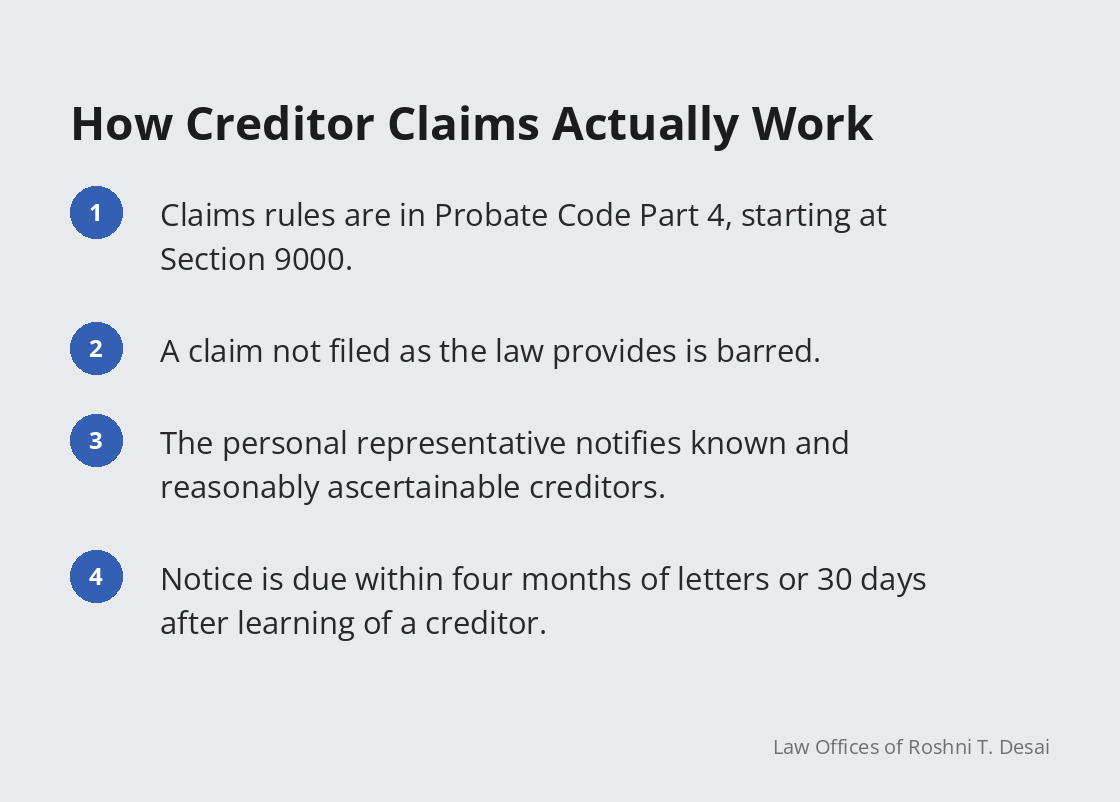
California’s rules for creditor claims are found in Part 4 of Division 7 of the Probate Code, beginning with Section 9000. The basic idea is simple. When a probate estate is opened, the court issues letters to a personal representative, who is the executor named in the will or an administrator appointed by the court. Creditors of the person who died then have a defined window to present their claims to the estate. Probate Code Section 9002 states the consequence plainly: except as otherwise provided by statute, all claims must be filed in the manner and within the time the law provides, and a claim that is not filed as provided is barred.
This structure protects everyone involved. Creditors receive a fair chance to come forward, and the family gains certainty, because once the claim period closes and the remaining claims are resolved, the estate can be distributed without the worry that an old debt will surface years later. The process is formal, but it is predictable when you know the steps.
Who Counts as a Creditor of the Estate
A creditor is anyone the decedent owed money to at the time of death, along with certain obligations that arise from the decedent’s own liabilities. Common examples include credit card issuers, medical providers, personal lenders, landlords, contractors, and businesses with unpaid invoices. Creditor claims are different from the ordinary expenses of running the estate, such as paying for property upkeep during administration, which the personal representative handles as part of managing the estate. Knowing which obligations are true creditor claims helps the personal representative apply the right rules to each one.
The Personal Representative’s Notice Duty
Probate Code Section 9050 requires the personal representative to give notice of administration of the estate to the known or reasonably ascertainable creditors of the decedent. The statute explains that a personal representative has knowledge of a creditor if the personal representative is aware that the creditor has demanded payment from the decedent or the estate. This mailed or delivered notice is in addition to the published notice of the probate petition that runs in a newspaper under Section 8120. In practice, this means the personal representative should review the decedent’s mail, bills, statements, and records carefully, because each creditor that can reasonably be identified should receive direct notice.
When the Notice Must Be Sent
Section 9051 sets the timing. The notice must be given within the later of four months after the date letters are first issued, or thirty days after the personal representative first has knowledge of the creditor. That second option matters, because new creditors often appear partway through an administration when a forgotten account or a late statement arrives. Each time a new creditor becomes known, the personal representative should send notice promptly rather than assuming the original deadline has already passed.
The Creditor Claim Process From Filing to Decision
Once notice goes out, the burden shifts to creditors. A claim is not valid simply because a creditor sends a bill or a letter to the family. The creditor must file a formal claim with the probate court and deliver a copy to the personal representative, and the personal representative must then decide whether to allow or reject it. Each of these steps comes with its own rule and its own deadline.
The Four-Month Claim Deadline
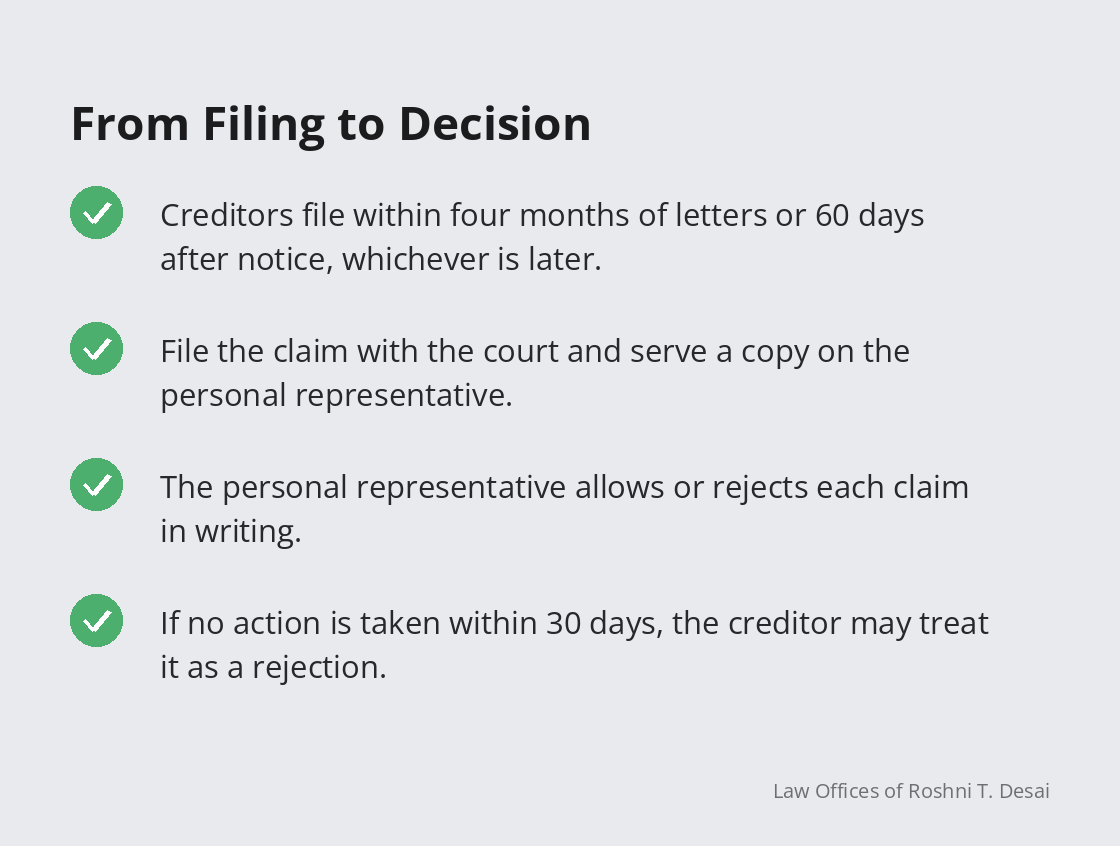
Probate Code Section 9100 provides that a creditor must file a claim before the expiration of the later of two times: four months after the date letters are first issued to a general personal representative, or sixty days after the date notice of administration is mailed or personally delivered to the creditor. For most creditors who receive notice early in the case, the four-month window controls. For a creditor who receives notice late in that period, the sixty-day window gives them a fair opportunity to respond. Section 9100 also makes clear that it does not extend the separate one-year limit in Code of Civil Procedure Section 366.2, which is discussed below.
How a Claim Must Be Filed and Served
Section 9150 requires that a claim be filed with the court and that a copy be served on the personal representative. Service must be made within the later of thirty days of filing the claim or four months after letters issue to a personal representative with general powers. The statute is direct about the consequence: if the creditor does not both file the claim with the court and serve it on the personal representative as required, the claim is invalid. Section 9153 adds that the Judicial Council claim form must inform creditors of these requirements and include a proof of delivery of a copy to the personal representative. Creditors who skip the court filing and only send a demand letter to the family risk losing the claim entirely.
Allowing or Rejecting a Claim
When a claim is filed, Section 9250 requires the personal representative to allow or reject it, in whole or in part. The decision must be in writing, filed with the court clerk, and sent to the creditor along with a copy of the allowance or rejection. The written decision must include specific information, such as the name of the creditor, the date letters issued, the date of death, whether the personal representative is acting under the Independent Administration of Estates Act, and a statement that the creditor has 90 days in which to act on a rejected claim. Executors who have independent authority often have more flexibility in handling claims, and our guide to the Independent Administration of Estates Act explains how that authority works.
When Silence Counts as Rejection
Sometimes a personal representative does not respond at all. Section 9256 addresses that situation. If within thirty days after a claim is filed the personal representative, or the court or judge, has refused or neglected to act on it, the creditor may choose to treat that refusal or neglect as a notice of rejection given on the thirtieth day. This gives creditors a way to move forward rather than waiting indefinitely, and it gives personal representatives a strong reason to review and respond to claims on time.
Common Mistakes That Derail Creditor Claims
Most problems with creditor claims come from missed deadlines and incomplete steps rather than from complicated legal questions. Because the rules are strict, a small oversight by either side can change the outcome. The mistakes below are the ones that most often lead to delays, disputes, or claims that are lost altogether.
Assuming a Late Claim Is Always Allowed
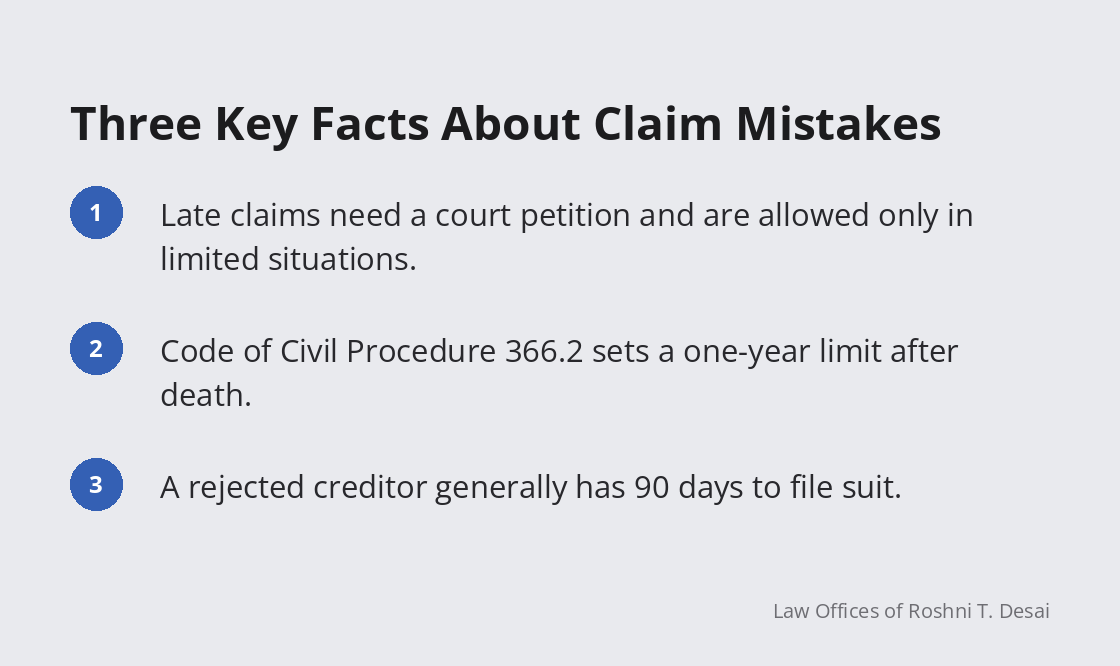
Creditors who miss the claim period sometimes assume the court will accept a late claim as a matter of course. Section 9103 allows a late claim only in limited situations, and only on a petition to the court. One situation is when the personal representative failed to send proper and timely notice and the creditor files the petition within sixty days after gaining actual knowledge of the administration. Another is when the creditor had no knowledge of the facts giving rise to the claim until shortly before the claim deadline, and petitions within sixty days of learning both of those facts and of the administration. Even then, the court cannot allow a late claim after it makes an order for final distribution, and nothing in the section revives a claim barred by Code of Civil Procedure Section 366.2.
Overlooking the One-Year Limit After Death
Code of Civil Procedure Section 366.2 is a separate rule that applies whether or not a probate case is ever opened. When a person dies before the limitations period for a claim against them has expired, and the cause of action survives, an action may be commenced within one year after the date of death, and the limitations period that would otherwise have applied does not apply. The statute also states that this one-year period may not be tolled or extended except in specific listed circumstances, including the creditor claim provisions of the Probate Code. For creditors, this means waiting for the family to open probate can be risky. For families, it means the one-year mark is an important date in planning the administration.
Missing the 90-Day Window After Rejection
A rejection is not the end of the road for a creditor, but it starts a short clock. Under Probate Code Section 9353, a claim rejected in whole or in part is barred as to the rejected part unless the creditor commences an action on the claim, or the matter is referred to a referee or to arbitration, within 90 days after the notice of rejection is given if the claim was due at that time, or within 90 days after the claim becomes due if it was not yet due. Section 9353 applies regardless of whether the ordinary statute of limitations would expire earlier or later. Creditors who let that window pass usually lose the rejected portion of the claim, and personal representatives benefit from tracking the date each rejection notice was given.
Paying Debts Out of Order
When an estate has enough to pay every allowed claim, the order of payment rarely causes trouble. When it does not, order matters a great deal. Probate Code Section 11420 sets the priority among classes of debts, beginning with expenses of administration and obligations secured by a mortgage, deed of trust, or other lien, followed by funeral expenses, expenses of last illness, family allowance, wage claims, and then general debts. The statute also provides that no debt of any class may be paid until all those of prior classes are paid in full, and that debts within a class share proportionately if the estate cannot cover them all. A personal representative who pays a general creditor early, before higher-priority obligations are handled, can create real problems for the administration.
Final Thoughts
Creditor claims in California probate follow a clear sequence. The personal representative sends notice to known and reasonably ascertainable creditors, creditors file and serve formal claims within the deadline, the personal representative allows or rejects each claim in writing, and rejected creditors must act within a short window. When each step is handled carefully, the claim period brings certainty to the estate and lets the family complete distribution with confidence that old debts have been addressed properly.
Whether you are an executor trying to identify every creditor or a creditor trying to preserve a claim against an estate, the deadlines leave little room for delay. Keeping dated records of every notice, claim, and decision is one of the simplest ways to protect yourself throughout the process.
If you are administering an estate or need help with a claim in a California probate case, contact Law Offices of Roshni T. Desai to speak with our probate team. We will review your situation, explain your rights and responsibilities under California law, and help you take the next step with confidence.