




Irrevocable Trust Administration Attorney: Safeguarding Your Irrevocable Trusts
An irrevocable trust is one of the most powerful estate planning tools available, but it comes with serious responsibilities that most people don’t fully understand.
Once you create an irrevocable trust, you can’t simply change your mind or undo it. That’s why working with an irrevocable trust administration attorney matters so much. We at Law Offices of Roshni T. Desai help clients navigate the complex legal and tax requirements that come with managing these trusts properly.
What Makes an Irrevocable Trust Permanent and Powerful
An irrevocable trust is a legal arrangement where you transfer ownership of your assets to a trustee who manages them for your beneficiaries. Once created, you cannot modify, amend, or revoke it without permission from all beneficiaries and a court order-which courts rarely grant. This permanence is not a limitation. It’s the feature that gives irrevocable trusts their real power.
The moment you transfer control of your assets, you also transfer away the IRS’s ability to count those assets as part of your taxable estate. According to the IRS, assets placed in an irrevocable trust are removed from your gross estate, potentially reducing estate taxes significantly for high-net-worth individuals. For someone with a $5 million estate in California, this difference translates to substantial tax savings when the federal estate tax threshold and California’s own estate tax considerations come into play.
Asset Protection That Actually Works
The second major advantage is creditor protection. Once assets sit in an irrevocable trust, creditors cannot easily seize them if you face a lawsuit or financial judgment. This protection applies to both current and future creditors, making irrevocable trusts far more effective than revocable trusts for shielding wealth.
Business owners, medical professionals, and high-income earners use this strategy specifically because their professions carry higher litigation risk. A business owner facing a malpractice suit or a professional liability claim will find that assets held in an irrevocable trust remain inaccessible to plaintiffs’ attorneys. This is why professionals in high-risk fields want genuine asset protection, not just the appearance of it.
When Irrevocable Trusts Make Sense
You should consider an irrevocable trust if you have significant assets you want to pass to heirs with minimal tax burden, if you want to qualify for Medicaid benefits while preserving wealth for your family, or if you need protection from creditors in your profession. Irrevocable life insurance trusts are particularly popular-they remove life insurance proceeds from your taxable estate and provide liquidity to your heirs tax-free. Spousal lifetime access trusts allow your spouse to access income and principal while still removing assets from your estate.
The decision to create an irrevocable trust requires careful planning because you’re making a permanent choice. An attorney who understands both the tax implications and your specific financial situation can guide you through this decision and help you structure the trust correctly-which brings us to the responsibilities that come after you establish one.
Common Responsibilities of Irrevocable Trust Administration
Managing Assets and Making Distributions
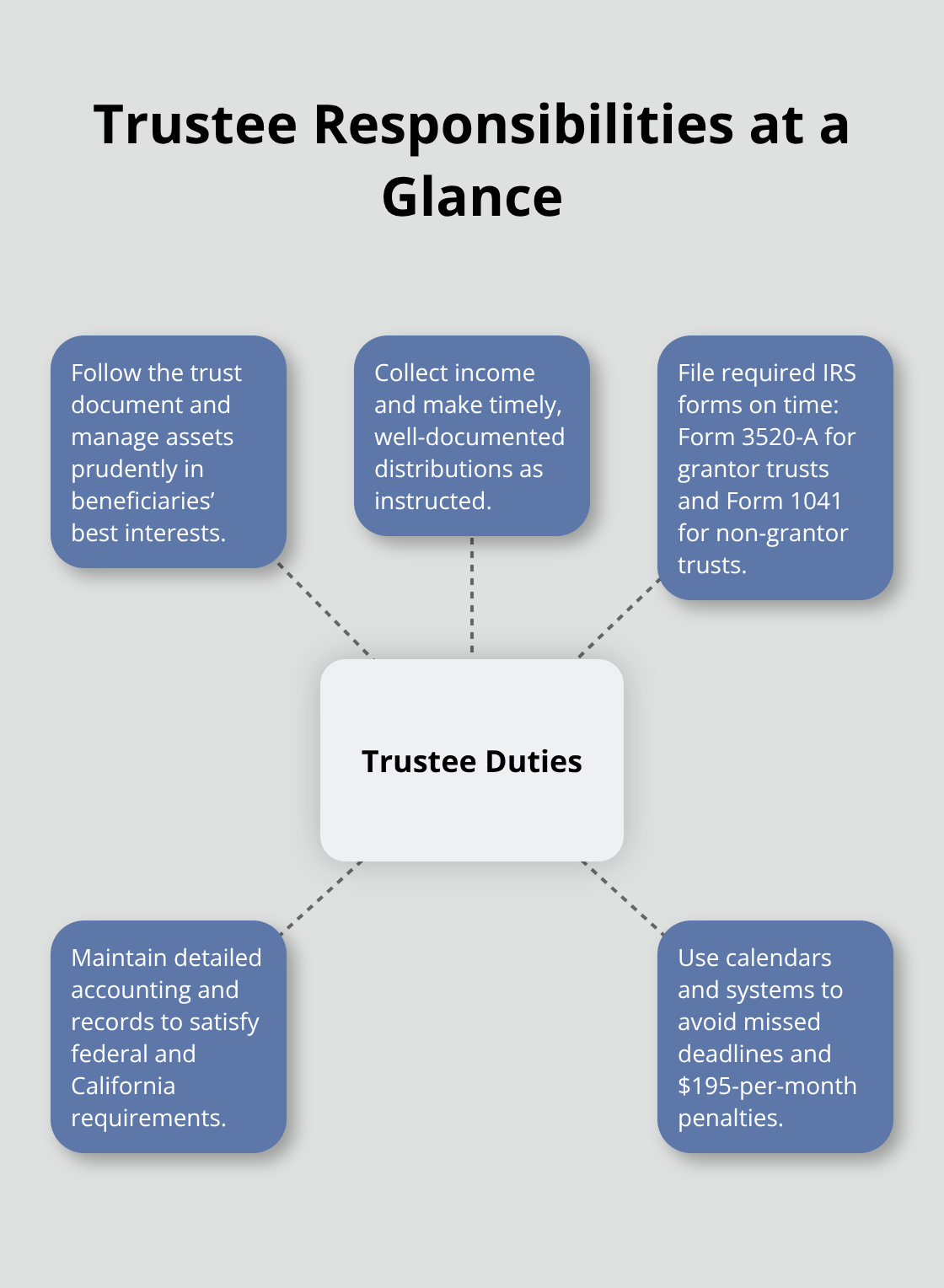
Once your irrevocable trust is established, the trustee-whether that’s you, a family member, or a professional-must manage assets according to the trust document’s specific instructions. This means making investment decisions, collecting income, and distributing funds to beneficiaries on schedule. The IRS requires trustees to file Form 3520-A annually if the trust is a grantor trust, and Form 1041 if it’s a non-grantor trust. Missing these deadlines carries penalties that start at $195 per month of non-filing, according to IRS guidelines.
Filing Tax Returns and Maintaining Compliance Records
Beyond federal filings, California requires trustees to maintain detailed accounting records and provide annual statements to beneficiaries showing all transactions, income, and distributions. A trustee managing a $2 million irrevocable trust with three beneficiaries and quarterly distributions needs systems in place to track each transaction, reconcile accounts monthly, and prepare documentation that withstands scrutiny. Many trustees underestimate how time-intensive this becomes-particularly with multiple beneficiaries or complex investment portfolios. The compliance burden is substantial, which is why professional trustees or experienced trust administration attorneys handle the day-to-day mechanics for many families.
Communicating with Beneficiaries
Beneficiary communication ranks among the most overlooked responsibilities, yet it creates the majority of disputes we see in trust administration. Beneficiaries have legal rights to information-they can request an accounting, ask why distributions were delayed, or challenge the trustee’s investment decisions. California Probate Code Section 16062 requires trustees to provide information to beneficiaries about the trust and its administration, and silence is not an acceptable response. Failing to respond to these requests within reasonable timeframes gives beneficiaries grounds to petition the court to remove you as trustee.
Preventing Disputes Through Transparency
Disputes escalate quickly when beneficiaries feel excluded or misinformed. A trustee who sends annual statements with clear explanations of distributions, investment performance, and upcoming decisions prevents most conflicts before they start. Proactive communication-explaining decisions before beneficiaries have to demand explanations-protects both the trust’s assets and the trustee from liability. When disputes do arise over trustee conduct, interpretation of trust terms, or distribution disagreements, the costs of litigation in California can exceed $50,000 to $150,000 depending on complexity. These expenses come directly from trust assets, reducing what beneficiaries ultimately receive.
The administrative weight of irrevocable trust management reveals why many trustees turn to legal professionals for guidance. Understanding your obligations is one thing; executing them flawlessly while managing beneficiary expectations is another. This is where the right attorney becomes invaluable in protecting your trust’s integrity and your own position as trustee.
Why You Need an Irrevocable Trust Administration Attorney
Irrevocable trusts demand expertise that goes far beyond basic bookkeeping. The IRS imposes strict filing deadlines, California probate law creates specific disclosure requirements, and a single administrative error can trigger penalties, litigation, or loss of the very tax benefits that made the irrevocable trust valuable in the first place. Many people assume they can handle trust administration themselves or rely on a general accountant, then discover too late that they’ve violated state law, missed tax filing deadlines, or created liability for themselves as trustee. An irrevocable trust administration attorney prevents these problems by managing the technical requirements while you focus on your life.
Tax Compliance That Protects Your Trust’s Value
The tax filing requirements for irrevocable trusts are non-negotiable and complex. If your trust is classified as a grantor trust, Form 3520-A must be filed annually with the IRS, and failure to file within the deadline triggers penalties of $195 per month according to IRS guidelines. Non-grantor trusts require Form 1041 filings, and California adds its own state income tax return requirements. Beyond federal and state filings, trustees must track basis calculations, capital gains distributions, and income allocations across multiple beneficiaries. A trustee managing a $3 million irrevocable trust with appreciated securities, rental income, and quarterly distributions to three beneficiaries faces tax reporting so intricate that errors compound across multiple years. An attorney who specializes in trust administration knows exactly which forms apply to your specific trust structure, catches issues before the IRS does, and ensures distributions are taxed correctly to minimize the beneficiaries’ tax burden rather than creating unexpected liability.
Defending Against Creditor Claims and Legal Challenges
Irrevocable trusts provide creditor protection only if they’re structured and administered correctly. If a trustee makes improper distributions, commingles trust assets with personal funds, or fails to maintain separate accounting, courts may find the trust’s creditor protection invalid. Poor administration can undermine the entire purpose of the trust. An attorney ensures the trustee maintains clear separation between trust assets and personal property, documents all decisions, and follows the trust document’s specific language exactly as written. This documentation also protects you as trustee if beneficiaries later claim you mishandled funds or made improper distributions. California Probate Code requires trustees to maintain detailed records and respond to beneficiary inquiries, and an attorney helps you fulfill these obligations in writing, creating a clear record that protects you from future disputes or removal petitions.
Avoiding Mistakes That Cost More Than Legal Fees
Trustee mistakes are expensive. Litigation over disputed distributions, trustee removal, or breach of fiduciary duty costs $50,000 to $150,000 or more in California depending on complexity, and these expenses drain trust assets that should go to beneficiaries. A missed tax deadline can trigger penalties and interest that accumulate annually. Improper distributions to beneficiaries may trigger Medicaid clawback issues if the trust was designed to preserve Medicaid eligibility, permanently disqualifying someone from benefits. An attorney catches these issues before they happen (reviewing the trust document’s language, understanding its tax classification and purpose, and creating systems for proper administration from the start). The cost of professional guidance is a fraction of what a single major error costs both financially and emotionally.
Final Thoughts
Irrevocable trust administration requires precision, consistency, and knowledge of both tax law and California probate requirements. The stakes are high because mistakes drain trust assets, trigger penalties, and create conflict among beneficiaries. A single missed filing deadline or improper distribution can undermine years of careful estate planning and cost far more than professional guidance would have.
An irrevocable trust administration attorney prevents costly errors by handling the technical requirements that most trustees find overwhelming, from annual tax filings to beneficiary accounting to creditor protection strategies. Whether you serve as trustee yourself or manage a professional trustee, having an experienced attorney in your corner protects both the trust’s value and your position as fiduciary. We at Law Offices of Roshni T. Desai specialize in trust administration across Southern California, and our personalized approach addresses the unique circumstances, beneficiary situations, and tax considerations that define your specific trust.
Contact us at Law Offices of Roshni T. Desai to discuss your situation without pressure or complicated logistics-we offer free consultations with flexible scheduling at your home or office. Ms. Desai’s dual background as both attorney and real estate professional means we streamline property-related trust matters, reducing delays and unnecessary costs when trust assets include real estate. The time to get professional guidance is now, not after problems develop.