




Probate Administration Costs in Santa Ana, California: Budgeting for Your Estate
Probate administration costs in Santa Ana can quickly spiral without proper planning. Most families underestimate expenses like court fees, attorney charges, and appraisals until bills start arriving.
We at Law Offices of Roshni T. Desai help families understand these costs upfront so there are no surprises. This guide breaks down what you’ll actually pay and how to reduce those expenses.
What You’ll Actually Pay in Santa Ana Probate
Court Fees and Filing Requirements
Court fees in Santa Ana probate cases are set by Orange County and must be paid upfront when you file. The Orange County Public Fee Schedule, effective January 1, 2024, lists specific filing costs that vary depending on the estate’s complexity and which forms you submit. Filing with insufficient funds gets voided unless you pay the full amount within 20 days, and you’ll face a $45 service charge for returned checks under California Code of Civil Procedure sections 411.20 and 411.21.
The Probate Fee Payment Portal lets you track payments and manage cash flow. Beyond initial filing fees, you’ll pay for document copies, court reporter services if hearings occur, and potential transcript fees. The Orange County Superior Court offers eFiling for probate, which simplifies the process, though the court cannot provide legal advice on which fees apply to your specific situation.
How Attorney Fees Actually Work in California Probate
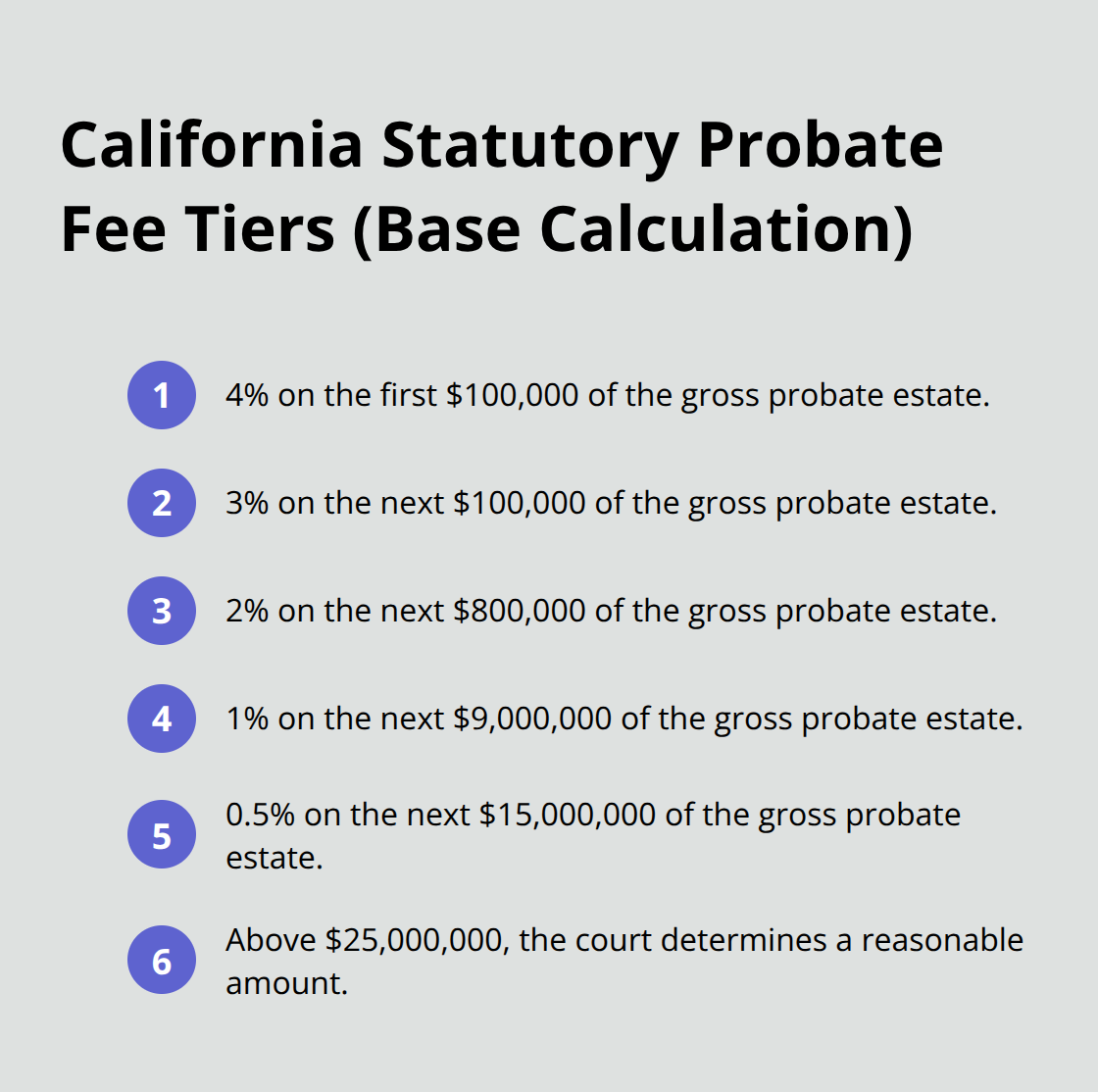
California Probate Code section 10810 sets statutory rates that apply to most Santa Ana estates. The calculation starts with your gross probate estate value-not reduced by mortgages or liens-and applies tiered percentages. You pay 4% on the first $100,000, 3% on the next $100,000, 2% on the next $800,000, 1% on the next $9 million, and 0.5% on the next $15 million. For estates exceeding $25 million, the court determines a reasonable amount.
Both the attorney and personal representative receive the same statutory fee unless the will specifies different compensation. If your estate involves extraordinary services (selling property, handling tax audits, defending against will contests, or locating hidden assets), the attorney can petition for additional compensation. These extraordinary fees require court approval after a noticed hearing and must be documented with time records showing hours spent and services performed. Contingency fee agreements for extraordinary work must be in writing and comply with California Business and Professions Code section 6147. A straightforward estate with minimal complications stays within the statutory framework, while contested wills or complex asset sales push costs significantly higher.
Appraisals, Notifications, and Hidden Administrative Costs
Beyond court and attorney fees, probate administration includes appraisal costs for real estate and personal property, notification expenses to creditors and beneficiaries, and potential publication fees if the decedent had unknown creditors. Appraisals typically run $500 to $2,500 depending on property complexity. You must notify known creditors and publish notices in newspapers, both of which incur costs.
If the estate holds a business, retirement accounts, or out-of-state property, administrative expenses climb further. Many families overlook these secondary costs and find their final bill significantly higher than the base attorney and court fees combined. The total probate cost typically ranges from 3% to 7% of the estate’s total value, though complex estates with litigation can exceed this range substantially.
Understanding these cost categories helps you prepare for what’s ahead. The next section shows you how to estimate your total expenses based on your specific estate size and situation.
How Much Will Your Santa Ana Probate Actually Cost
Calculate Your Base Attorney and Personal Representative Fees
Start with your gross estate value and apply California Probate Code section 10810’s tiered rates to calculate base attorney and personal representative fees. A $500,000 estate pays 4% on the first $100,000 ($4,000) plus 3% on the next $100,000 ($3,000) plus 2% on the remaining $300,000 ($6,000), totaling $13,000 in statutory fees before court costs or additional services. A $1 million estate reaches $23,000 in base fees. These numbers assume straightforward administration with no complications.
Account for Court Costs and Secondary Expenses
Add 3% to 7% to your estate’s total value to account for all probate costs combined. Court filing fees typically run $200 to $500, appraisals cost $500 to $2,500, and notification expenses add another $300 to $800.
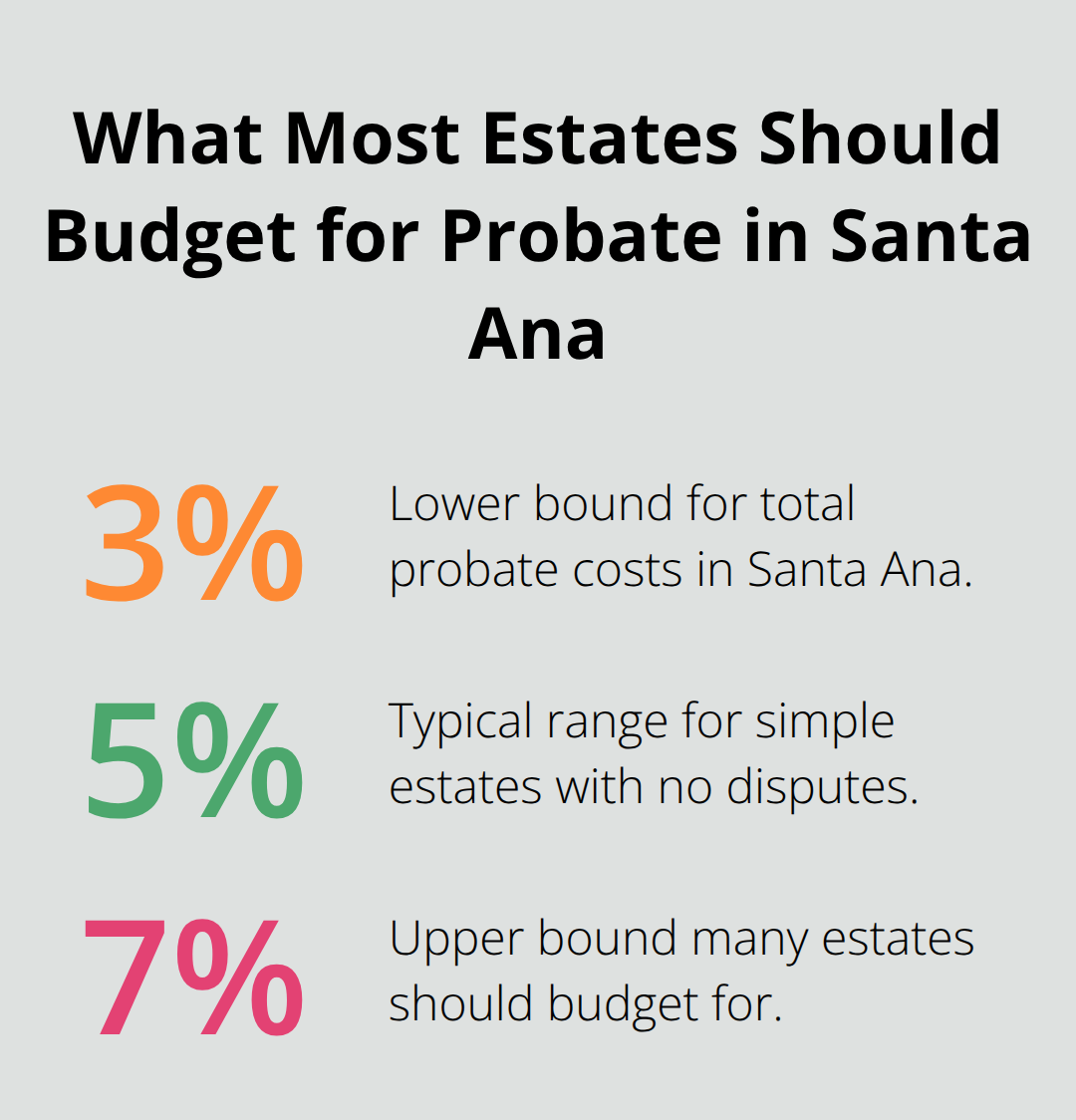
For a $500,000 estate, expect $15,000 to $35,000 total; for $1 million, plan for $30,000 to $70,000. Orange County’s fee schedule sets specific filing costs, and the Probate Fee Payment Portal helps you track what you’ve paid and what remains due.
Understand How Estate Complexity Drives Costs Higher
Estate complexity determines whether you stay near the lower end or climb toward 7%. Real estate sales trigger extraordinary attorney fees under California Rules of Court 7.703, with attorneys compensated for property sales, securing loans, or handling tax audits-each requiring separate court approval and documented time records. Tax return preparation and defending against will contests add significant costs beyond the statutory framework. If your estate includes out-of-state property, business interests, or contested beneficiary designations, extraordinary compensation petitions can double or triple your attorney bill. Conversely, straightforward estates with liquid assets and no disputes stay close to the statutory minimums.
Recognize Litigation as Your Biggest Cost Driver
The single biggest factor affecting your final bill is whether litigation erupts. Will contests, creditor disputes, or removal proceedings transform a $25,000 probate into a $75,000+ matter. Plan conservatively by budgeting toward the 6% to 7% range if your estate involves property sales, multiple properties, or family tension. If your situation is simple-modest assets, no disputes, clear beneficiaries-the 3% to 5% range is realistic.
Get Accurate Projections for Your Specific Situation
Your next step is to identify which cost factors apply to your estate so you can plan with confidence. We at Law Offices of Roshni T. Desai offer free consultations to review your specific estate and provide accurate cost projections. Ms. Desai’s dual licensure as an attorney and real estate professional streamlines property transactions to reduce unnecessary delays and fees-a significant advantage if your estate involves real property sales or transfers.
Ways to Reduce Probate Costs Before and During Administration
Use a Revocable Living Trust to Avoid Probate Entirely
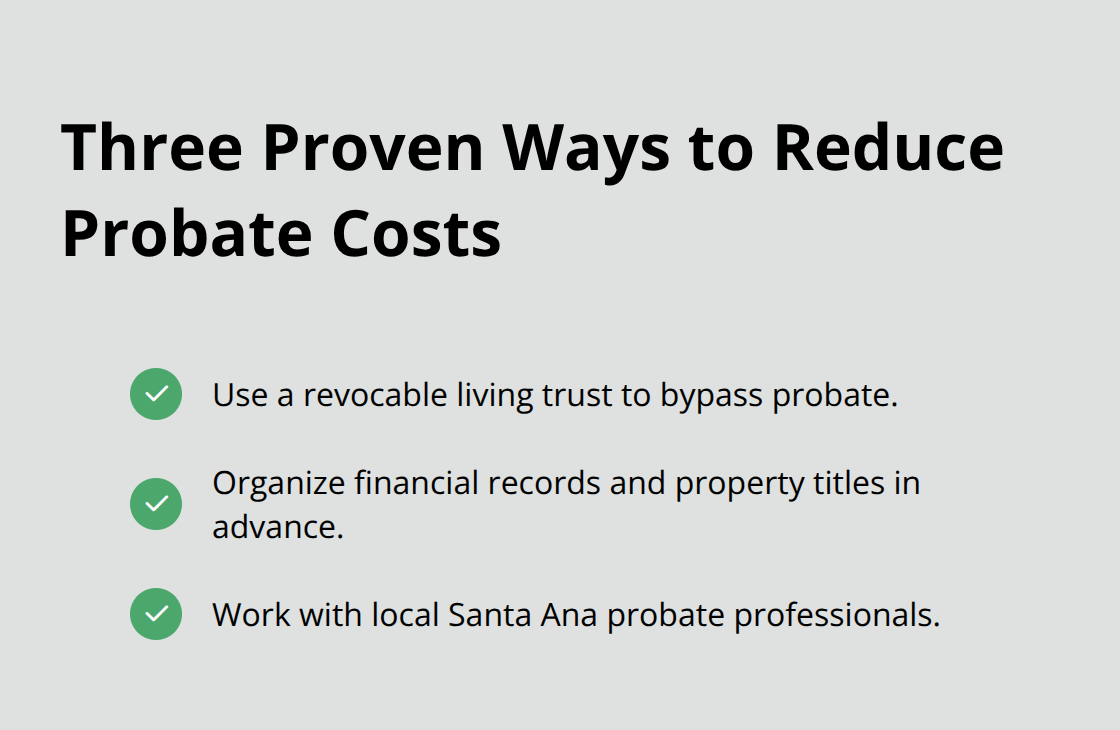
The most effective way to reduce probate costs is to avoid probate altogether, and a revocable living trust accomplishes this directly. Assets held in a trust transfer to beneficiaries outside probate court, bypassing statutory attorney fees, court filings, and the 3% to 7% cost range entirely. California allows you to fund a revocable trust during your lifetime and retitle property-real estate, investment accounts, bank accounts-into the trust’s name. When you pass away, the trustee distributes assets according to your instructions without filing a single probate petition.
This approach works especially well if you own real property in Santa Ana or hold accounts across multiple institutions, as each asset that avoids probate saves you filing fees and reduces the estate value subject to statutory compensation calculations. The trade-off is modest: you pay $1,500 to $3,500 upfront to establish and fund the trust properly, but you save $15,000 to $50,000 or more depending on your estate size. For estates exceeding $500,000, the trust investment pays for itself within months of your death.
Organize Your Financial Records and Property Titles in Advance
Organizing your financial records and property titles before administration begins eliminates delays that inflate attorney hours and court costs. Create a comprehensive list identifying which assets hold beneficiary designations (retirement accounts, life insurance), which are jointly owned with rights of survivorship, and which require probate. Gather deeds, account statements, insurance policies, and business documents in one location so your executor or trustee doesn’t spend weeks hunting for information.
This preparation reduces the time your attorney spends on administrative tasks and keeps fees closer to statutory minimums. When you identify which assets avoid probate upfront, you shrink the estate value subject to statutory compensation calculations, directly lowering your final bill. A well-organized estate also prevents missed deadlines and filing errors that trigger additional court appearances and costs.
Work with Local Probate Professionals Who Know Santa Ana Courts
Attorneys familiar with Santa Ana courts know which judges prefer certain filing formats, which hearings can be handled ex parte to reduce court appearances, and how to navigate the Probate Fee Payment Portal efficiently. These operational efficiencies compress timelines, reduce unnecessary hearings, and keep attorney fees closer to statutory minimums rather than climbing toward extraordinary compensation territory. A local professional also recognizes when simplified procedures apply to smaller estates, potentially cutting your entire probate cost to under $5,000 instead of the standard 3% to 7% range.
A dual role as attorney and real estate professional means probate counsel can identify which assets avoid probate and which strategies fit your specific property holdings, streamlining both planning and administration. This combination of legal and real estate credentials streamlines property transactions to reduce unnecessary delays and fees-a significant advantage if your estate involves real property sales or transfers.
Final Thoughts
Santa Ana probate administration costs range from 3% to 7% of your estate’s total value, but your actual expenses depend entirely on whether you plan ahead and organize your assets strategically. Probate costs spike when estates lack clear titles, when litigation erupts between heirs, or when assets could have avoided probate through a revocable living trust. Conversely, costs drop significantly when you establish a trust, maintain current beneficiary designations, and identify which assets transfer outside probate court.
Assess your situation honestly right now. Do you own real property in Santa Ana, or does family tension suggest potential disputes over your will? These questions determine whether you face a straightforward $15,000 probate or a complex $75,000+ administration. The time to address these issues is now, not after your death when your family confronts mounting bills and court deadlines.
We at Law Offices of Roshni T. Desai offer free consultations to review your specific estate and provide accurate cost projections tailored to your circumstances. Ms. Desai’s dual licensure as an attorney and real estate professional means she identifies which assets avoid probate, streamlines property transactions, and reduces unnecessary delays that inflate fees. Contact us today to discuss your estate and discover how strategic planning now can save your family thousands in probate administration costs later.