




Probate Administration Filing in Santa Ana, California: A Step-by-Step Overview
Probate administration filing in California involves specific legal steps that many people find overwhelming. The process requires careful attention to deadlines, court requirements, and proper documentation.
We at Law Offices of Roshni T. Desai help families navigate this complex journey from start to finish. This guide breaks down each stage so you understand what to expect.
When Probate Administration Becomes Necessary
Understanding When Probate Applies in Santa Ana
Probate administration in Santa Ana becomes necessary when someone passes away with assets held in their individual name and no designated beneficiary. California Probate Code Division 7 governs the formal probate process, which applies to estates exceeding certain thresholds. If the deceased left a will, the probate court must validate it and appoint an executor to manage the estate. Without a will, California intestacy laws determine who inherits, and the court appoints an administrator to distribute assets according to a strict statutory order: surviving spouse first, then children, grandchildren, and other relatives.
Required Documents and Court Locations
The Orange County Superior Court’s Probate Division handles Santa Ana cases at the Costa Mesa Justice Complex and Central Justice Center. Petitioners must file specific documents including the Petition for Probate (Judicial Council Form DE-111), Notice of Petition to Administer Estate (DE-121), and supporting attachments. The court requires complete, properly prepared filings-court staff cannot provide legal advice on form preparation, so many families turn to professional guidance to avoid costly errors.
Alternatives to Full Probate
Not all estates require full probate administration. California law allows smaller estates to avoid formal probate through simplified procedures if the estate’s gross value falls below $166,250 as of 2024.
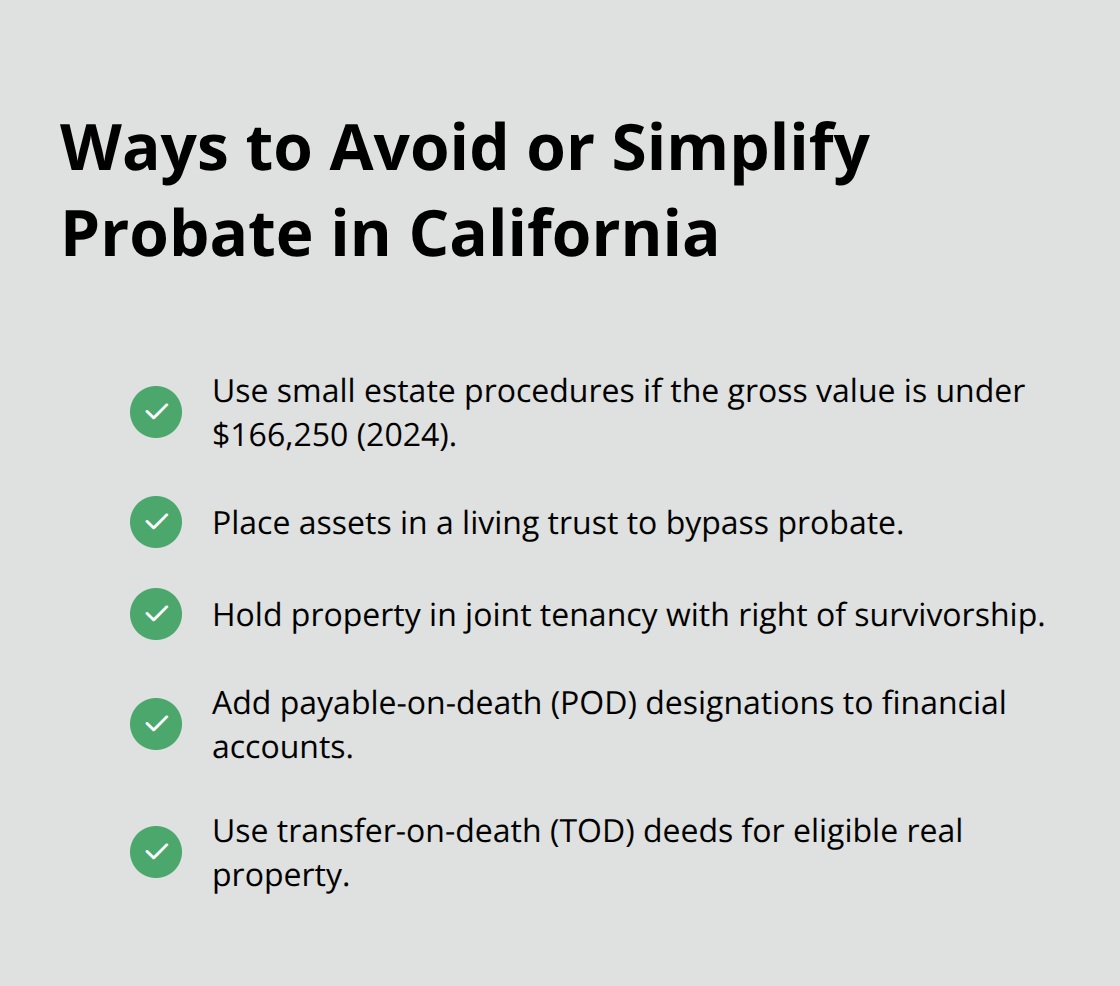
Assets transferred through living trusts, joint tenancy, payable-on-death accounts, or transfer-on-death deeds avoid probate entirely. Many families work with professionals to structure their estates strategically during life, which can save significant time and expense later.
Key Deadlines and Timeline
The timeline for Santa Ana probate administration typically spans four to six weeks from initial filing to the issuance of Letters (the court order proving the executor’s or administrator’s authority). Orange County probate examiners review each petition within three to four weeks before the hearing, preparing probate notes that detail any missing documents or required corrections. Heirs and creditors must receive notice at least 15 days before the hearing, and the Notice of Petition must appear three times in a local newspaper with the first publication occurring at least 15 days before the court date.
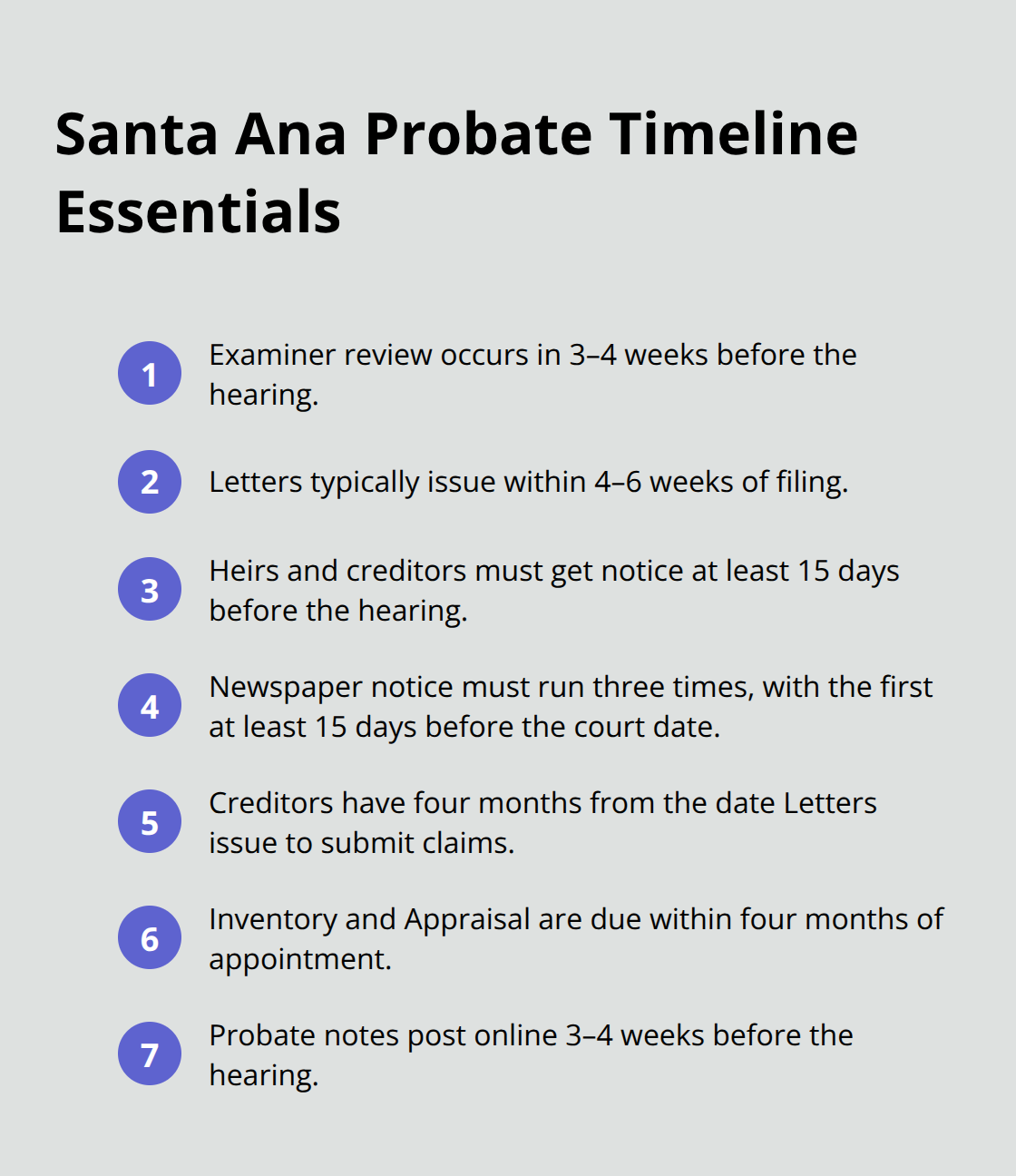
Filing deadlines are firm: creditors have four months from the date Letters issue to present claims against the estate, and the personal representative must file an Inventory and Appraisal within four months of appointment. Failure to meet these deadlines can result in claims being barred or creditors losing their right to payment, which shifts financial responsibility to beneficiaries. The probate filing fee in Orange County varies based on the estate’s gross value, so checking the Orange County Public Fee Schedule is essential before submitting documents. Probate notes appear online through Orange County’s Online Services three to four weeks before the hearing, allowing you to address any issues the court identifies and avoid delays at the hearing.
Understanding these requirements and timelines sets the foundation for the actual filing process. The next section walks through each step of filing the petition and preparing the required documents that the court demands.
The Five Core Stages of Probate Administration
Filing the Petition for Probate
The probate process unfolds in five distinct phases, each with specific deadlines and requirements that Santa Ana families must follow precisely. Filing the Petition for Probate with the Orange County Superior Court marks the first critical step, and accuracy matters because incomplete petitions trigger probate notes from court examiners that delay everything by weeks. The Petition for Probate (Form DE-111) must include Attachment 8 with all required supporting documents-missing even one element forces you to refile and restart the three to four week examination period. Court staff cannot provide legal advice on proper form completion per California Government Code, so many families benefit from professional guidance to avoid rejected filings and frustrated delays.
Notifying Heirs and Creditors
Once the court approves your petition after the examiner’s review, you must notify every heir listed in the will and all intestate heirs through formal Notice of Petition to Administer Estate (Form DE-121) sent at least 15 days before your court hearing. This notice must also appear three times in an adjudicated Orange County newspaper, with the first publication occurring no fewer than 15 days before the hearing date. You then file Proof of Service by Mail and an Affidavit of Publication with the court to demonstrate compliance. These notification steps protect beneficiaries and creditors while establishing the court’s jurisdiction over the estate administration.
Inventorying Assets and Obtaining Appraisals
Meanwhile, you begin the critical task of inventorying all estate assets and obtaining appraisals from court-approved probate referees-a process that must be completed within four months of your appointment as executor or administrator. Real property, vehicles, securities, business interests, and personal property all require documented valuation, with the Probate Referee’s Report of Status of Appraisal (Probate Code 8940) serving as the official court record of these values. This inventory phase establishes the estate’s total value and forms the basis for calculating taxes, fees, and distributions to beneficiaries.
Paying Debts and Taxes
Simultaneously, you must identify and pay all legitimate debts and taxes owed by the estate, including final income taxes, property taxes, and creditor claims filed within the four month claims period. The personal representative bears responsibility for verifying each claim’s validity and ensuring proper payment from estate funds. This phase protects beneficiaries from personal liability while satisfying the estate’s legal obligations.
Distributing Assets to Beneficiaries
Only after debts are satisfied and taxes are paid can you distribute remaining assets to beneficiaries according to the will or California intestacy law. You may use either an expedited hearing for final distribution or a standard petition, depending on the estate’s complexity and whether all parties agree. The distribution phase concludes the formal probate process and transfers ownership to those entitled to receive it. Understanding each phase helps you prepare for the specific challenges that arise during Santa Ana probate administration.
Common Challenges in Santa Ana Probate Cases
Family Disputes Over Asset Distribution
Santa Ana probate cases frequently encounter three major obstacles that derail timelines and drain estate resources. Family disputes over asset distribution arise in roughly 25 to 30 percent of probate cases, according to data from the American Academy of Estate Planners and Councils.
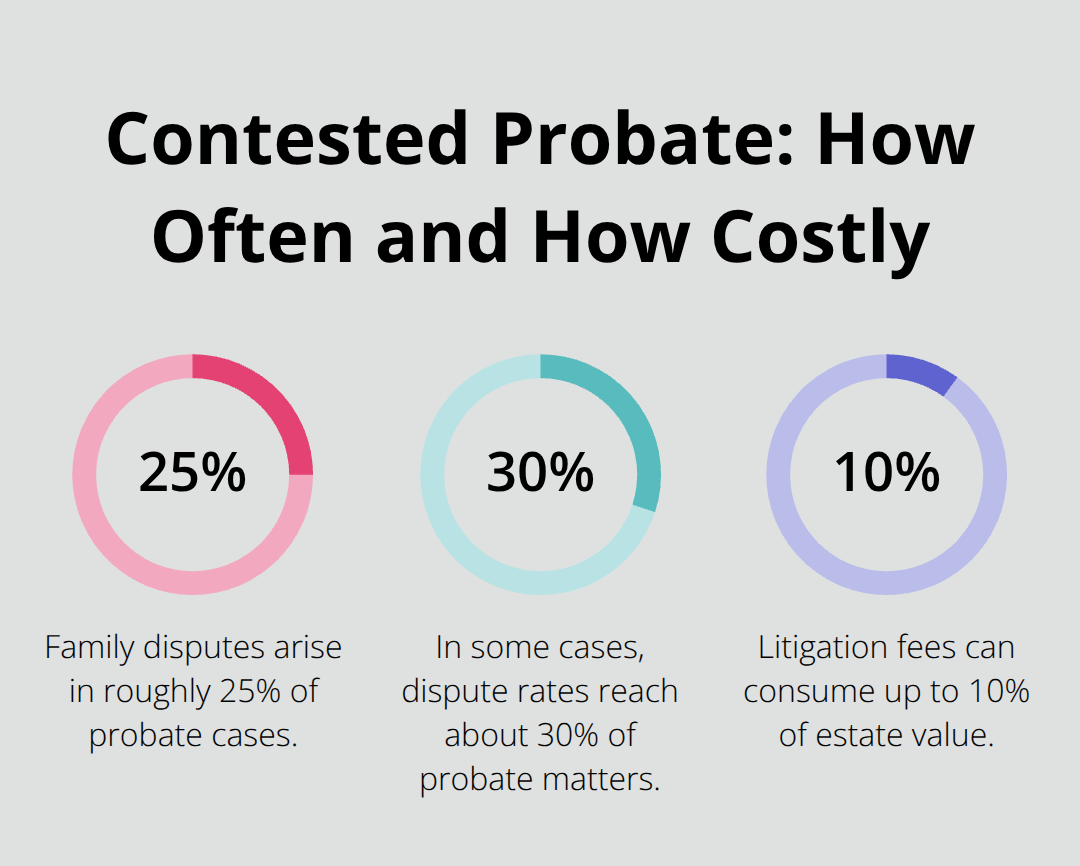
These conflicts intensify when the will is ambiguous, when a family member feels excluded unfairly, or when beneficiaries question the executor’s decisions. California Probate Code gives beneficiaries standing to challenge distributions, petition the court for removal of an executor, or object to accounting reports. Once litigation begins, legal fees accumulate quickly-sometimes consuming 5 to 10 percent of estate value or more-and court hearings stretch the probate timeline from months into years. The Orange County Superior Court’s probate examiners prepare notes identifying missing documents or procedural errors within three to four weeks, but contested matters bypass this streamlined path entirely and land in full litigation.
Complex Estate Assets Require Specialized Appraisals
Complex estates containing real property, business interests, or significant investment portfolios require specialized appraisals from court-approved probate referees under Probate Code Section 8940. A single commercial property or family business can take months to appraise accurately, especially if the business operates in multiple states or the property involves environmental concerns. Out-of-state real estate adds layers of complexity because each state has different transfer requirements and potential tax implications. Probate referees charge between $1,500 and $5,000 or more for comprehensive appraisals (depending on asset type and complexity), and delays in obtaining these valuations directly delay the four-month creditor claims deadline and subsequent distributions. Executors who attempt to estimate values without professional appraisals face court objections and potential personal liability if valuations prove inaccurate later.
Court Documentation Demands Strict Compliance
The Orange County Superior Court requires precise compliance with Judicial Council forms and local rules or it will issue probate notes requiring corrections that restart the examination timeline. Form DE-111 (Petition for Probate) must include Attachment 8 with all supporting documents completely filled out-missing even a single signature or date triggers rejection. Proof of Service by Mail, Affidavit of Publication, and Inventory and Appraisal forms each contain technical language and specific formatting requirements that confuse self-represented filers. Court staff cannot provide legal guidance per California Government Code Section 68082, meaning you cannot call the Probate Clerk’s Office for help completing forms correctly. The Costa Mesa Justice Complex and Central Justice Center process hundreds of petitions monthly, and court examiners strictly enforce compliance standards (which means families who attempt probate without professional assistance frequently encounter rejected filings, missed deadlines, and extended probate timelines that could have been avoided with proper preparation from the start).
Final Thoughts
Santa Ana probate administration filing demands strict adherence to deadlines, precise documentation, and multiple procedural steps that move quickly once you understand the five core stages. Court examiners review petitions within three to four weeks and issue probate notes identifying missing documents or corrections needed before your hearing, so accuracy matters from day one. Missing even a single element on Form DE-111 or its required Attachment 8 forces you to refile and restart the entire examination period, which compounds delays and frustration.
The obstacles you’ll face-family disputes, complex asset appraisals, and strict compliance requirements-derail many self-represented filers who attempt probate administration filing without professional guidance. Court staff cannot provide legal advice on form preparation, probate referees charge $1,500 to $5,000 or more for specialized appraisals, and creditors have four months to file claims against the estate. These complications accumulate quickly without proper planning and support.
We at Law Offices of Roshni T. Desai help families navigate probate administration from start to finish with personalized service and practical solutions. Contact us at Law Offices of Roshni T. Desai to schedule your free consultation and take the first step toward protecting your family’s future.