




SoCal Trust Planning Attorney: Expert Guidance for Your Estate
Southern California’s real estate market has created complex estate situations that demand careful planning. Property values keep climbing, and without a solid trust strategy, your family could face years of probate delays and public court proceedings.
We at Law Offices of Roshni T. Desai work with families throughout SoCal to build trust plans that protect assets, maintain privacy, and avoid costly mistakes. This guide walks you through the trust strategies that actually work for Southern California families.
Why Trust Planning Matters in Southern California
Southern California’s Real Estate Creates Estate Complexity
Southern California’s median home price reached $850,000 in 2024, according to the California Association of Realtors. This explosive appreciation means most SoCal families now hold estates large enough to trigger serious tax and probate complications. When you die without a trust, your family’s property goes through probate court-a public process that typically takes 12 to 18 months and costs 3 to 7 percent of your estate’s total value. For a $1 million estate, that amounts to $30,000 to $70,000 in legal fees and court costs alone. A living trust bypasses probate entirely, transfers your assets privately within weeks, and costs far less to administer.
Rising Property Values Trigger Tax Exposure
Rising real estate values create tax exposure that catches families off guard. If you own multiple properties, rental income, or significant investments alongside your home, the IRS may claim a substantial portion of your estate when you pass. California has no state estate tax, but federal estate tax applies to estates exceeding $13.61 million in 2024, according to the IRS. That threshold sounds high until you calculate it: a primary residence worth $900,000, a rental property worth $500,000, investment accounts totaling $300,000, and life insurance proceeds of $200,000 quickly push you to $1.9 million. An irrevocable trust or other tax-efficient structure can shelter assets from federal taxation and preserve wealth for your children rather than handing it to the government.
Probate Exposes Your Family’s Financial Details
Probate court documents become public record. This means your children’s names, the amounts they inherited, the identities of your creditors, and details about any disputes all appear in searchable court files. This transparency creates safety risks, invites unwanted solicitation, and strips your family of financial privacy at their most vulnerable moment. A trust keeps everything confidential.
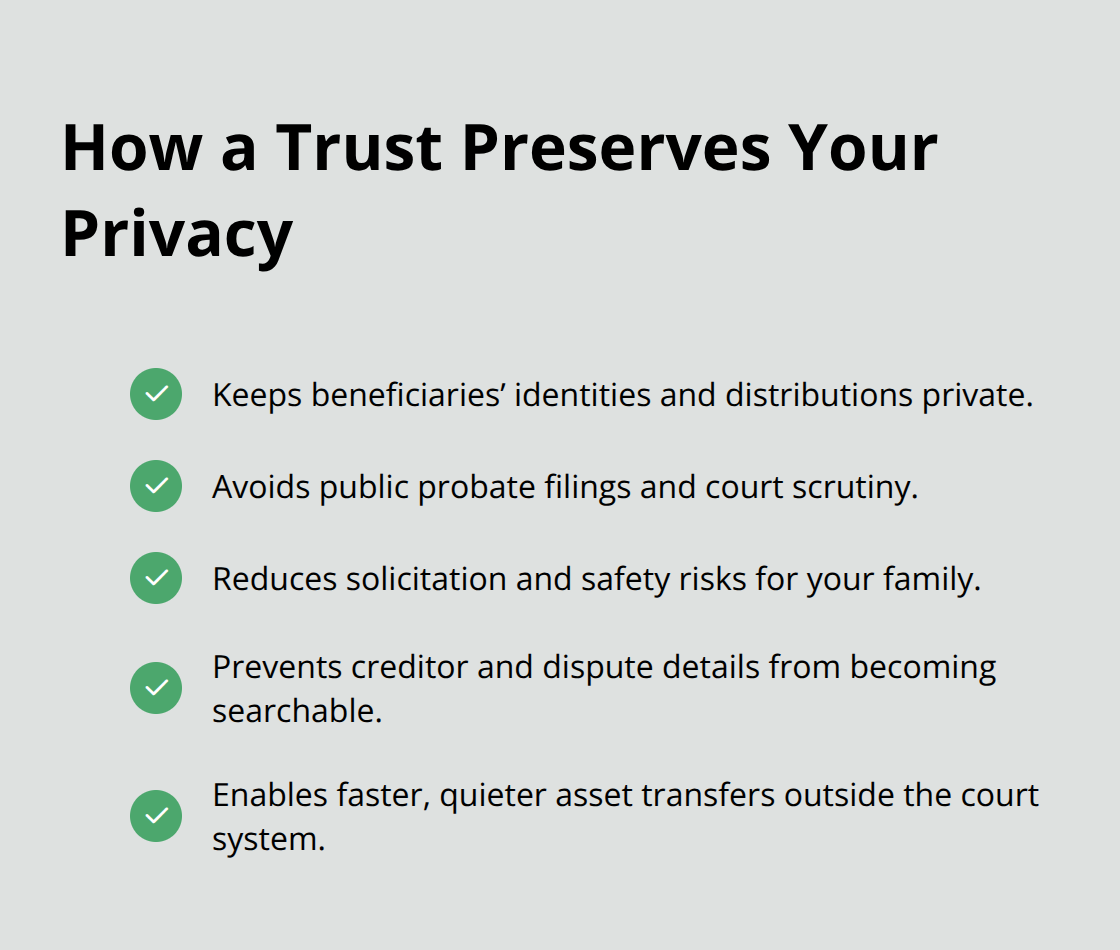
Transfers happen outside the court system with no public disclosure.
Understanding these risks sets the stage for selecting the right trust structure. Different trust types serve different purposes, and the right choice depends on your specific assets, family situation, and goals.
Types of Trusts and How They Protect Your Assets
Living Trusts Give You Control Now and Smooth Transfers Later
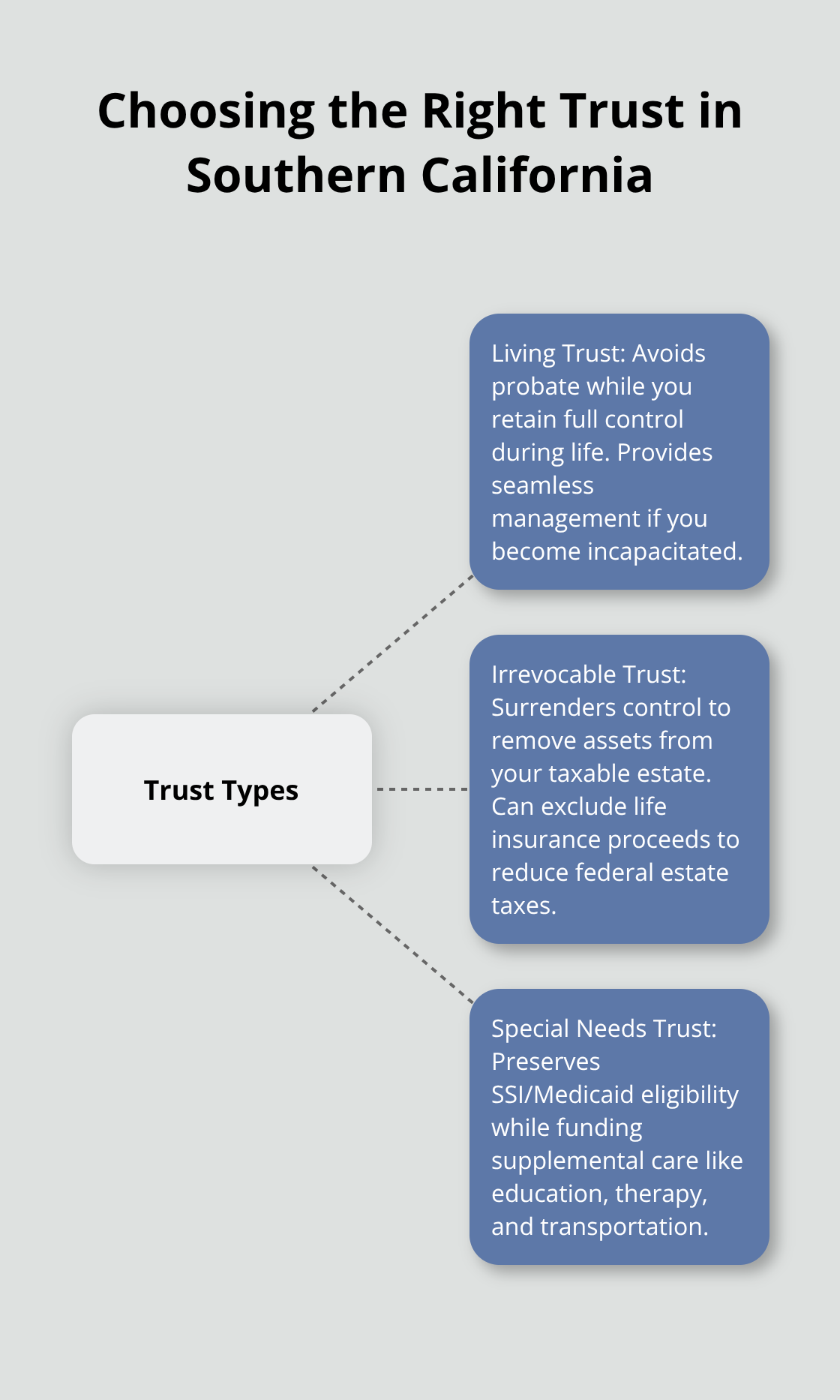
Living trusts dominate Southern California estate planning because they give you control while you’re alive and seamless transfers after you’re gone. You retain complete access to all assets, can modify or revoke the trust anytime, and avoid probate entirely when properly funded. The catch: a living trust requires you to transfer ownership of your property, bank accounts, and investments into the trust’s name. Many families hesitate at this step, worried about complexity, but the process is straightforward.
You work with an attorney to prepare a deed transferring your real estate into the trust, then notify your financial institutions to retitle accounts. Once funded, your living trust operates silently in the background. If you become incapacitated, your successor trustee steps in immediately without court intervention-a massive advantage over powers of attorney, which many institutions refuse to accept. The cost to establish a living trust typically ranges from $1,200 to $2,500 depending on asset complexity, according to pricing data from legal service providers across California. That upfront investment pays dividends when your family avoids $30,000 to $70,000 in probate costs.
Irrevocable Trusts Reduce Taxes by Surrendering Control
Irrevocable trusts serve a completely different purpose: they function as tax reduction machines that you cannot change once established. The tradeoff is harsh-you permanently surrender control and access to the assets inside. But that loss of control is precisely what makes them powerful for tax planning. When you place assets into an irrevocable trust, they’re no longer counted in your taxable estate, immediately reducing your exposure to federal estate taxes.
For Southern California families with significant real estate holdings or investment portfolios, an irrevocable life insurance trust removes life insurance proceeds from your taxable estate, potentially saving hundreds of thousands in taxes. This strategy works because the trust (not your personal estate) owns the policy, so death benefits fall outside the taxable calculation entirely.
Special Needs Trusts Protect Vulnerable Family Members
Families with vulnerable members benefit from special needs trusts, a specific type of irrevocable trust designed to hold assets for someone receiving government benefits like SSI or Medicaid. The trust pays for supplemental expenses-education, therapy, transportation, recreation-without disqualifying the beneficiary from means-tested assistance. Without this structure, a direct inheritance would immediately terminate their benefits, forcing them to spend down inherited funds before requalifying.
The decision between these trust types hinges on your specific situation: living trusts for flexibility and probate avoidance, irrevocable trusts for serious tax reduction, and special needs trusts for protecting beneficiaries who depend on government support. Each structure addresses different goals, and selecting the wrong one creates unnecessary complications and costs down the road. Understanding which trust fits your assets and family circumstances requires careful analysis of your property holdings, tax exposure, and beneficiary needs-the foundation for the next critical step in your planning process.
Common Trust Planning Mistakes to Avoid
Failing to Fund Your Trust Properly
A beautifully drafted trust document means nothing if you don’t transfer your assets into it. Your property, bank accounts, and investment portfolios must be retitled into the trust’s name for it to work. Many people complete the trust paperwork, pay the attorney fees, then never follow through with the transfers. When they pass away, those unfunded assets go through probate anyway, defeating the entire purpose.
After your attorney creates the trust, work with them to create a planning checklist. Identify every asset-your home, vacation property, rental income, investment accounts, vehicles-and systematically transfer each one. For real estate, this means recording a new deed. For bank and investment accounts, this means calling your financial institution and requesting a retitling form. This process typically takes four to eight weeks but eliminates probate exposure and protects your family’s privacy.

Ignoring Your Trust After Major Life Changes
Your trust becomes outdated when major life events occur. Southern California families experience divorces, remarriages, births, deaths, and significant financial changes. Each of these events can render your trust ineffective. If you get divorced but don’t remove your ex-spouse as trustee or beneficiary, they retain power over your estate distribution. If you have a new child after creating your trust, that child may receive nothing unless you amend the document.
Substantial asset growth-through real estate appreciation or inheritance-can also make your tax planning strategy obsolete. Review your trust every three to five years or immediately after any major life event. This doesn’t require a complete overhaul; amendments and restatements are often simple and cost far less than addressing disputes later. Taking action promptly protects your intentions and your family’s financial security.
Selecting the Wrong Trustee or Successor
Your trustee manages all trust assets, pays bills, files tax returns, and distributes funds to beneficiaries-a role requiring both competence and integrity. Naming a family member out of obligation rather than ability creates serious problems. If your successor trustee lacks financial literacy, becomes incapacitated, or lives far from your assets, administration becomes complicated and expensive.
Many families appoint co-trustees or professional trustees to avoid these issues. A corporate trustee or professional fiduciary charges fees (typically one to two percent of trust assets annually) but brings institutional knowledge and removes family conflict from financial decisions. This approach works particularly well for larger estates or complex asset structures where professional management prevents costly mistakes and ensures smooth administration.
Final Thoughts
Trust planning in Southern California requires matching the right structure to your specific assets, family situation, and goals. A living trust handles probate avoidance and privacy for most families, while an irrevocable trust reduces federal estate taxes when your assets exceed $13.61 million or when you own significant life insurance. A special needs trust protects vulnerable beneficiaries who depend on government assistance, and proper funding plus regular updates determine whether your plan actually works when your family needs it most.
The mistakes we see most often stem from incomplete planning or outdated documents. Families create trusts but fail to fund them, or they ignore major life changes that render their plans obsolete (divorces, remarriages, births, or significant financial shifts). These oversights turn what should be a smooth transition into probate court battles and family conflict, which taking action now prevents entirely.
Schedule a consultation with a SoCal trust planning attorney who understands your local real estate market and tax environment. We at Law Offices of Roshni T. Desai offer flexible home or office visits to make planning convenient, and Ms. Desai’s dual background as both an attorney and real estate professional means we streamline property-related transactions within your estate plan. Visit Law Offices of Roshni T. Desai to arrange your consultation and begin protecting your family’s financial future.