




Trust Administration Attorney Practice in Santa Ana, California: What Clients Expect
Trust administration requires careful attention to assets, taxes, and beneficiary communication. At Law Offices of Roshni T. Desai, we guide clients through each step of this complex process.
Many people don’t know what to expect when working with a trust administration attorney. This guide covers the real responsibilities involved, what clients should demand from their legal team, and how attorneys solve common problems that arise during settlement.
What Happens During Trust Administration
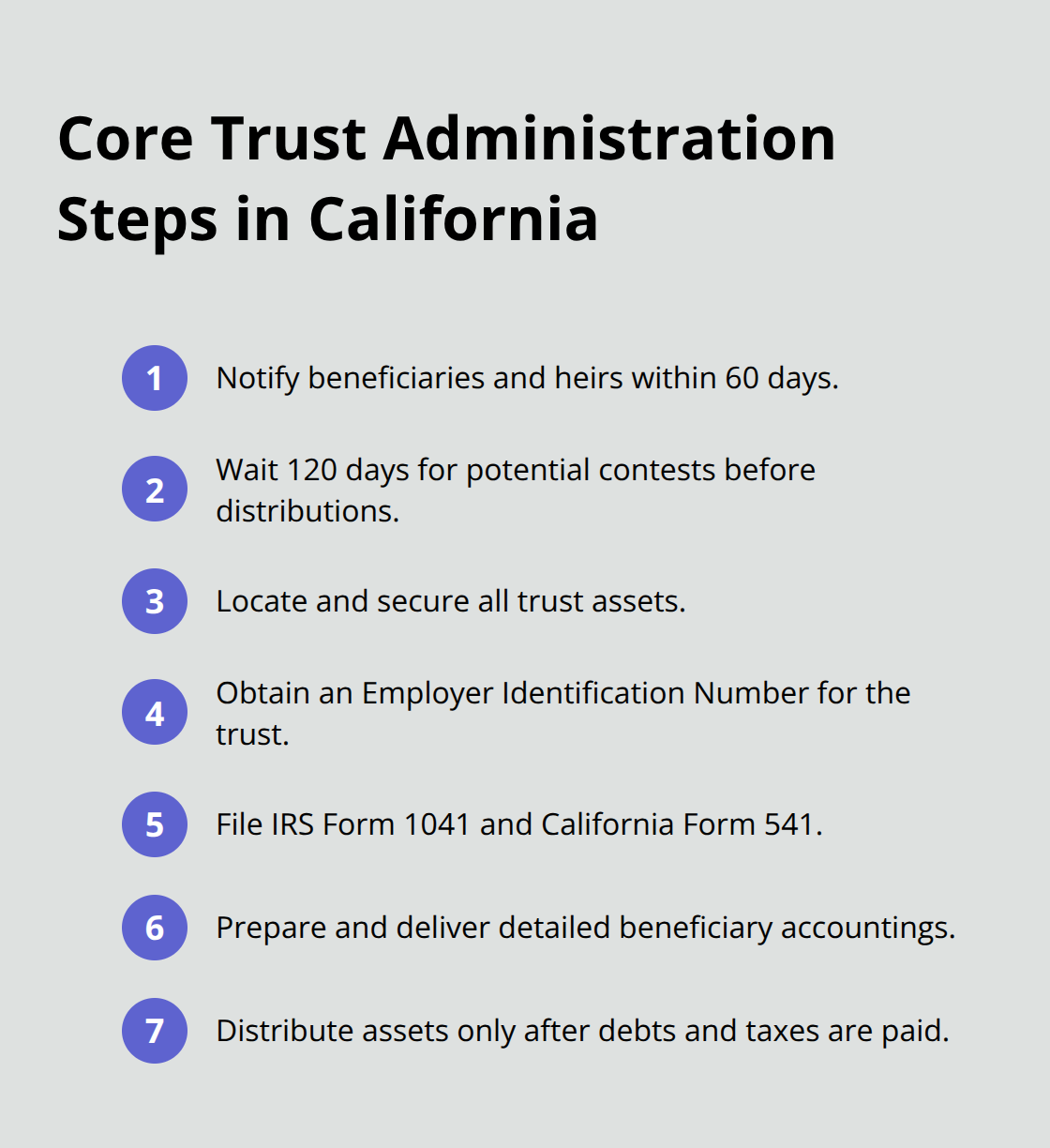
Trust administration in California takes time because the law requires specific steps in a defined sequence. California Probate Code sections require trustees to notify beneficiaries and heirs within 60 days of the trust creator’s death, then wait 120 days for any contests before distributing assets. This timeline alone stretches the process, but managing trust assets, paying taxes, and handling beneficiary questions adds months to the overall settlement. Most trusts in California take 9 to 18 months to fully administer, even straightforward ones, because trustees must locate assets, obtain an Employer Identification Number for the trust, file federal and state tax returns using IRS Form 1041 and California Form 541, and prepare detailed accountings before releasing funds to beneficiaries. The successor trustee becomes personally liable for mistakes during this period, so understanding what administration actually involves protects both the trustee and beneficiaries from costly errors.
Securing and Managing Assets First
The first concrete task after the trust creator’s death is ordering at least 10 certified copies of the death certificate and locating the original trust document. The successor trustee must then gather every asset the trust holds, from real estate and bank accounts to business interests and personal property. Assets titled in the trust’s name transfer smoothly, but assets titled in the deceased person’s individual name or held outside the trust may require probate or other court involvement to transfer into the trust. Once secured, trust assets require protection and management until distribution. If the trust holds real estate, the trustee files a Change in Ownership Statement with the county assessor within 150 days to address property tax records and potential reassessment issues. For business interests or investment accounts, the trustee may need to maintain operations, manage investments, or coordinate with accountants to prevent deterioration in value while administration proceeds.
Handling Taxes and Debts Methodically
Trustees must pay debts and taxes from trust assets before distributing anything to beneficiaries, and the order matters under California law. Funeral costs and administration expenses come first, then other debts and taxes. The trust files its own federal income tax return on IRS Form 1041 each year it remains open, and California requires Form 541 filings as well. Federal estate taxes may apply if the trust is large enough (though California has no separate state-level estate tax). A trustee who distributes assets before paying taxes and debts faces personal liability for those unpaid amounts. The trustee must also provide beneficiaries with a detailed final accounting showing all assets, income received, expenses paid, and proposed distributions before asking beneficiaries to sign off and release the trustee from further liability. This accounting is not optional; California Probate Code sections require it, and beneficiaries have the right to review and challenge it.
Communicating with Beneficiaries Throughout
Beneficiaries expect regular updates on trust settlement progress and clear explanations of what happens next. The trustee must notify beneficiaries within the required timeframes and answer questions about asset location, tax filings, and distribution timelines. Transparency about fees and costs prevents misunderstandings later. When beneficiaries understand the steps involved and the reasons for delays, disputes become less likely. A trustee who communicates poorly or withholds information invites legal challenges and family conflict. Providing copies of accountings, tax returns, and asset valuations (when appropriate) demonstrates that the trustee is acting in good faith and following California law. This openness also protects the trustee from later accusations of misconduct or self-dealing.
What to Demand From Your Trust Administration Attorney
When you hire a trust administration attorney, you are paying for clarity and accountability, not vague promises or generic advice. A trustee should never feel abandoned during the 9 to 18 months it takes to settle a trust. Your attorney must provide a written fee structure upfront that breaks down costs by task, such as asset identification, tax return preparation, and final accounting preparation. Some attorneys charge hourly rates ranging from $150 to $350 per hour depending on location and experience, while others use flat fees for straightforward trusts. Ask whether your attorney charges for phone calls, emails, or routine questions, because these costs accumulate quickly if not addressed early. A trustee managing a trust worth $500,000 or more with multiple beneficiaries should expect to spend $3,000 to $8,000 in legal fees depending on complexity, but you deserve to know this range before work begins. Request a detailed engagement letter that lists what the attorney will handle and what falls outside the scope, so you avoid surprise bills later. Your attorney should also explain which tasks require a CPA or tax professional and whether the firm coordinates with those advisors or leaves you to manage that relationship separately.
Get Written Fee Breakdowns Upfront
Transparent pricing protects you from unexpected costs. Your engagement letter should itemize fees for each major task: locating and securing assets, obtaining the trust’s Employer Identification Number, filing tax returns, preparing the final accounting, and communicating with beneficiaries. Some attorneys bundle these services into a flat fee for simple trusts, while others charge hourly for complex situations involving business interests or contested assets. You have the right to ask how your attorney bills for routine communications and whether phone calls or email responses cost extra. If your attorney cannot provide a clear fee estimate before starting work, that’s a red flag. The engagement letter should also specify what happens if the trust becomes more complicated than initially expected and whether additional fees apply. Knowing the cost structure upfront prevents disputes later and helps you budget for administration expenses.
Receive Regular Status Updates and Milestone Reports
Regular updates matter more than you might think. The trustee should receive written status reports at least quarterly or whenever significant milestones occur, such as when assets are located, tax returns are filed, or the 120-day contest period closes. Your attorney should explain why certain steps take longer than expected and what happens next.
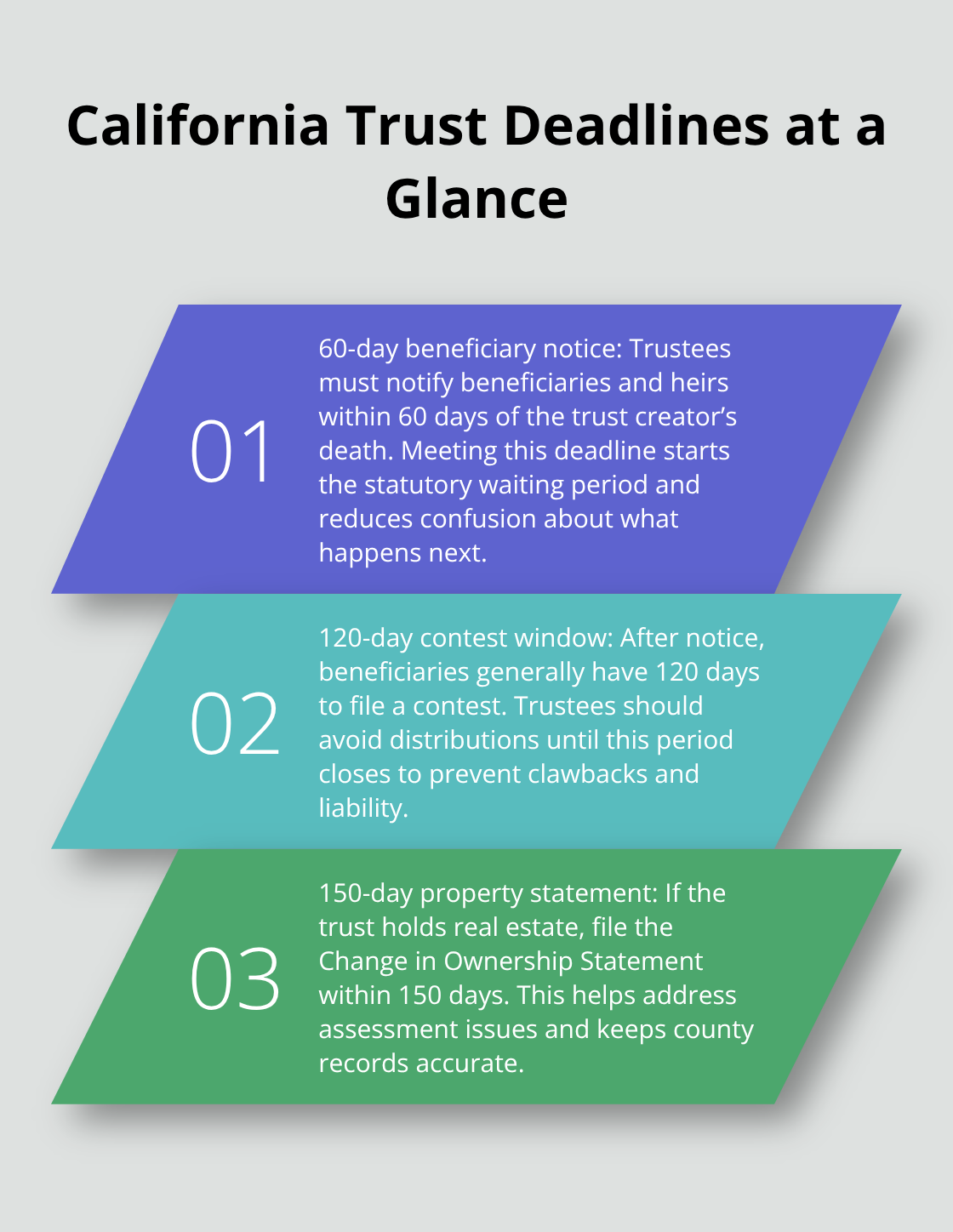
If the trust holds real estate, the attorney should confirm that the Change in Ownership Statement was filed with the county assessor within the 150-day window and advise on any property tax implications. If the trust holds a business, the attorney should coordinate with your accountant to ensure the business continues operating smoothly and that ownership transitions are handled correctly. When it comes time to prepare the final accounting for beneficiaries, your attorney should walk you through the document line by line so you understand what you are presenting and can answer beneficiary questions confidently.
Understand Legal Requirements and Deadlines
A trustee who understands the reasoning behind each step feels more confident and is less likely to make errors that could trigger disputes. Your attorney should remind you of critical deadlines, such as the 60-day notice requirement to beneficiaries and the 120-day contest window, because missing these dates creates serious legal problems. California Probate Code sections impose strict timelines on trustees, and your attorney must track these obligations carefully. The attorney should also explain the order in which you must pay debts and taxes (funeral costs and administration expenses first, then other debts and taxes) and confirm that you understand personal liability if you distribute assets prematurely. Your attorney should provide a written timeline showing when each major task must occur and what documents you need to prepare or sign. This clarity prevents costly mistakes and protects both you and the beneficiaries from disputes that arise when legal requirements are overlooked.
Coordinate with Tax and Financial Professionals
Trust administration involves more than legal work. Your attorney should clarify whether the firm works with CPAs and tax professionals or whether you must hire them separately. If your attorney coordinates with a CPA, that saves you time and reduces miscommunication between advisors. The attorney should explain what information the CPA needs to prepare the trust’s federal Form 1041 and California Form 541 tax returns, and when those filings must occur. If the trust holds investments or business interests, your attorney should advise on whether a financial advisor or business valuation specialist is needed. Coordinating these professionals early prevents delays and ensures that tax obligations are met on schedule. Your attorney should also explain whether the trust owes federal estate taxes and what steps are necessary to address them, since federal estate taxes can apply to large trusts even though California has no separate state-level estate tax.
Know What Happens When Disputes Arise
Trust administration sometimes uncovers disagreements between beneficiaries or questions about how to interpret the trust terms. Your attorney should explain what options exist if disputes arise-mediation, arbitration, or court involvement-and what each option costs. Some trusts include arbitration clauses that require disputes to be resolved outside court, while others allow beneficiaries to file in probate court. Your attorney should advise on whether the trust language is clear enough to prevent disputes or whether ambiguous provisions might trigger conflict later.
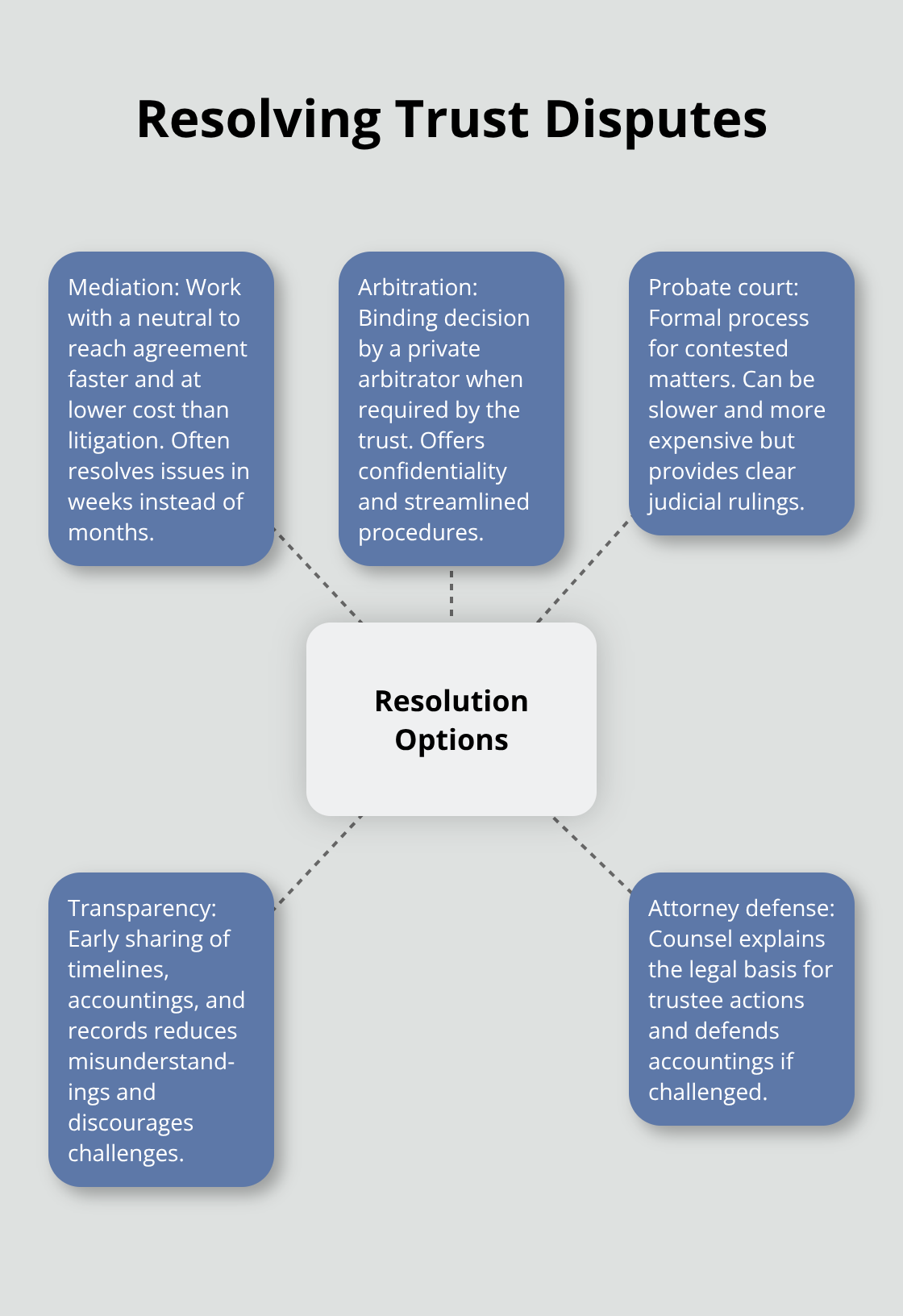
If a beneficiary challenges the trustee’s actions or questions the accounting, your attorney should be ready to defend your decisions and explain the legal basis for your actions. Knowing in advance how your attorney handles disputes gives you confidence that you have support if problems emerge during administration.
Common Challenges in Trust Administration and How Attorneys Address Them
Disputes between beneficiaries happen more often than trustees expect, and they rarely start with a single clear disagreement. One beneficiary questions why the trustee chose a particular real estate appraiser, another disputes the value assigned to a family business, and a third demands an accounting before the 120-day contest period closes. These conflicts escalate quickly when beneficiaries lack information or feel excluded from decisions. California Probate Code section 16061.7 requires trustees to notify beneficiaries within 60 days of the trust creator’s death, but notification alone prevents conflict only when paired with transparency. Beneficiaries have the right to request copies of the trust document and financial records, and they can file a legal challenge within 120 days if they believe the trustee is acting improperly.
Resolving Disputes Between Beneficiaries
The best defense against disputes is transparency from the start. Provide beneficiaries with a written timeline showing when major steps will occur, explain why certain tasks take longer than expected, and answer questions promptly even if the answer is simply that you are still gathering information. When a beneficiary raises a concern, address it directly rather than ignoring it or becoming defensive. If a beneficiary formally contests the trust or challenges your accounting, you have options beyond litigation. Mediation allows both sides to work with a neutral third party to reach agreement outside court, often taking weeks instead of months and costing a fraction of litigation fees. Arbitration, required by some trusts, provides binding resolution through a private arbitrator rather than a judge, offering faster timelines and confidentiality that keeps family disputes private.
Managing Complex or Contested Assets
Complex assets like real estate, business interests, or investment portfolios demand specialized attention that generic trust administration cannot provide. A trust holding commercial real estate worth $2 million requires property management, tenant coordination, lease review, and decisions about whether to sell or hold the asset. A family business held in trust creates additional pressure because the trustee must decide whether to sell the business, transfer it to a family member, or wind down operations, and each choice carries tax consequences and affects beneficiaries differently. California’s Uniform Directed Trust Act, effective in 2022 under Probate Code sections 16600 through 16632, allows trusts to appoint a trust director or advisor who oversees certain decisions and can approve distributions or asset management actions. This structure reduces the trustee’s personal liability because the trustee follows the director’s instructions rather than making independent decisions. If your trust holds a business or significant real estate, appointing a trust director with relevant knowledge prevents costly mistakes and protects you from personal liability if decisions later prove unprofitable.
Navigating State-Specific Probate and Trust Laws
State-specific probate and trust laws create traps for trustees who lack legal guidance. California requires specific notices at specific times, imposes strict liability for missed deadlines, and holds trustees personally accountable for mismanagement. Missing the 60-day beneficiary notification deadline or failing to file required tax returns on time creates legal exposure that personal liability insurance may not cover. Trustees in Santa Ana and Orange County must also understand how local court procedures work if disputes require court intervention, because probate court processes differ from civil litigation. An attorney familiar with California Probate Code requirements and Orange County court practices ensures compliance and prevents costly errors that delay administration or expose you to personal liability.
Final Thoughts
Trust administration in California demands attention to detail, legal compliance, and clear communication with beneficiaries. The process takes 9 to 18 months because state law requires specific steps in a defined sequence, and trustees who skip steps or miss deadlines face personal liability. A trust administration attorney practice provides the accountability and clarity you need during this demanding period.
Your attorney should deliver transparent fee structures upfront, regular status updates throughout settlement, and guidance on California Probate Code requirements and deadlines. When disputes arise between beneficiaries or questions emerge about complex assets, your attorney should explain your options and defend your decisions with confidence. The cost of professional legal guidance-typically $3,000 to $8,000 for trusts worth $500,000 or more-is far less than the cost of litigation, missed tax deadlines, or personal liability from mismanagement.
Finding the right trust administration attorney means looking for someone who communicates clearly, coordinates with tax professionals, and understands Orange County court procedures. You need an attorney who explains why each step matters and what happens next, not someone who leaves you guessing about progress or costs. Contact Law Offices of Roshni T. Desai to schedule a free consultation and discuss your trust administration questions with someone who has served Southern California families for over 25 years.