




Trust Administration Help in Santa Ana, California: Getting Clear, Compassionate Guidance
When a loved one passes away, managing their trust becomes a significant responsibility. Many trustees in Santa Ana feel overwhelmed by the legal requirements, asset management, and family expectations that come with the role.
We at Law Offices of Roshni T. Desai understand these challenges and provide trust administration help tailored to your situation. This guide walks you through what trust administration involves and how we support Santa Ana residents through every step.
What Happens During Trust Administration
Trust administration requires three core actions that unfold simultaneously. You identify and secure all trust assets-bank accounts, real estate, investments, insurance policies, and personal property. This inventory phase matters because missing assets create delays and potential legal liability. California law requires notifying beneficiaries within 60 days of the trustor’s passing, so speed matters. You also settle the trust’s debts and obligations before distributing anything to beneficiaries. This includes paying final income taxes, addressing outstanding bills, and handling claims from creditors. The trustee bears personal liability for distributions made before debts are settled, so this step cannot be rushed. Finally, you distribute remaining assets according to the trust terms once all financial obligations are complete.
Securing Assets and Creating a Clear Inventory
Start by obtaining at least ten certified copies of the death certificate-you’ll need multiple copies to satisfy financial institutions and government agencies. Locate the original trust document to understand the grantor’s specific wishes and any restrictions on how assets must be managed. Contact banks, investment firms, insurance companies, and property records offices to compile a complete asset list. For real estate, obtain professional appraisals to establish accurate valuations, especially if property sales are necessary. Open a separate trust bank account immediately to keep trust funds distinct from personal finances (mixing these accounts creates serious legal problems and invites challenges from beneficiaries). Document everything in writing as you proceed through administration. This transparency prevents misunderstandings and protects you from accusations of mismanagement.
Handling Taxes and Settling Obligations
The trustee must file IRS Form 1041 for trust income taxes and address any federal estate tax exposure if the estate exceeds the current threshold. California has no state-level estate tax, which simplifies matters for Santa Ana residents compared to other states. If the decedent died mid-year, file their final personal income tax return as well. Pay all valid claims from creditors before distributing assets to beneficiaries. This waiting period typically lasts several months to allow creditors time to submit claims (the exact timeline depends on your trust terms and local court procedures). Professional guidance during this phase protects you from personal liability for tax mistakes and ensures compliance with California law.
Moving Forward With Distributions
Once you settle all debts, taxes, and creditor claims, you can distribute remaining assets according to the trust terms. Maintain detailed records of each distribution and obtain written acknowledgment from beneficiaries when possible. This documentation protects you if disputes arise later and demonstrates that you acted in good faith. The distribution phase often reveals why clear communication with beneficiaries matters-beneficiaries who understand the timeline and process are less likely to question your decisions or challenge the administration.
What Trustees Get Wrong About Their Legal Obligations
Underestimating Fiduciary Duties
Most trustees in Santa Ana underestimate the scope of their fiduciary duties until problems surface. A fiduciary duty means you must act in the beneficiaries’ best interests at all times, not your own. This obligation extends beyond simply following the trust terms-it requires transparency, prompt action, and sound financial judgment. Many trustees make critical mistakes by mixing personal and trust funds, delaying asset inventory, or failing to communicate with beneficiaries regularly. These missteps create legal exposure and invite disputes that could have been prevented.
The trustee bears personal liability for losses caused by negligence or misconduct, which means your own assets are at risk if something goes wrong. California law requires notifying beneficiaries within 60 days of the trustor’s passing, yet some trustees delay this notification and later face accusations of intentional concealment. Poor communication is the single most common trigger for beneficiary disputes-when beneficiaries feel uninformed, they assume the worst.
The Power of Transparent Communication
Trustees who provide regular written updates about asset inventory, tax filings, and distribution timelines experience far fewer conflicts. The role involves substantial time commitment and emotional strain, often lasting months to over a year depending on estate complexity. If your trust includes real estate, business interests, or multiple beneficiaries with competing expectations, the administration becomes significantly more complicated and legally risky without professional guidance.
When Family Dynamics Complicate Everything
Family dynamics often intensify after a death, and beneficiaries who previously got along may suddenly compete over asset distribution or question your management decisions. One beneficiary might believe you’re moving too slowly on distributions while another demands immediate action on property sales-satisfying both becomes impossible without clear documentation of your reasoning. If beneficiaries suspect mismanagement, undue influence in the original trust, or fraud, they can pursue mediation or legal action to remove you as trustee or recover damages from your personal assets.
These disputes consume time, money, and emotional energy that could have been invested in proper administration. The complexity intensifies when you lack professional support to coordinate with tax professionals, manage real estate transactions, and maintain transparent communication with all parties. Establishing clear timelines, documenting decisions thoroughly, and addressing beneficiary concerns proactively rather than reactively reduces conflict significantly. This is where professional guidance becomes not just helpful but necessary to protect yourself and honor the decedent’s wishes.
How We Support Santa Ana Trustees Through Administration
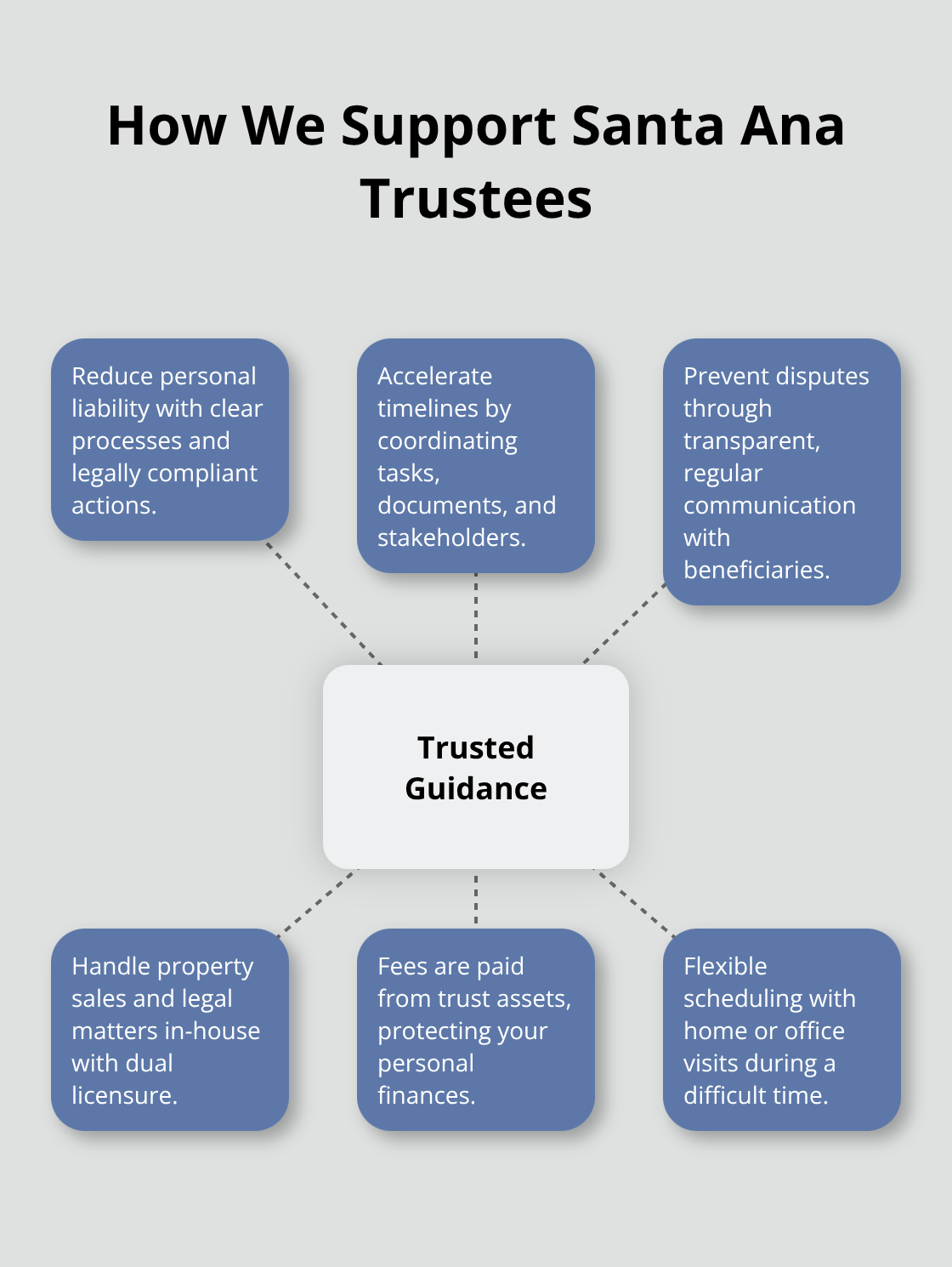
Trust administration in Santa Ana demands someone who understands California’s Probate Code, local court procedures, and the emotional weight families carry after a loss. We at Law Offices of Roshni T. Desai bring over 25 years of experience navigating these complexities so trustees don’t shoulder the burden alone. Our approach centers on reducing your personal liability, accelerating timelines, and preventing the disputes that derail so many administrations.
Understanding Your Obligations Under California Law
When you contact us for a free consultation, we review your specific trust document, clarify your obligations under California law, and explain exactly what comes next. Many trustees hesitate to seek help because they assume legal fees will drain the estate, but here’s the reality: attorney fees in trust administration are paid from trust assets, not from your personal pocket. This means professional guidance actually protects your finances while protecting beneficiaries’ interests.
We’ve seen firsthand how trustees who act alone face challenges that cost far more to resolve later. Missed tax deadlines trigger penalties, poor asset documentation invites litigation from suspicious beneficiaries, and real estate complications spiral into months of delay. Our role is to coordinate the entire process so you avoid these expensive mistakes.
Managing Property Sales and Real Estate Transactions
Ms. Desai’s dual licensure as both an attorney and real estate professional gives us a significant advantage when your trust includes property. Rather than juggling separate professionals for legal matters and property sales, we handle both in-house, which reduces costs, eliminates communication gaps, and accelerates transactions that might otherwise stall for months.
Many Santa Ana estates involve real property-whether a family home, rental property, or investment land-and property sales often create friction between beneficiaries with competing interests. We manage these transactions with clear timelines and transparent communication so no beneficiary feels blindsided.
Coordinating Complex Financial and Tax Matters
We coordinate with tax professionals and financial advisors when trust administration involves complex investments or multi-generational wealth transfer, ensuring every piece of the puzzle fits together. Whether you need help interpreting vague trust language, notifying beneficiaries properly, filing tax returns, or resolving disputes that have already surfaced, we guide you through every stage.
Flexible Support When You Need It Most
Our free consultations include flexible scheduling with home or office visits, because we understand that trustees are often managing grief, work commitments, and family obligations simultaneously. The goal is simple: honor the decedent’s wishes while protecting yourself from personal liability and closing the administration efficiently.
Final Thoughts
Trust administration in Santa Ana demands navigation of California law, management of complex assets, and balance between multiple beneficiaries’ expectations-all while processing grief. Mistakes that trustees make alone often cost far more to fix later than professional guidance would have cost upfront, since missed tax deadlines trigger penalties, poor communication sparks litigation, and property complications extend timelines by months. You don’t have to shoulder this burden by yourself.
We at Law Offices of Roshni T. Desai bring over 25 years of experience helping Santa Ana residents through trust administration help. Our approach is straightforward: we clarify your obligations under California law, coordinate every piece of the process, and protect you from personal liability while honoring the decedent’s wishes. Ms. Desai’s dual licensure as both an attorney and real estate professional means we handle property sales and legal matters in-house, eliminating communication gaps and reducing costs that would otherwise drain the estate.
Contact Law Offices of Roshni T. Desai today to schedule your free consultation. Attorney fees are paid from trust assets, not your personal finances, so professional guidance actually protects your wallet while protecting beneficiaries’ interests. We offer flexible scheduling with home or office visits because we understand that trustees manage grief, work, and family obligations simultaneously.