




Trust Documentation Review: Ensuring Accurate and Complete Paperwork
A trust documentation review catches errors that could derail your family’s financial plans. Missing beneficiary information, unclear language, and improper notarization are common problems we see regularly at Law Offices of Roshni T. Desai.
These mistakes often lead to expensive disputes and probate delays. This guide walks you through what to look for and how to fix it.
What Mistakes Hide in Your Trust Documents
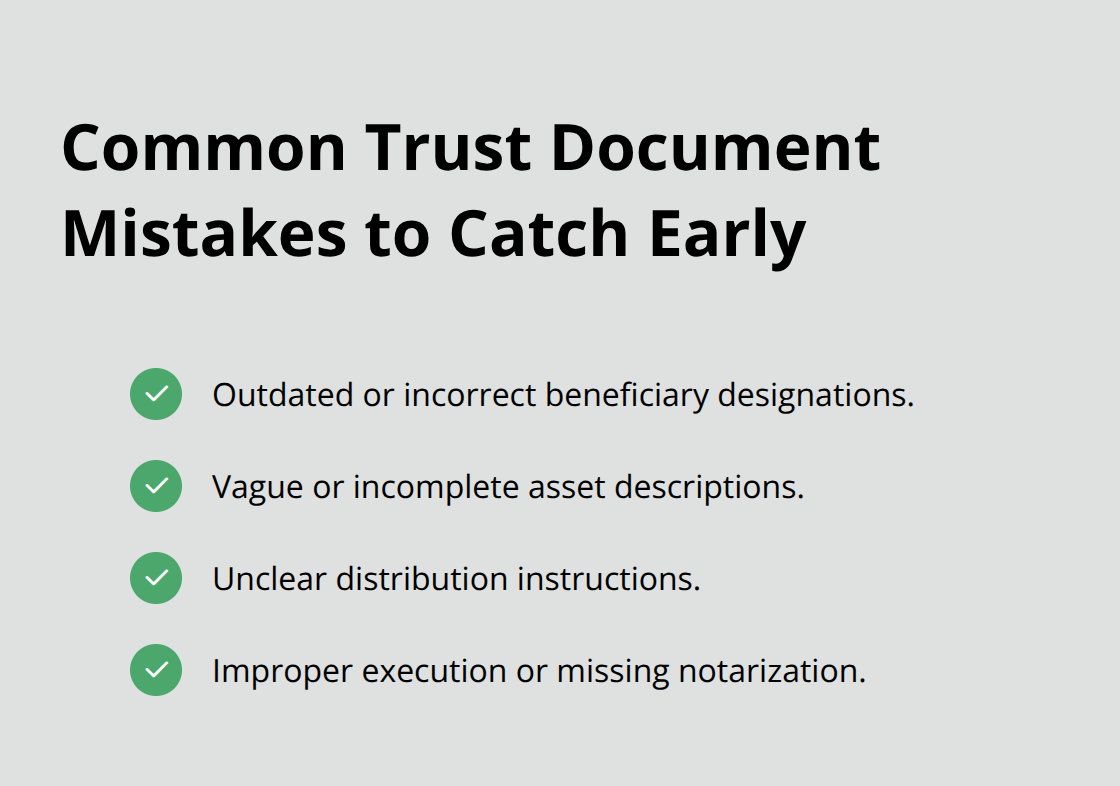
Outdated Beneficiary Information Creates Real Problems
Beneficiary information that sits unchanged for a decade creates real problems. You may list beneficiaries who have passed away, moved out of state, or no longer represent your wishes. One client discovered their ex-spouse was still named as a primary beneficiary-a mistake that would have transferred significant assets after their death. California law does not automatically update these designations when life circumstances change. You must manually review and modify beneficiary sections whenever marriages end, children are born, or relationships shift.
Vague Asset Descriptions Lead to Costly Delays
Missing asset descriptions are equally dangerous. Some trusts contain vague language like “the property in Los Angeles” or “certain bank accounts” without account numbers or institution names. When your trustee tries to locate and distribute these assets after your death, ambiguity creates delays and invites disputes. The trustee may struggle to identify which specific accounts you meant, leading to months of investigation and legal fees that drain the estate.
Unclear Instructions Breed Family Conflict
Unclear instructions throughout the trust document breed conflict among family members. Phrases like “the trustee should distribute assets fairly” or “provide for the beneficiary’s needs” lack the specificity trusts demand.
What does fairly mean to different family members? One sibling interprets it as equal distribution; another sees it as need-based. These vague instructions generate costly litigation between heirs.
Improper Execution and Notarization Invalidate Your Plan
Improper execution and notarization problems are equally common and surprisingly costly to fix. California requires specific formalities for valid trusts-signatures, dates, and in some cases notarization. Trusts executed incorrectly may face legal challenges during probate, forcing your family into court to validate the document’s authenticity. Some people create trusts without professional guidance, missing notarization requirements or failing to use proper language that California courts recognize. Others update trusts informally through handwritten notes, which courts often reject as invalid modifications. These execution errors can invalidate years of planning and push your estate into the probate process you tried to avoid.
Understanding these common mistakes positions you to take action. The next section walks you through why regular reviews matter and how they protect your family’s financial future.
Why Your Trust Needs Regular Reviews
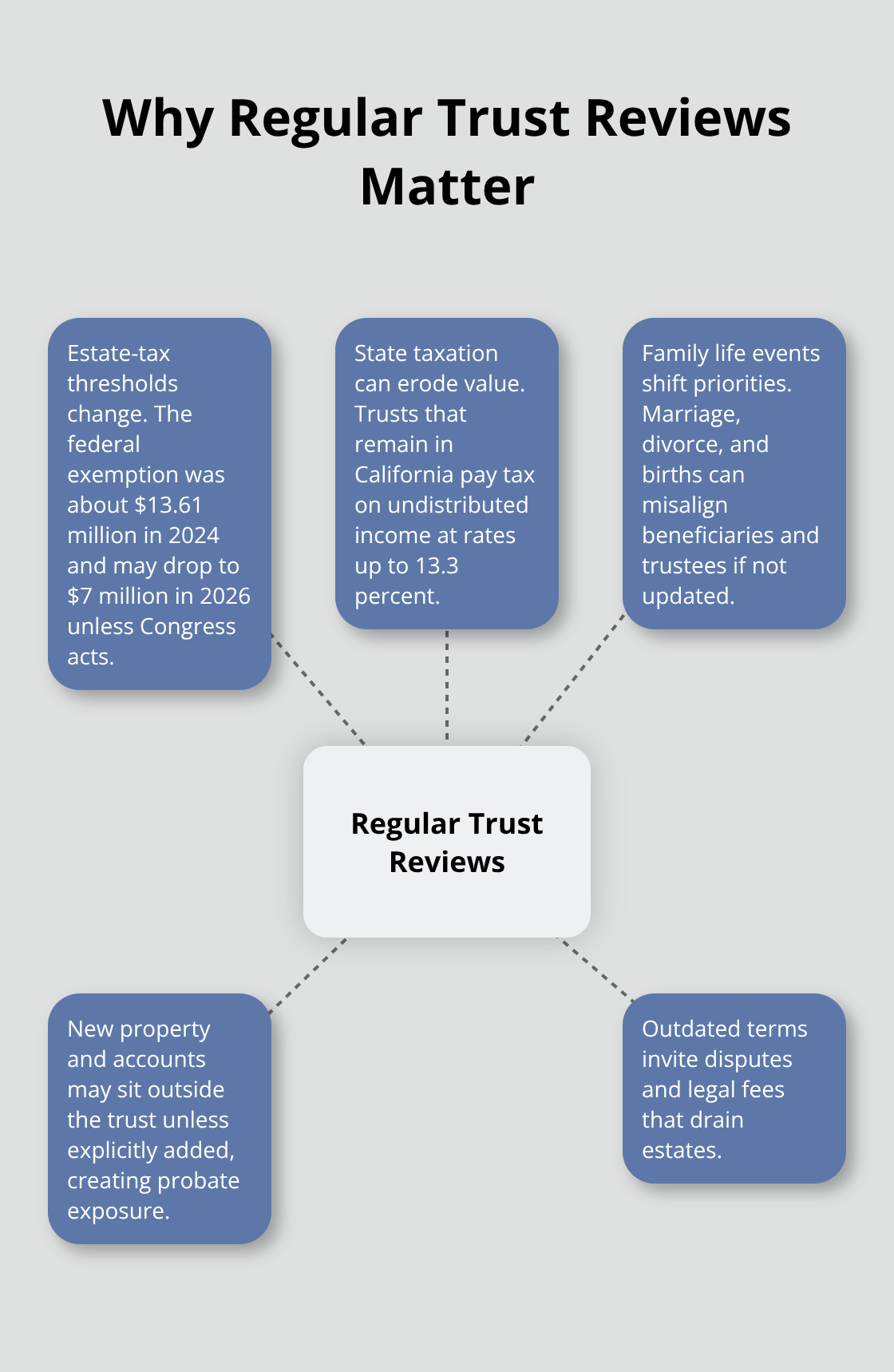
Trusts are not set-it-and-forget-it documents. Life changes constantly, and your trust must adapt accordingly. California tax laws shift, property values fluctuate, and family circumstances transform. A trust that made perfect sense in 2015 may create tax liability or unintended consequences in 2026. We recommend reviewing your trust every three to five years, or immediately after major life events like marriage, divorce, the birth of children, significant asset acquisition, or relocation.
Without regular reviews, your trust becomes a liability rather than protection. Outdated trusts frequently trigger disputes because beneficiaries feel excluded or misrepresented. Family members challenge distributions they believe contradict your actual wishes. These disputes consume estate resources that should pass to your heirs instead. Courts in California see hundreds of trust contests annually, many stemming from documents that simply failed to keep pace with reality.
Missed Tax Opportunities Cost Thousands
Federal and California tax laws change regularly, and trusts must reflect current strategies to minimize what your family owes. The federal estate tax exemption stood at approximately 13.61 million dollars per individual in 2024, but it drops to 7 million dollars in 2026 unless Congress acts. If your trust was drafted before 2022, it likely lacks portability language that allows married couples to combine exemptions and potentially save hundreds of thousands in taxes. Trusts created before recent changes also miss strategies for capital gains tax planning. Property that passes through a trust may receive a stepped-up basis, which can eliminate capital gains taxes entirely when heirs sell real estate or investments. Older trust language often fails to maximize this benefit. Additionally, California’s state income tax applies to trusts in ways that surprise many people. Trusts that remain in California pay state tax on undistributed income at rates up to 13.3 percent. Regular reviews catch these issues before they drain your estate.
Life Changes Make Old Trusts Dangerous
Marriage, divorce, children, grandchildren, and substantial asset changes all demand trust modifications. California law does not automatically update trusts when you marry or have children. A trust executed before your second marriage may inadvertently exclude your new spouse or create unequal treatment between children from different relationships. Trusts that name a deceased sibling as backup trustee create months of delay and confusion during administration. Those that list specific dollar amounts for grandchildren gifts become inadequate over twenty years of inflation. Property acquisitions create additional complexity. If you purchased real estate, investments, or a business after your trust was created, these assets may fall outside trust protection entirely. Without explicit language adding new property to the trust, your heirs face probate on those assets regardless of your intentions. Regular reviews identify these gaps and fix them before they become problems.
When to Act on Trust Changes
Major life events trigger the need for immediate trust review. A marriage, divorce, or the birth of a child should prompt you to examine your trust within weeks, not months. Significant asset purchases (real estate, business interests, or investment accounts) require you to add these items to your trust explicitly. Relocation to another state or country introduces new legal considerations that your current trust may not address. Even smaller changes matter-a change in your primary residence, a substantial inheritance, or a shift in your financial situation all warrant review. The cost of updating a trust through amendments or restatement is minimal compared to the expense of resolving disputes or probate complications later. Waiting until after a major life event to review your trust means your protection lapses precisely when your family needs it most.
How to Review Your Trust Documents Properly
Collect All Trust Documents and Related Paperwork
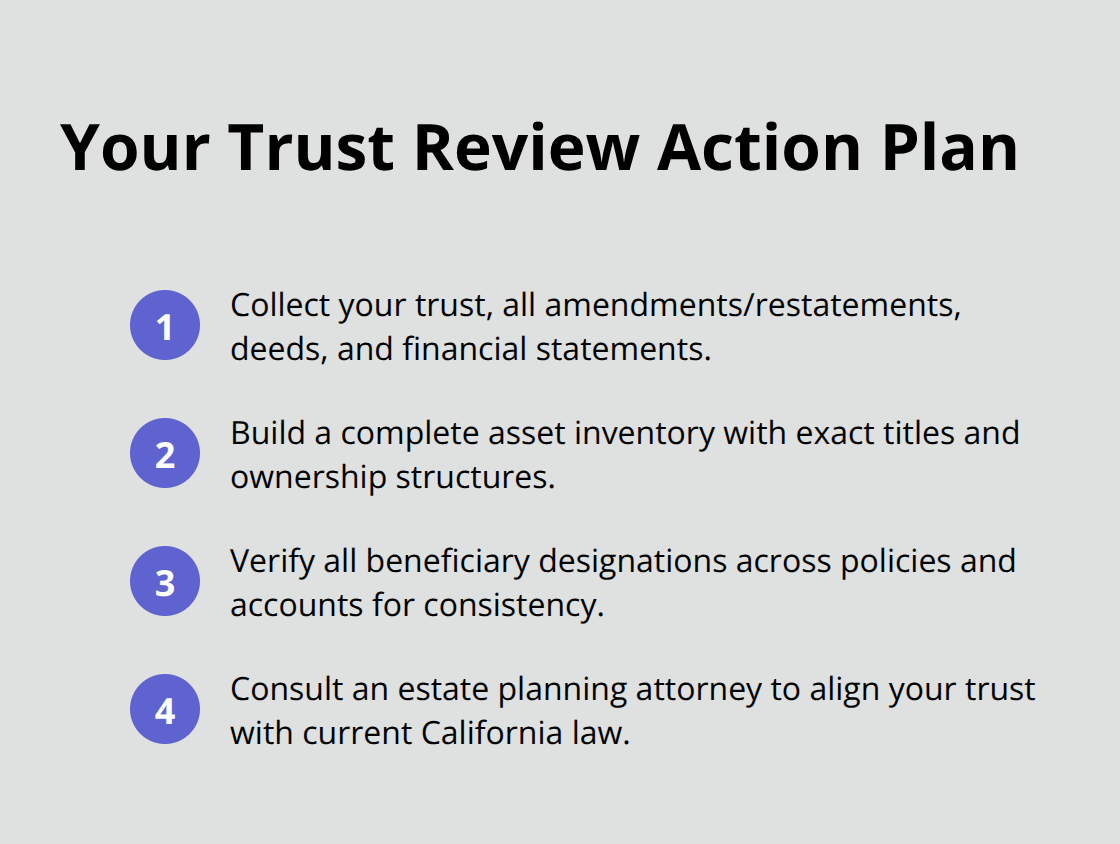
Start by gathering every document related to your trust in one place. This includes the original trust agreement, any amendments or restatements, the deed transferring property into the trust, beneficiary designation forms from retirement accounts and insurance policies, and bank statements showing which accounts are titled in the trust’s name. Many people have multiple versions of their trust stored in different locations-a copy from their attorney, a handwritten version with notes, and an older version they thought had been replaced. Having all documents together prevents you from reviewing an outdated version and making decisions based on stale information.
Create a Complete Asset Inventory
Next, create a detailed inventory of every asset you own, including real estate, investment accounts, retirement accounts, life insurance policies, and business interests. For each asset, write down the exact title or ownership structure. Does your deed say the property is owned in your individual name, in the trust’s name, or as joint tenants with your spouse? Is your brokerage account titled in your name alone or in the trust? This inventory reveals a critical gap most people miss: assets that sit outside the trust entirely. California residents frequently own investment accounts, rental properties, or insurance policies that never got transferred into their trust. These assets bypass your trust completely and either go through probate or pass through beneficiary designations that contradict your trust’s intent.
Verify Beneficiary Designations Across All Accounts
Once you have your asset inventory, verify that your beneficiary designations match across all documents. A common error involves naming one person as beneficiary in your trust but listing a different person on your life insurance policy or IRA. Insurance proceeds and retirement account distributions bypass your trust entirely and go directly to whoever you named on those specific forms. If you named your ex-spouse on a life insurance policy but your current spouse in your trust, your ex receives the insurance money regardless of what your trust says. California law does not automatically update these designations when life changes occur. You must manually review and update beneficiary forms on every account-retirement accounts, life insurance policies, transfer-on-death bank accounts, and investment accounts. Check the dates on these beneficiary designations too. Forms from 2010 or 2012 may reference people who have since passed away or relationships that have ended.
Have an Attorney Review Your Trust Against Current Law
Finally, have an attorney review your trust against current California law. Tax laws shifted significantly between 2020 and 2024, and trusts drafted before 2022 likely lack portability language for married couples, miss capital gains tax strategies, and contain outdated language California courts no longer recognize. An attorney can identify whether your trust complies with current state requirements, whether it addresses your actual property and family situation, and whether it contains the specific language needed to accomplish your goals. This step costs far less than fixing problems after your death. At Law Offices of Roshni T. Desai, we offer free consultations to review your trust documents and identify gaps in your current plan. With over 25 years of experience in estate planning, we help Southern California residents ensure their trusts reflect their actual wishes and current circumstances.
Final Thoughts
A trust documentation review uncovers gaps that cost your family thousands in taxes, legal fees, and probate delays. The mistakes outlined in this guide-outdated beneficiaries, vague asset descriptions, unclear instructions, and improper execution-are preventable with regular attention to your documents. Your trust must reflect your current life, not the circumstances of five or ten years ago.
Marriage, divorce, children, property purchases, and tax law changes all demand that you revisit your trust periodically. Waiting until after a major life event leaves your family unprotected during the transition. The cost of updating your trust through amendments or a complete restatement is minimal compared to the expense of resolving disputes or navigating probate later.
If you have not reviewed your trust in the past three to five years, or if you have experienced major life changes since your trust was created, contact us now. We at Law Offices of Roshni T. Desai offer free consultations to examine your trust documents and identify gaps in your current plan. Schedule your consultation and take the first step toward peace of mind.