




Southern California Probate Attorney Services: Compassionate Guidance When It Matters
Losing a loved one brings overwhelming emotions, and handling their estate shouldn’t add to that burden. Probate can feel complicated, with court deadlines, paperwork, and decisions that affect your family’s future.
We at Law Offices of Roshni T. Desai understand what families face during this time. This guide walks you through Southern California probate attorney services and shows you how compassionate legal guidance makes the process clearer.
When You Need a Probate Attorney in Southern California
Probate becomes necessary when someone passes away with assets that require court oversight to transfer to heirs or beneficiaries. Not every estate needs formal probate-if the deceased person had a living trust, most assets titled in the trust’s name bypass probate entirely. However, many Southern California families find they need probate help when property, bank accounts, or vehicles remain in the deceased person’s individual name. The California Courts Self Help Guide identifies three situations where you should hire an attorney: when the estate value exceeds what qualifies for simplified procedures, when family members disagree about who should manage the estate or how assets should be distributed, or when debts, taxes, or creditor claims complicate the settlement. Probate timelines in California typically stretch 9 to 12 months for straightforward estates, but contested cases or complex asset situations easily extend to 18 months or longer. During this period, court deadlines are non-negotiable-missing a filing deadline can delay distributions by months and frustrate beneficiaries who are already grieving. The statutory fee schedule under California Probate Code sections 10800-10810 shows that attorney fees alone on a $2 million estate run approximately $33,000, plus executor compensation of roughly $33,000, totaling around $66,000. This substantial cost makes proper planning and efficient administration critical, since poor management or missed deadlines can erode the estate further.
Estate Assets That Trigger Probate
Real property titled solely in the deceased person’s name almost always requires probate to transfer ownership to new beneficiaries. Bank accounts without a named beneficiary or payable-on-death designation also go through probate, as do vehicles and investment accounts held individually. Life insurance proceeds and retirement accounts with named beneficiaries typically avoid probate, but if the deceased failed to name a beneficiary or named the estate itself, those funds get pulled into probate. Many families discover too late that they could have avoided probate with simple planning steps-adding a spouse as a joint tenant, establishing a living trust, or designating a payable-on-death beneficiary on bank accounts.
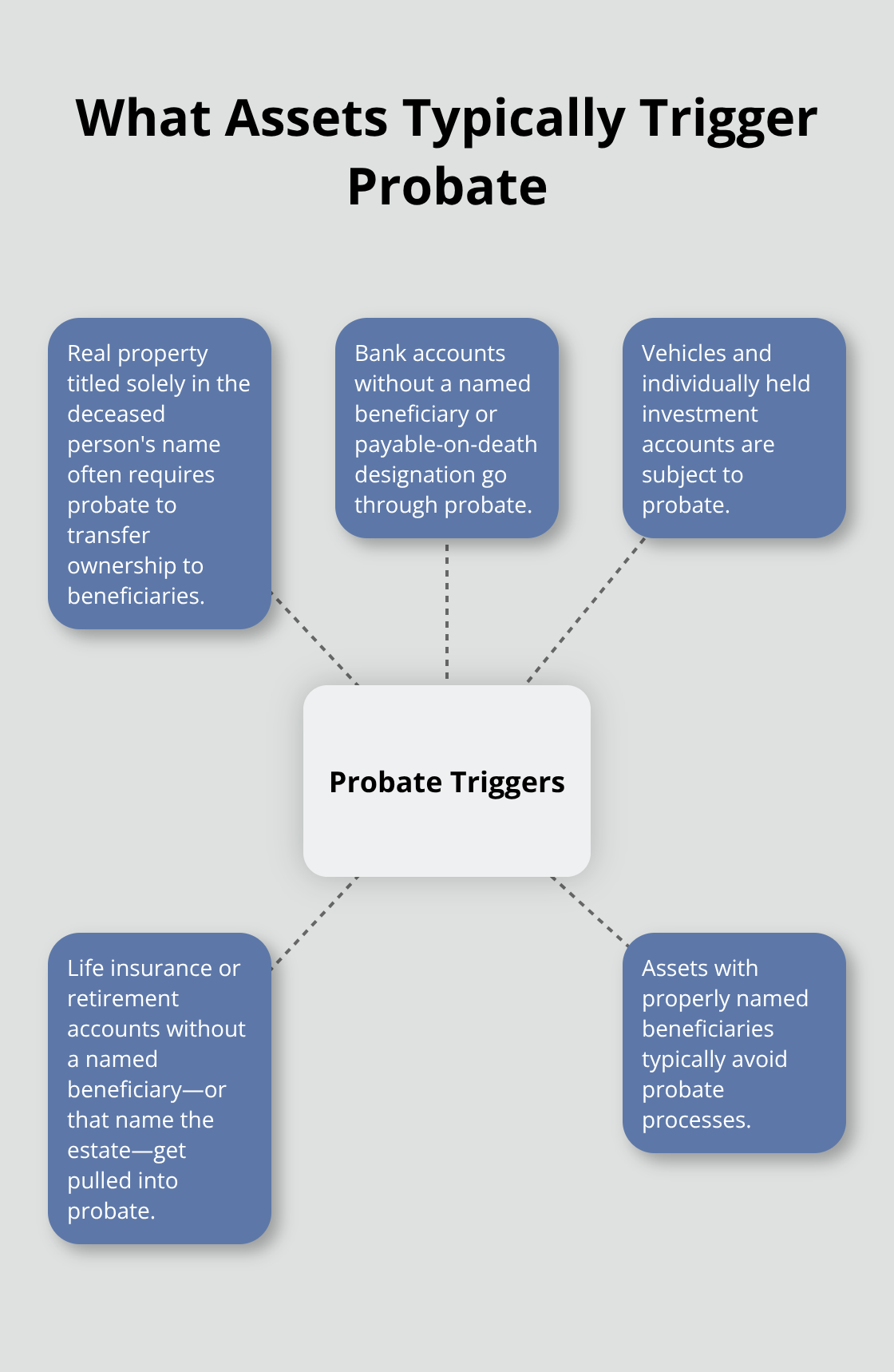
Understanding which assets actually need probate and which can transfer outside the court system reduces both timeline and expense.
When Family Disagreement Becomes Costly
Disputes over who should serve as executor, whether the will is valid, or how assets should be divided turn straightforward probate into litigation. Will contests claiming undue influence or lack of capacity happen in roughly 1 to 3 percent of probate cases according to probate court statistics, but when they occur, costs spike dramatically and timelines extend by years. Even without a formal contest, tension between beneficiaries over asset distribution or executor decisions requires court intervention to resolve-and court involvement means formal hearings, attorney arguments, and judicial decisions that replace family negotiation. An experienced probate attorney identifies these red flags early and either helps families communicate and reach agreement or prepares for litigation if necessary. These disputes consume time, money, and emotional energy that families can ill afford during grief.
Why Timelines Matter for Your Family
Court deadlines in probate administration are strict and unforgiving. Missing a filing deadline can delay asset distributions by months, leaving beneficiaries waiting for inheritance funds they need. The longer probate stretches, the more attorney fees accumulate and the more executor compensation the estate pays out. For families already stressed by loss, extended timelines add frustration and uncertainty about when they can move forward with their lives. A probate attorney who understands Southern California court procedures and local filing requirements helps you meet every deadline and keeps the process moving efficiently. Understanding what happens next in the probate process-from court filings to asset distribution-helps you prepare for the work ahead.
What Happens During Probate Administration
Probate administration follows a structured path, though the exact sequence depends on whether the estate qualifies for simplified procedures or requires formal court oversight. Once you file the petition to appoint a personal representative with the probate court, the court issues letters testamentary or letters of administration that authorize the executor or administrator to act on the estate’s behalf. This appointment typically happens within 2 to 4 weeks in Southern California courts, though some counties move faster than others.
Court Filings and Initial Notifications
The personal representative faces immediate obligations after appointment. They must locate the original will and deliver it to the court, notify all beneficiaries and heirs of the probate filing, and publish notice to creditors in a local newspaper. California law requires creditor notification within 15 days of the petition filing, and creditors have four months from the publication date to submit claims against the estate.
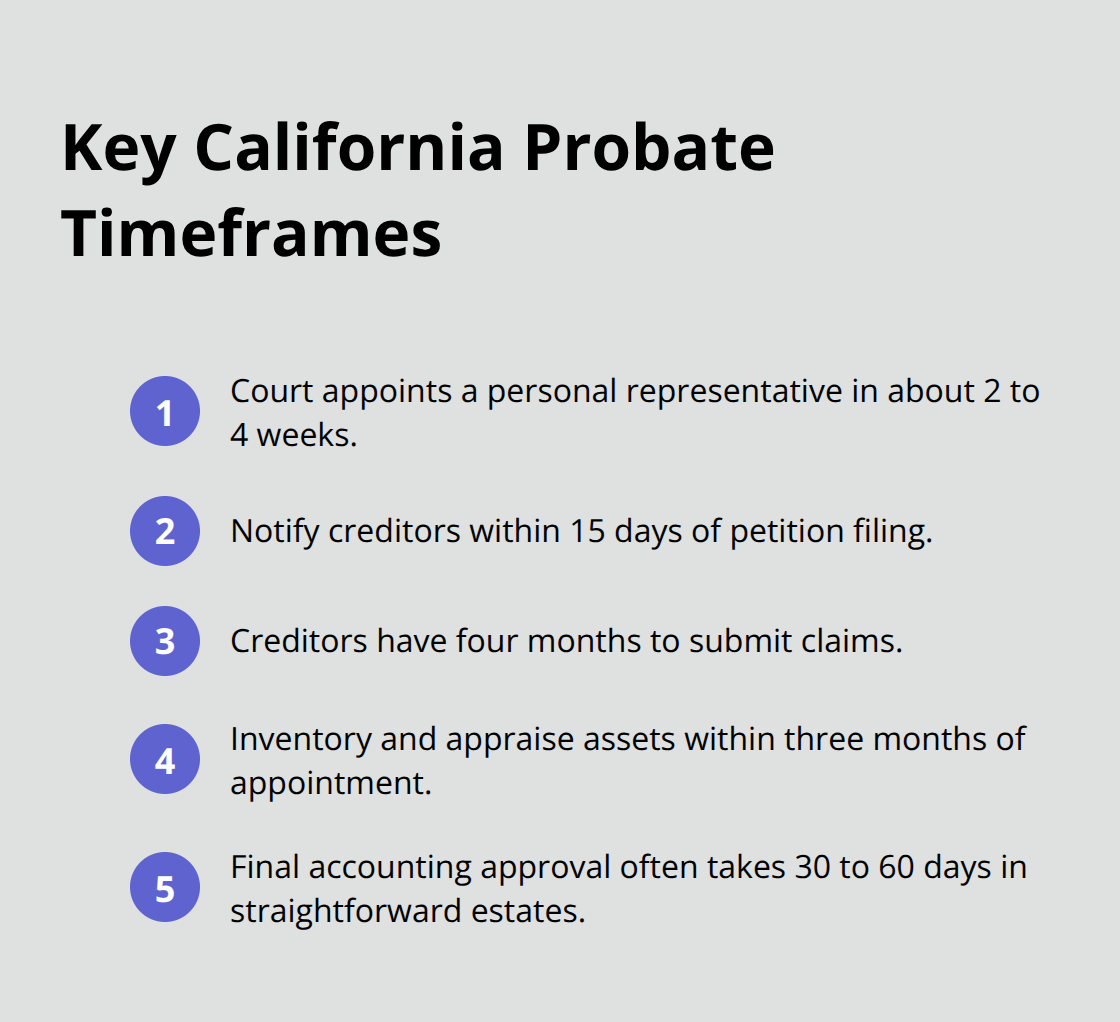
This creditor period matters significantly because the personal representative cannot distribute assets to beneficiaries until the creditor claim window closes and all legitimate debts are paid. The timing creates a natural pause in the process-one that protects both the estate and beneficiaries from future liability.
Asset Inventory and Valuation Requirements
The personal representative must inventory all estate assets within three months of appointment and obtain appraisals for real property and valuables. They file a detailed inventory with the court showing the estate’s total value. For a $2 million estate, this documentation alone involves substantial work: property appraisals, bank statements, investment account valuations, and life insurance payouts all require collection, organization, and reporting.
Missing any of these deadlines triggers court orders or extensions that delay the entire process. The court takes these timelines seriously, and delays compound quickly when documentation falls behind schedule.
Final Accounting and Asset Distribution
Asset distribution happens only after the court confirms that all debts, taxes, and creditor claims have been addressed. The personal representative prepares a final account showing all money received, all expenses paid, and the remaining assets ready for distribution to beneficiaries. This accounting must be filed with the court and approved by the judge before any final distributions occur.
In straightforward estates, this final accounting approval takes 30 to 60 days; in contested cases or estates with complex assets, approval stretches much longer. Once approved, the personal representative distributes the remaining assets according to the will or California intestacy laws if no will exists, obtains signed receipts from beneficiaries, and files a final report with the court closing the probate.
Understanding Timeline and Cost Implications
The entire cycle from petition filing to probate closure typically requires 9 to 12 months for uncontested estates, but estates with significant real property, multiple beneficiaries, or creditor disputes routinely take 18 months or longer. Throughout this period, attorney fees accumulate and executor compensation is paid based on statutory rates tied to estate value. For a $2 million estate, these costs (attorney fees around $33,000 plus executor compensation of roughly $33,000) total approximately $66,000-a substantial sum that makes efficient administration essential.
Understanding what the personal representative must accomplish at each stage helps you prepare for the decisions and documentation that come next. The probate process demands attention to detail and strict adherence to court deadlines, which is why many families benefit from professional guidance through each phase. As the process moves forward, families often face questions about whether probate was truly necessary or whether other options might have simplified the settlement-questions that point toward the value of planning before death occurs.
Why Probate Might Not Be Your Only Path Forward
Probate is often treated as an inevitable consequence of death, but the reality is more flexible. Many Southern California families assume they must go through formal court probate when other options exist that move faster, cost less, and avoid public court records entirely. Small estates valued under $166,200 in personal property and $55,425 in real property qualify for a Small Estate Affidavit, which lets beneficiaries collect assets without any court involvement-typically within weeks rather than months. If the deceased person established a living trust before death and properly titled assets in the trust’s name, those assets transfer directly to beneficiaries outside probate completely, bypassing court filings, creditor notification periods, and the nine to twelve month timeline that formal probate requires. The California Courts Self Help Guide confirms this path works efficiently when planning happens in advance. The problem is that most people never create these planning tools, leaving their families forced into probate when a different approach would have served them better. We at Law Offices of Roshni T. Desai see this pattern constantly-families frustrated by probate costs and delays who discover that living trusts or updated beneficiary designations could have prevented the entire situation. This is why planning before death matters so much more than managing probate after it occurs.
How Living Trusts Provide Speed and Privacy
Living trusts offer something probate cannot: privacy and speed combined with complete control over how and when assets transfer to beneficiaries. A living trust lets you name successor trustees to manage assets according to your instructions, specify exactly when beneficiaries receive funds, and handle real property transfers without court involvement. For families with significant real estate holdings or multiple properties across different counties, trusts eliminate the need to probate each property separately in multiple jurisdictions.
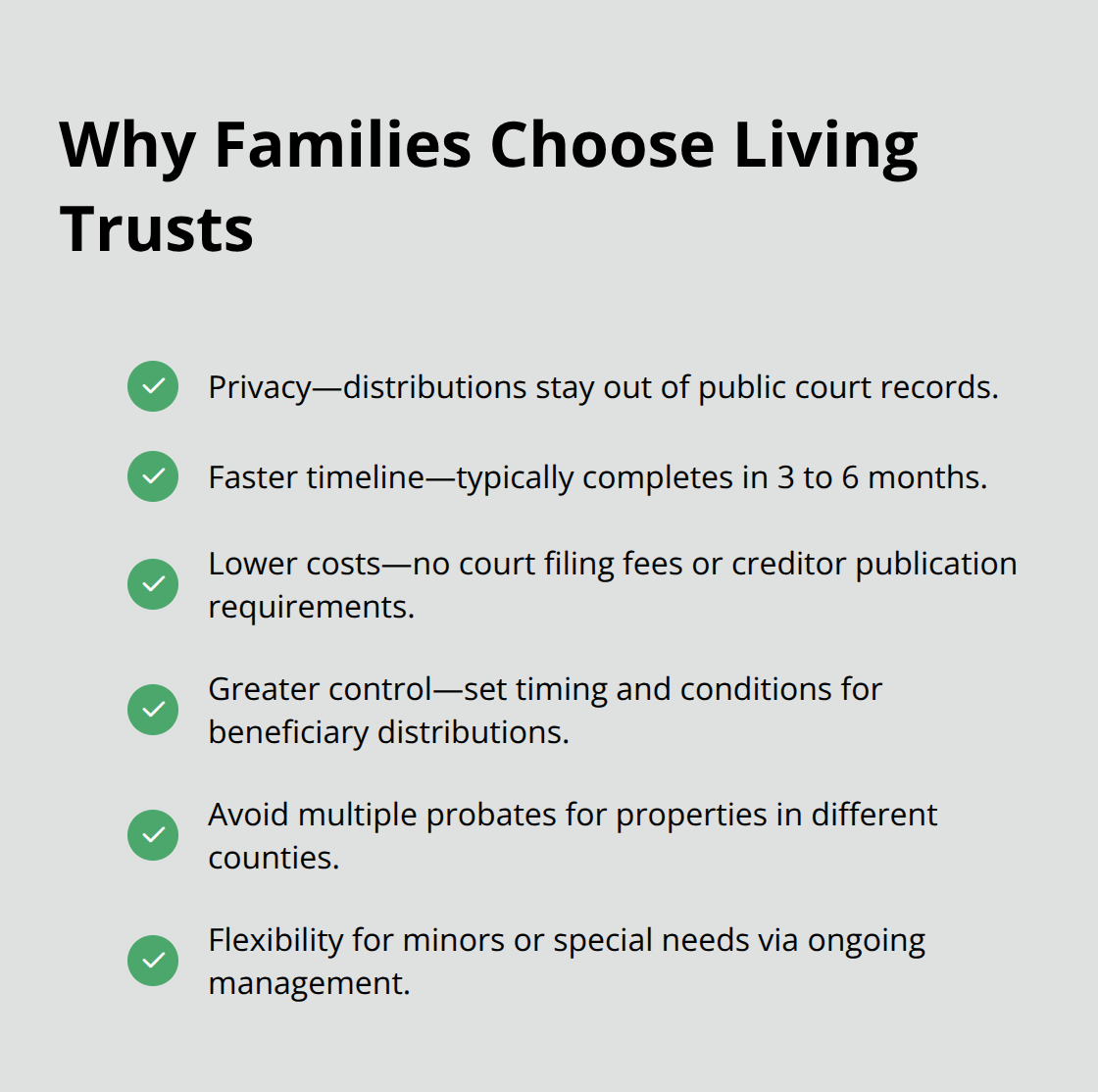
Trust administration typically completes in three to six months once the trustmaker dies, compared to the one to two year probate timeline. The cost difference is substantial too-trust administration usually costs far less than probate because there are no court filing fees, no creditor notification requirements, and no judge approval needed for asset distribution. Beneficiaries also receive assets privately rather than through public court records that anyone can access. If your family includes minor children or beneficiaries with special needs, a trust gives you far more flexibility than a will to structure how they receive money-you can direct a trustee to pay for education, healthcare, or living expenses rather than handing over a lump sum to someone unprepared to manage it.
Understanding the Cost-Benefit Analysis
The upfront cost of creating a trust ranges from $1,500 to $3,500 depending on complexity, but this investment pays for itself quickly when you consider the probate costs and delays it prevents. For estates over $1 million, trusts become almost essential-the probate fees alone on a $2 million estate run around $33,000 plus executor compensation, making trust planning a financial no-brainer. The upfront expense protects your family from substantial court costs and extended timelines that erode the estate value.
The Real Difference Between Probate and Trust Administration
Probate requires court supervision at every step, which means filing deadlines, published notices, creditor claim periods, and judge approval before distributions occur. Trust administration happens privately between the trustee and beneficiaries with no court involvement unless someone contests the trustee’s actions. This distinction matters practically because court supervision adds months to the timeline and thousands in fees, while trust administration lets the trustee move quickly once debts and taxes are paid. A trustee can distribute assets to beneficiaries weeks after death if the estate is straightforward, whereas probate requires waiting through the creditor claim period and court approval cycles. The trustee also has more flexibility to distribute assets gradually or hold funds in trust for ongoing management, which probate cannot accommodate as easily. For families who value privacy, trust administration is superior-asset values, beneficiary names, and distribution details remain confidential rather than becoming public court documents that anyone can examine.
When Professional Guidance Prevents Costly Mistakes
Many beneficiaries attempt to handle trust administration or simple probate themselves to save attorney fees, only to create problems that cost far more to fix. Missing a tax deadline, failing to properly account for estate funds, or distributing assets before all debts are paid can trigger liability for the trustee or personal representative personally. A trustee who fails to file the final income tax return or misses the deadline for federal estate tax returns exposes themselves to penalties and potential beneficiary lawsuits. These mistakes happen frequently in self-administered estates because most people lack familiarity with the specific deadlines and documentation requirements. Working with an attorney from the start costs less than fixing errors after they occur and provides the trustee or executor with protection against claims that they mismanaged the estate.
Final Thoughts
Probate in Southern California doesn’t have to derail your family during an already difficult time. A $2 million estate pays roughly $66,000 in combined attorney fees and executor compensation through probate, while a living trust costs $1,500 to $3,500 upfront and completes administration in three to six months instead of nine to twelve. For families with real property, multiple beneficiaries, or concerns about privacy, that difference justifies planning now rather than managing probate later.
Missing court deadlines costs months of delay, failing to file tax returns on time triggers penalties, and distributing assets before debts are settled exposes trustees and executors to personal liability. These aren’t theoretical risks-they happen regularly when families try to navigate Southern California probate attorney services without professional guidance. Your situation determines your next step: if someone has already passed away and you’re managing their estate, you need immediate help with court filings, creditor notifications, and asset accounting to keep the process moving.
If you’re still planning your own estate or managing a parent’s affairs while they’re living, the time to act is now-establishing a trust or updating beneficiary designations takes weeks, not months, and prevents your family from facing probate entirely. We at Law Offices of Roshni T. Desai offer free consultations with flexible scheduling to discuss whether probate is truly necessary for your situation or whether planning can spare your family the burden entirely. Contact us today to take the first step.