



Probate Court Tips SoCal: Quick Wins for Probate Filings
Probate filing in Southern California courts doesn’t have to be complicated. Most people miss deadlines, submit incomplete paperwork, or fail to notify beneficiaries properly-mistakes that delay distributions and increase costs.
We at Law Offices of Roshni T. Desai have seen these issues repeatedly. This guide shares practical probate court tips for SoCal filers to avoid common pitfalls and move through the process faster.
What Mistakes Derail Probate Filings in Southern California
Missing Critical Deadlines
The four-month creditor claims period mandated by California Probate Code Section 9100 cannot be shortened, and missing this deadline alone extends your entire probate timeline by months. Filers often treat probate deadlines as flexible when they are not. When you file the Petition for Probate with a $435 filing fee, the court sets your hearing 30–45 days later. If you miss that hearing date or fail to file required documents by their due dates, the judge continues the case and pushes everything back. The Inventory and Appraisal form must be filed within a specific window; delays here trigger delays in the creditor claims process and postpone final distribution.
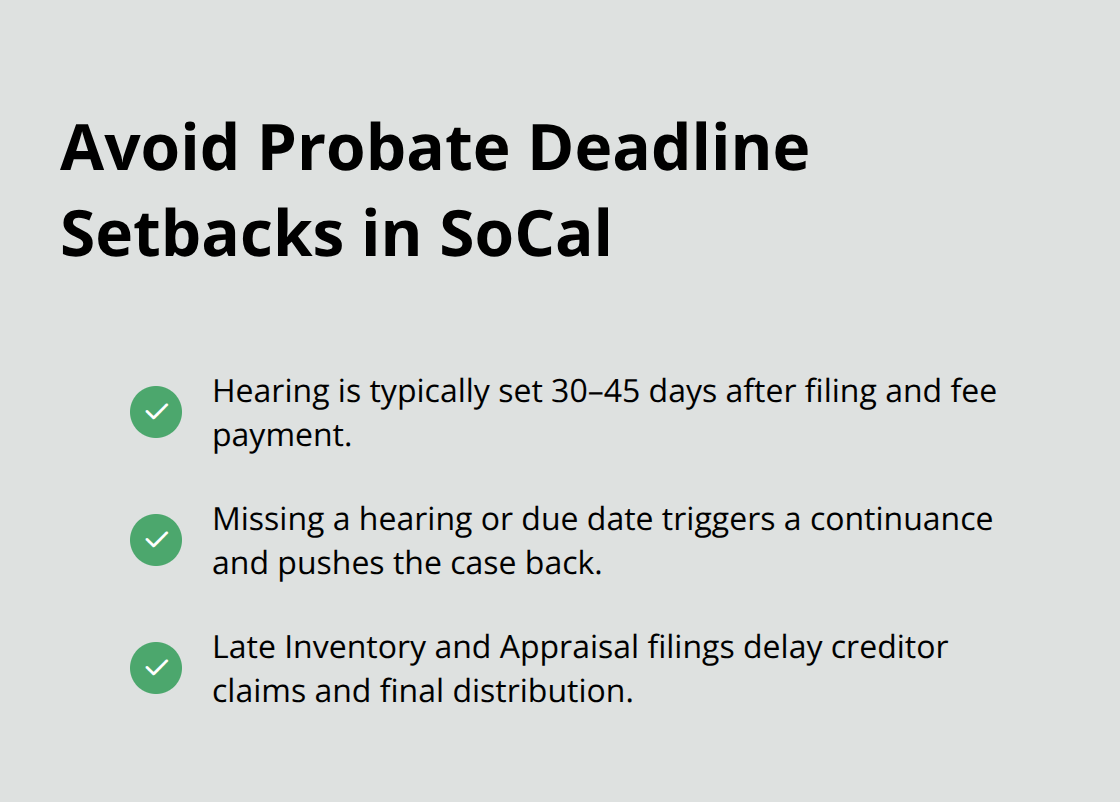
Orange County probate courts process hundreds of cases monthly, and missed deadlines move your case to the back of the queue.
Submitting Incomplete or Incorrect Paperwork
Many filers underestimate how long it takes to gather documents-bank statements, property deeds, investment account statements-and submit incomplete paperwork on their first attempt. Incomplete documentation forces the court to reject your filing, require corrections, and reschedule hearings. You must compile all required materials before submission to avoid multiple court visits and extended timelines. The cost of fixing these mistakes (court continuances, amended filings, attorney time to correct paperwork) often exceeds what proper planning would have cost upfront.
Failing to Notify Heirs and Beneficiaries Properly
You must notify heirs and beneficiaries formally through a neutral third party, not yourself, to create a proper proof of service record. Many executors notify family members personally and assume that satisfies the legal requirement; it does not. The court requires official notices mailed by someone other than the executor to prevent disputes later. If your proof of service is missing or improper, beneficiaries can object, the court sustains those objections, and you restart notification procedures entirely.
Understanding County-Specific Requirements
Southern California courts have county-specific quirks that affect your filing strategy. Some courts require particular forms or filing procedures that differ slightly from neighboring counties. Filing in the wrong location tops the list of avoidable errors in Los Angeles County and surrounding areas. Not knowing these local requirements means your paperwork arrives incomplete or in the wrong format, triggering rejection and delay. Understanding your specific county’s requirements before you file prevents costly mistakes and keeps your probate moving forward.
The path to efficient probate filing depends on preparation and attention to detail. Once you understand what mistakes derail cases in your county, you can focus on the strategic approaches that actually save time and money-and that’s where the real wins happen.
How to Speed Up Probate Without Court Delays
Qualify for Simplified Probate First
Southern California probate moves faster when you eliminate procedural roadblocks before they happen. The most direct path forward depends on your estate’s size, asset type, and whether you qualify for simplified procedures that bypass formal probate entirely. As of April 1, 2025, California raised the threshold for real property petitions to $750,000 for a decedent’s main home, which means far more estates now qualify for quick-path alternatives. If your estate’s total value falls under $208,850, you can transfer personal property using a Small Estate Affidavit without court involvement. A surviving spouse with community property under $20,875 can file a Spousal Property Petition and obtain a court order in weeks rather than months.
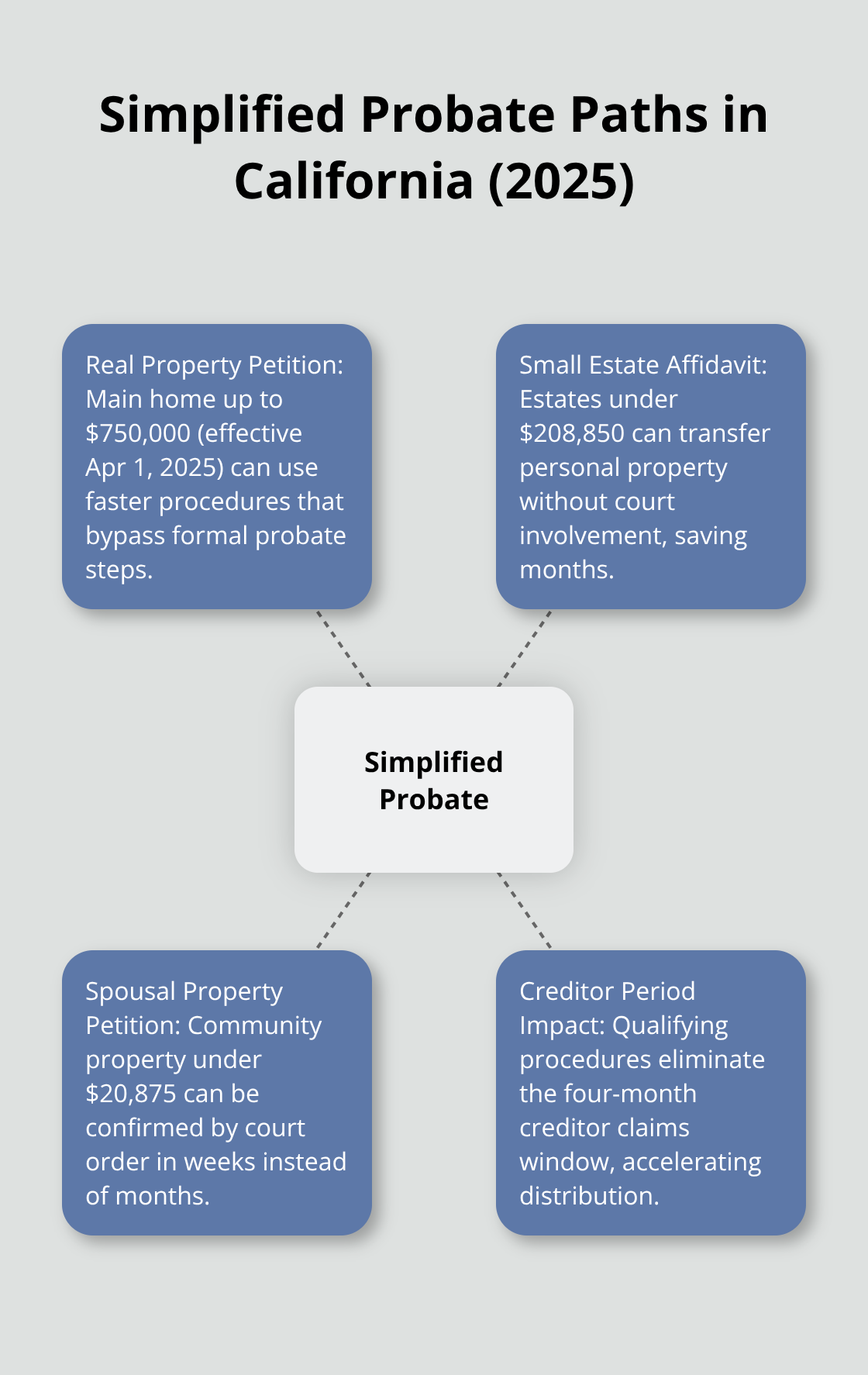
These procedures eliminate the four-month creditor claims period entirely when you qualify.
Before you file anything, calculate your exact estate value and asset breakdown. If the house, bank accounts, retirement funds, and personal property total less than the threshold for your situation, simplified probate saves you thousands in court costs and attorney time. Many executors skip this step and file for formal probate unnecessarily, burning months and money on a process they never needed.
Organize Your Documents Before Filing
When simplified probate doesn’t apply, proper document organization determines whether your formal filing moves smoothly or gets stuck in court backlogs. Gather every bank statement, property deed, investment account statement, and title document before submitting your Petition for Probate. Orange County probate courts reject incomplete filings within days, forcing you to resubmit and wait another 30–45 days for a hearing. Create a probate asset inventory listing each asset, its current value, how it’s titled, and whether it passes outside probate through beneficiary designation or joint ownership. This single document prevents the Inventory and Appraisal stage from becoming a bottleneck.
Know Your County’s Specific Requirements
Your local county court maintains specific filing requirements that vary across Southern California. Los Angeles County courts expect particular formatting on the DE-111 petition form, and Riverside County may require different proof-of-service procedures. Call your county’s probate department before filing and ask what documents they need, what format they accept, and whether they maintain an online filing portal. Some Southern California courts now accept electronic filings through their portals, which speeds up processing by days. Verifying these details with your specific county clerk’s office prevents delays, as requirements shift and what worked last year may not work this year. Once you understand your county’s exact procedures, your filing arrives complete on the first attempt, your hearing date stays on the calendar, and your probate advances without continuances.
How Southern California Courts Process Probate
County-Specific Timelines and Backlogs
Southern California probate doesn’t follow a one-size-fits-all timeline because each county’s court operates independently with different backlogs, staffing, and local rules. Orange County probate courts in the Costa Mesa Justice Complex handle probate differently than Los Angeles County or Riverside County courts, and your specific county’s pace matters more than state averages. The mandatory four-month creditor claims period under California Probate Code Section 9100 anchors every probate case, but the time before that window opens and after it closes varies dramatically by county. In less congested counties, you file your Petition for Probate with the $435 filing fee and receive a hearing scheduled 30–45 days later with minimal delays. Court backlogs in Southern California counties can push that initial hearing 60–90 days out, meaning your creditor window doesn’t even begin until months after you filed.
Asset Valuation and Appraisal Stages
The Inventory and Appraisal stage typically takes 30–60 days once you file the DE-160 form, though probate referees in busy counties may take longer to value non-cash assets. Real estate appraisals in Southern California counties with volatile property markets extend this stage further because referees must account for current market conditions. After the creditor window closes at month four, you face the Petition for Final Distribution stage around months nine through twelve, but Orange County courts might close your case by month ten while Los Angeles County estates often stretch to month fourteen or beyond.
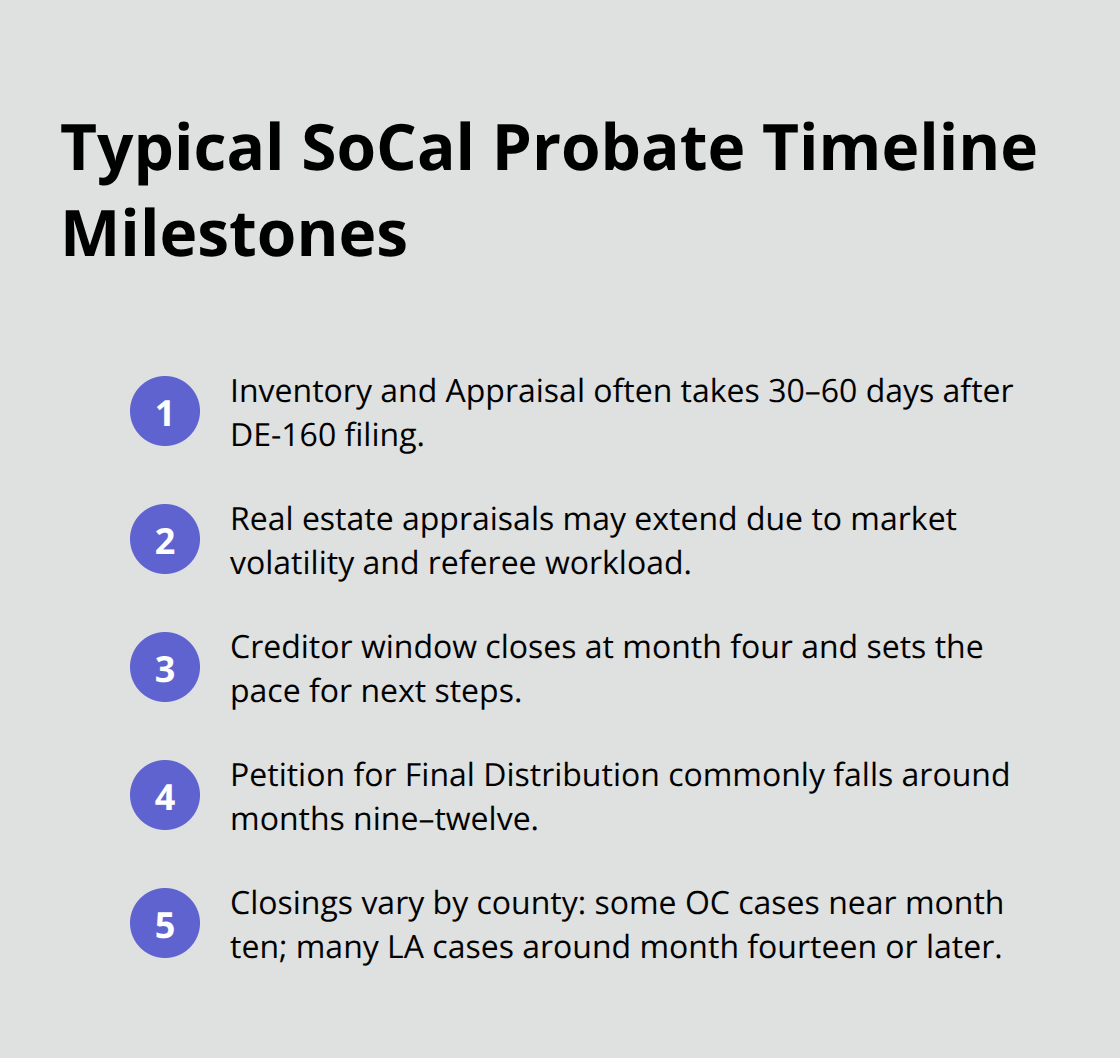
If federal estate taxes apply to estates exceeding the 2024 federal exemption of $13.61 million, add two to four additional months for IRS processing and final distribution delays.
Required Documents at Each Stage
When you file the Petition for Probate form DE-111, the court requires the original will (if one exists) and certified death certificate copies-typically five to ten copies prevent you from returning to the county clerk repeatedly. Within weeks, you file the DE-147 form accepting the personal representative role, which creates the legal contract binding you to manage assets and account for every dollar. The DE-157 Notice of Administration must be mailed by a neutral third party, not yourself, to establish a formal proof of service that beneficiaries cannot later challenge; mailing it yourself, even with good intentions, invalidates the notice and forces you to restart.
Inventory, Appraisal, and Creditor Claims
Around month three, file the DE-160 Inventory and Appraisal listing every asset with current fair-market valuations; non-cash property requires the probate referee’s assessment, and that fee typically runs around 0.1 percent of gross assets with minimums applying. The creditor claims process demands you publish notice in a local newspaper (your county clerk specifies which publication) and mail formal notice to known creditors; the court tracks these deadlines precisely, and missing publication deadlines extends the entire timeline by weeks.
Final Distribution and Property Recording
At final distribution, the DE-350 Petition for Final Distribution summarizes your complete accounting, the proposed distribution plan, and includes a court hearing with notice to all beneficiaries; this document must reconcile every penny received and spent. Property transfers require recording-real estate deeds get recorded with the county recorder’s office, and beneficiary transfers need signatures from you as the personal representative with proof you held authority. Your county’s probate court website lists the exact forms required and often provides fillable PDFs, but call the probate department directly to confirm whether your county accepts electronic filing through their portal, as some Southern California courts now process submissions digitally while others require paper copies mailed or delivered in person.
Final Thoughts
Probate court tips for SoCal filers come down to three actionable steps: qualify for simplified procedures when your estate allows, organize documents before filing, and understand your specific county’s requirements. Missing the four-month creditor claims deadline costs months of delay, submitting incomplete paperwork forces court rejections and rescheduled hearings, and failing to notify beneficiaries through proper channels invites objections that restart the entire process. These mistakes are avoidable when you prepare strategically upfront.
Calculate whether you qualify for a Small Estate Affidavit, Spousal Property Petition, or real property petition under the April 1, 2025 thresholds, as simplified probate applies to far more estates than most executors realize. If formal probate is necessary, gather every bank statement, property deed, and investment account statement before submitting your Petition for Probate, then call your county’s probate department and confirm their specific filing requirements, acceptable formats, and whether they accept electronic submissions through their portal. These steps prevent delays that would otherwise extend your timeline by months and multiply your costs.
We at Law Offices of Roshni T. Desai understand the county-specific challenges and practical obstacles executors face across Southern California, and we provide personalized guidance tailored to your situation and your county’s requirements. Contact us for a free consultation to map out your probate filing strategy and avoid the costly mistakes that derail cases in your area.