




Independent Administration of Estates Act California: A Guide for Executors
The Independent Administration of Estates Act in California can make a probate estate far easier to manage. Without it, a personal representative, often called the executor, may need a court order before taking many ordinary steps, from selling property to settling a dispute with a creditor. With it, many of those decisions can be made directly, as long as the right notices go to the right people at the right time.
At Law Offices of Roshni T. Desai, we help executors and administrators throughout Orange County and Southern California settle estates with clarity and care, so you can move forward with confidence. This guide explains what independent administration actually allows, how the notice of proposed action process works, and the mistakes that most often cause problems for personal representatives.
What Independent Administration Actually Means in California
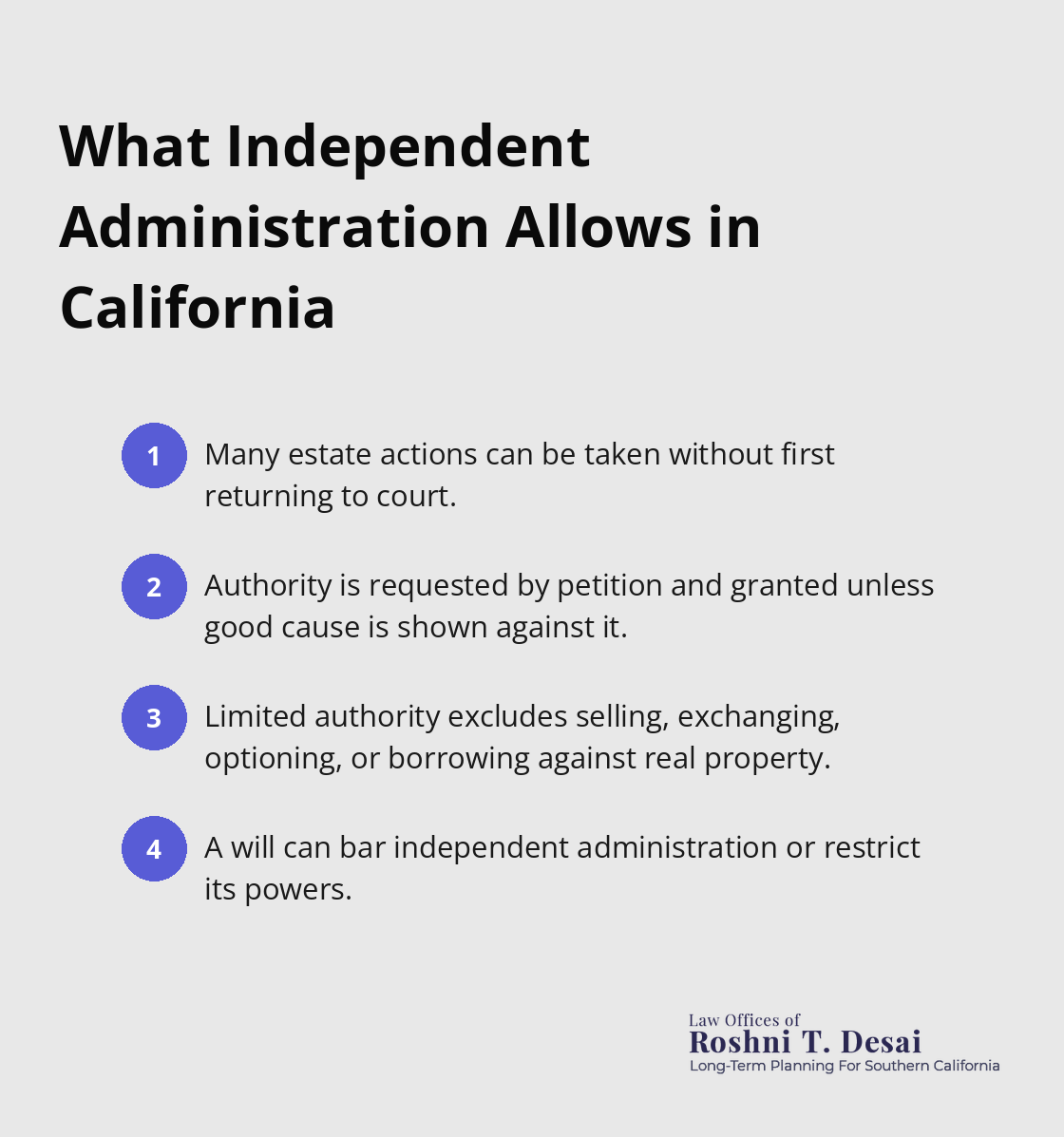
California’s rules for independent administration appear in Part 6 of Division 7 of the Probate Code, sections 10400 through 10592. The idea is simple. In a traditional probate, many actions require what the code calls court supervision, which section 10401 defines as the judicial order, authorization, approval, confirmation, or instructions that would be required if independent authority had not been granted. Independent administration lets a personal representative take many of those actions without first returning to court, while still giving heirs and beneficiaries a meaningful way to speak up.
How a Personal Representative Requests Authority
Authority under the Act is not automatic. Section 10450 provides that the personal representative must petition the court for it, either in the petition for appointment or in a separate petition filed in the estate proceeding. Under section 10452, the court shall grant the requested authority unless an interested person objects and the court determines that the objecting party has shown good cause why it should not be granted. If the objector shows good cause only for a narrower grant, the court grants limited authority instead.
Full Authority Versus Limited Authority
The petition can ask for either full or limited authority. Section 10402 defines full authority as authority that includes all the powers granted under the Act. Section 10403 defines limited authority as including all of those powers except the power to sell real property, exchange real property, grant an option to purchase real property, or borrow money with the loan secured by an encumbrance on real property. For many estates, the difference comes down to whether a house or other real estate will need to be sold. When only limited authority is granted, the letters issued to the personal representative carry a notation reflecting that limitation.
When a Will Can Change the Picture
The decedent’s own wishes still matter. Section 10404 states that a personal representative may not be granted authority under the Act if the will provides that the estate shall not be administered under this part. Section 10502 adds that the will may restrict the powers the personal representative may exercise. Reviewing the will carefully before filing the petition helps you avoid requesting powers the document does not allow and sets realistic expectations for how the estate will be handled.
How the Notice of Proposed Action Process Works
Independent authority does not mean acting in secret. For many significant decisions, the Act requires the personal representative to tell affected heirs and beneficiaries in advance through a notice of proposed action. That notice gives them a chance to object before anything happens. Understanding who must receive it, what it must say, and how much time must pass is central to using independent authority correctly.
Which Actions Require Advance Notice
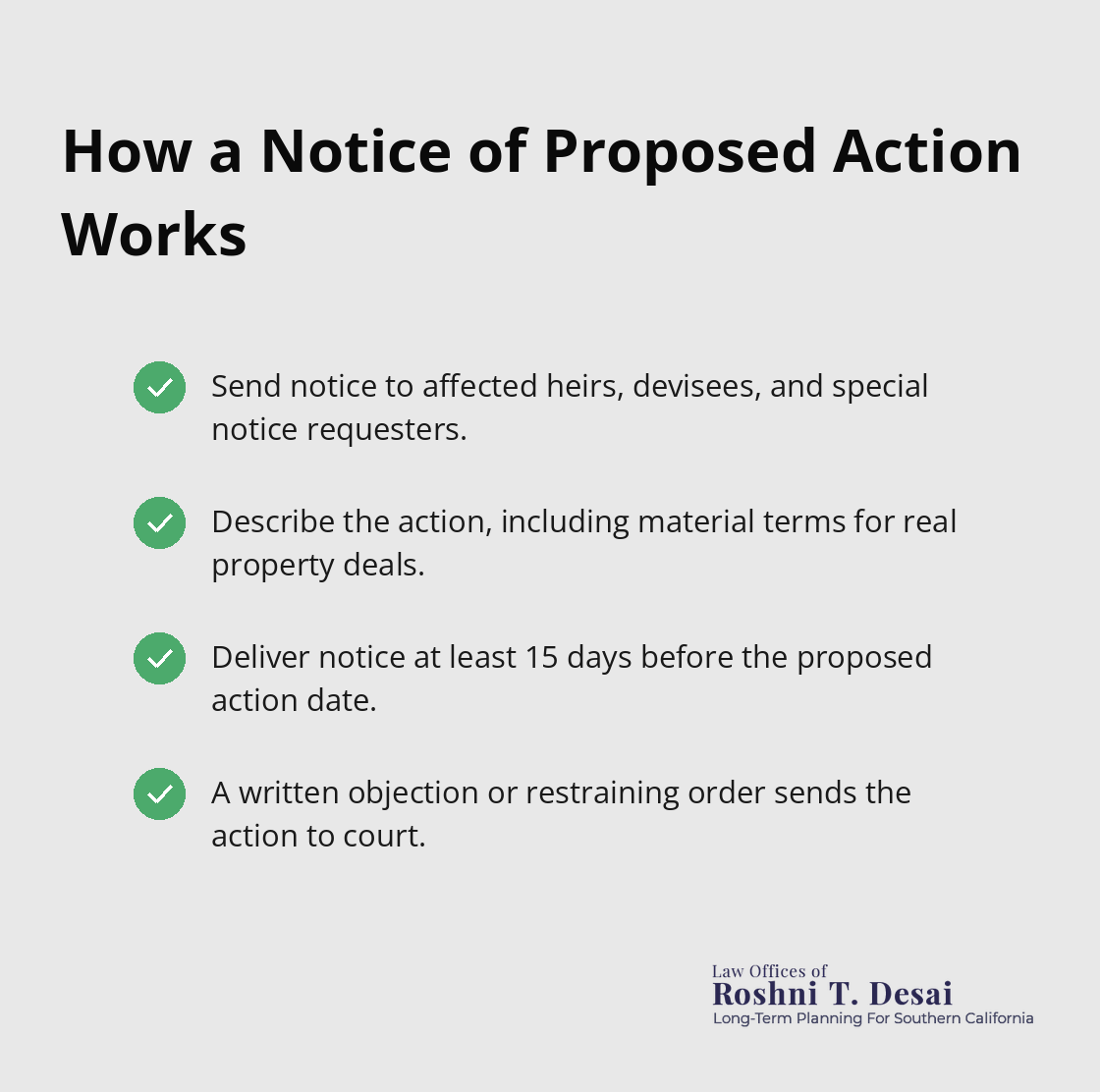
Section 10580 requires a personal representative to give notice of proposed action before taking an action without court supervision whenever the provision granting that power requires it. Article 2 of Chapter 3 of the Act is titled “Powers Exercisable Only After Giving Notice of Proposed Action,” and it includes section 10511, which gives a personal representative with full authority the power to sell or exchange real property of the estate. Section 10580 also allows a personal representative to give notice voluntarily even when it is not required, which can be a sensible way to keep everyone informed about a sensitive decision.
Who Receives the Notice and What It Must Say
Section 10581 lists the people entitled to notice: each known devisee and each known heir whose interest would be affected by the proposed action, each person who has filed a request for special notice in the proceeding, and the Attorney General if any part of the estate is to escheat to the state and that interest would be affected. Section 10585 requires the notice to state the personal representative’s name and contact information, the name of a person who may be contacted for more details, a reasonably specific description of the proposed action, and the date on or after which the action will be taken. For a sale, exchange, or option involving real property, the notice must state the material terms of the transaction. The Judicial Council’s Notice of Proposed Action form may be used.
The 15-Day Waiting Period
Timing is built into the statute. Section 10586 requires that the notice be delivered to each person entitled to it not less than 15 days before the date specified in the notice on or after which the action is to be taken. If the notice is mailed, it must go to the person’s last known address. Planning around this window matters, particularly when a buyer or escrow company is working on a schedule, so it helps to send notices as soon as the terms are settled.
How Beneficiaries Can Object
Under section 10587, a person entitled to notice may object by delivering a written objection to the personal representative at the address stated in the notice, using the Judicial Council form or any writing that identifies the proposed action with reasonable certainty. Section 10588 also allows that person to ask the court for an order restraining the personal representative from acting without court supervision, and the court shall grant the order without requiring notice to the personal representative and without cause being shown. Once the personal representative has notice of an objection or restraining order, section 10589 requires the action to proceed under the code’s court supervision rules, or through instructions from the court when supervision would not otherwise be required.
Mistakes That Derail Independent Administration
Independent authority is a powerful tool, but it comes with firm limits. Most problems arise when a personal representative assumes the authority covers more than it does, skips a notice step, or overlooks how beneficiaries can challenge decisions. The issues below are the ones that most often turn a smooth administration into a contested one.
Assuming Every Decision Is Covered
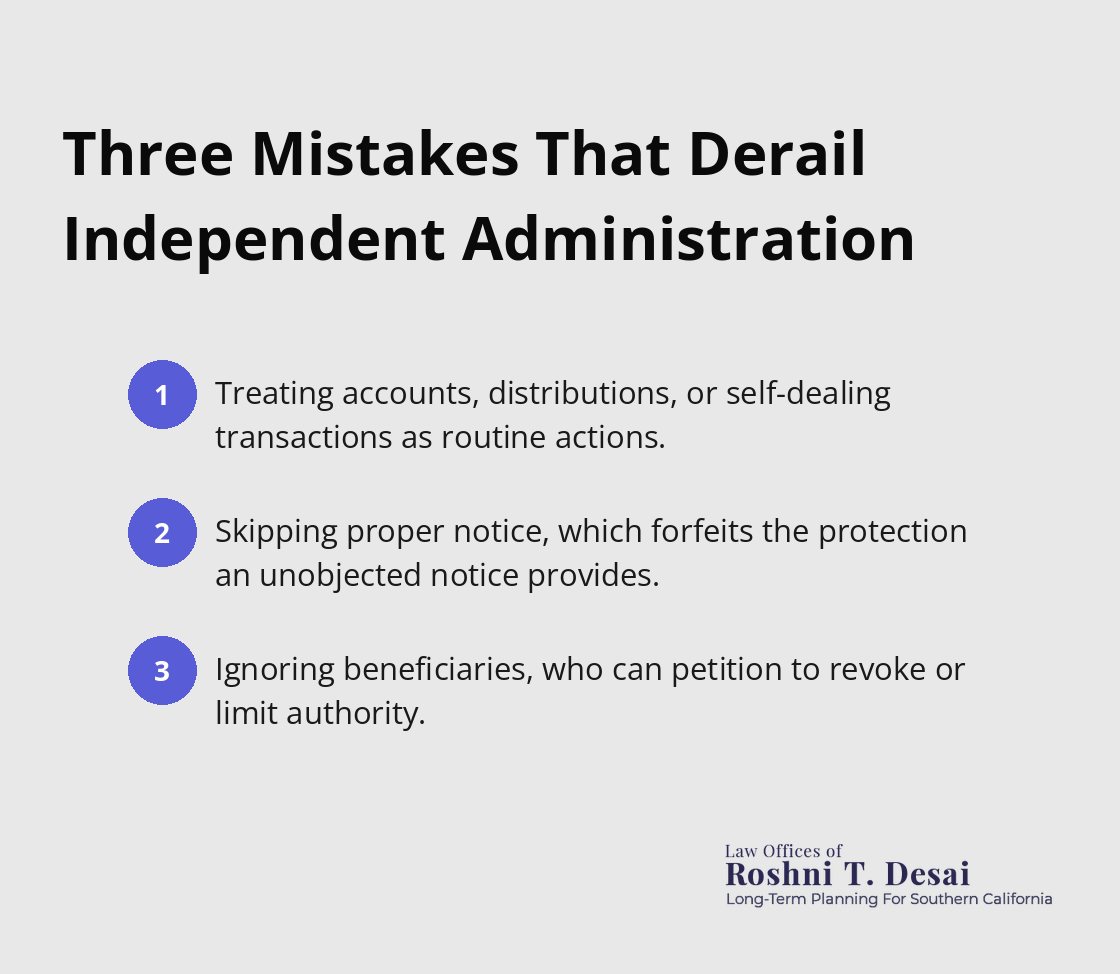
Section 10501 lists actions that always require court supervision, whether the personal representative holds full or limited authority. They include the settlement of accounts, preliminary and final distributions and discharge, and transactions between the estate and the personal representative or the personal representative’s attorney, such as a sale, exchange, or option to purchase estate property, or the payment or compromise of their own claims against the estate. Treating those matters as routine independent actions invites objections, delays, and difficult questions from the court.
Skipping or Rushing the Notice
Notice protects the personal representative as much as the beneficiaries. Section 10590 provides that a person entitled to notice who receives a proper notice of proposed action and fails to object as the statute provides generally waives the right to have the court review the action after it is taken. That protection depends on doing the notice correctly, with the required content and timing. The court may still review the action if a person shows that he or she did not actually receive the notice in time, or if an heir or devisee was a minor or lacked capacity and the guardian, conservator, or other legal representative did not receive notice or consent.
Overlooking the Risk of Revocation
Authority can be taken away. Section 10454 allows any interested person to petition the court to revoke the personal representative’s independent authority or to reduce full authority to limited authority. If the court finds good cause, it must make the order, and new letters are issued to reflect the change. Keeping beneficiaries informed, documenting decisions, and following every notice requirement are the best ways to preserve the flexibility that independent administration offers.
Final Thoughts
The Independent Administration of Estates Act gives California personal representatives a practical way to move an estate forward without a court hearing for every decision. Sections 10450 through 10454 explain how authority is granted and revoked, section 10501 lists what still requires court supervision, and sections 10580 through 10592 set out the notice of proposed action process that keeps heirs and beneficiaries informed.
Used well, independent authority can make administration smoother from appointment through closing a probate estate. Used carelessly, it can lead to objections, restraining orders, and court review that slow everything down.
If you have been named executor or administrator of an estate in Orange County or elsewhere in Southern California, contact Law Offices of Roshni T. Desai to speak with our team. We will review the estate, explain whether full or limited authority fits your situation, and help you take a practical next step.