




Amending a Living Trust California: How to Change a Revocable Trust the Right Way
Amending a living trust in California is one of the most common estate planning tasks, and one of the easiest to get wrong. Families change, property is bought and sold, and the people you trust to manage your affairs may not be the same people you chose years ago. A revocable trust is designed to change with your life, but only if the change is made in a way the law and your trust document recognize. Understanding the rules gives you real control over how your plan works when it matters most.
At Law Offices of Roshni T. Desai, we help California families keep their trusts current and enforceable so you can move forward with confidence. This guide walks you through what California law actually says about changing a revocable trust, the steps for making an amendment or restatement, and the mistakes that most often lead to confusion or disputes later.
What California Law Actually Says About Changing a Living Trust
Most living trusts in California are revocable trusts. The person who creates the trust, called the settlor or trustor, transfers property into the trust, usually serves as the first trustee, and keeps the power to change or cancel the trust during life. That flexibility is the main reason people choose a revocable trust, but the power to change the trust comes with specific legal requirements.
California’s Trust Law, found in Division 9 of the Probate Code, sets the default rules. Your trust document can add to those rules or, in some cases, replace them. That is why the first step in any amendment is reading what your own trust says about how changes must be made.
Revocable Unless Expressly Made Irrevocable
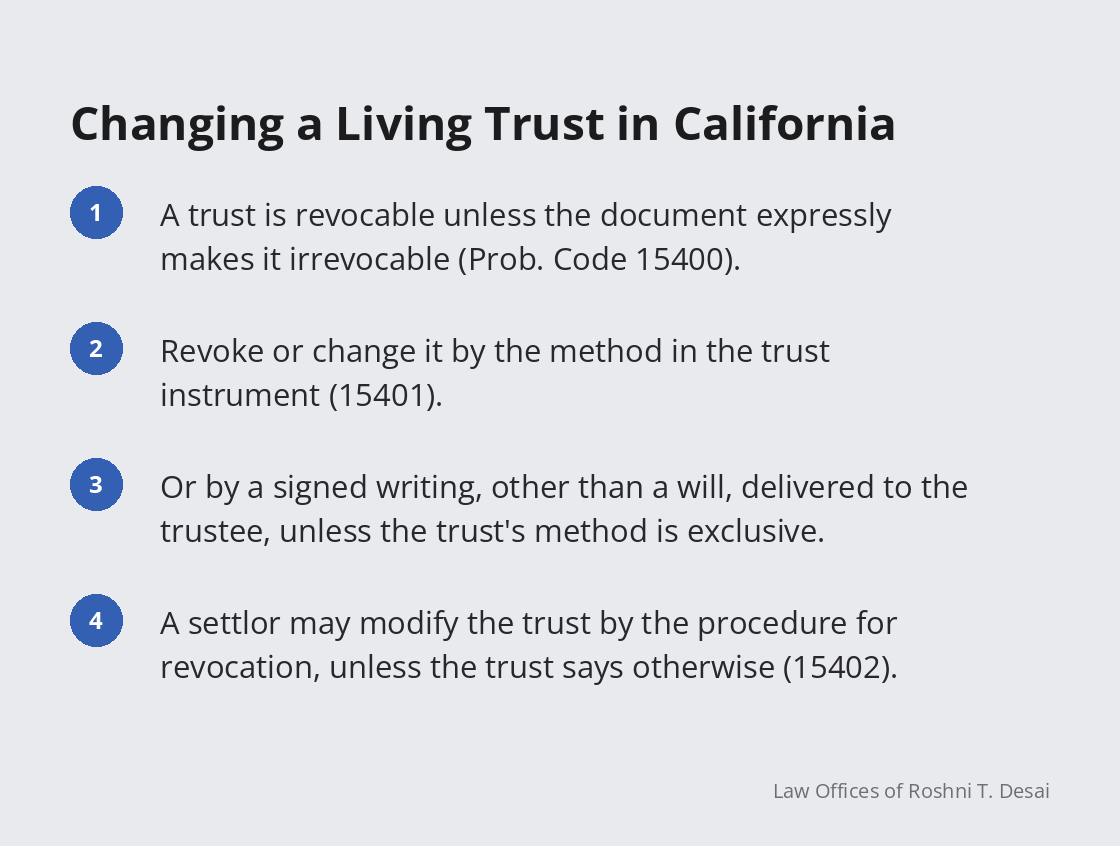
California starts from a presumption of flexibility. Under Probate Code Section 15400, unless a trust is expressly made irrevocable by the trust instrument, the trust is revocable by the settlor. The statute applies when the settlor was domiciled in California when the trust was created, when the trust instrument was executed in California, or when the trust instrument provides that California law governs. In practice, most living trusts state clearly that they are revocable, and many also state that they become irrevocable at the settlor’s death.
The Two Ways to Revoke or Change a Trust
Probate Code Section 15401 provides two methods for revoking a revocable trust in whole or in part. The first is compliance with any method of revocation provided in the trust instrument. The second is a writing, other than a will, signed by the settlor and delivered to the trustee during the settlor’s lifetime. That second method has an important limit: if the trust instrument explicitly makes its own method the exclusive method of revocation, the signed-writing option is not available. Probate Code Section 15402 then ties modification to revocation, stating that unless the trust instrument provides otherwise, a settlor may modify the trust by the procedure for revocation.
Who Holds the Rights While the Trust Is Revocable
While you are alive and competent, the trust works for you. Probate Code Section 15800 provides that, unless the trust instrument otherwise provides, during the time a trust is revocable and at least one person holding the power to revoke is competent, that person, and not the beneficiaries, has the rights afforded beneficiaries, and the trustee’s duties are owed to the person holding the power to revoke. This is one reason beneficiaries generally cannot block changes you make to your own revocable trust.
How to Amend or Restate a Revocable Trust Step by Step
Once you understand the legal framework, the practical process is straightforward. The goal is to create a clear written record that follows your trust’s instructions, leaves no doubt about what you intended, and is easy for a successor trustee to find and follow years from now.
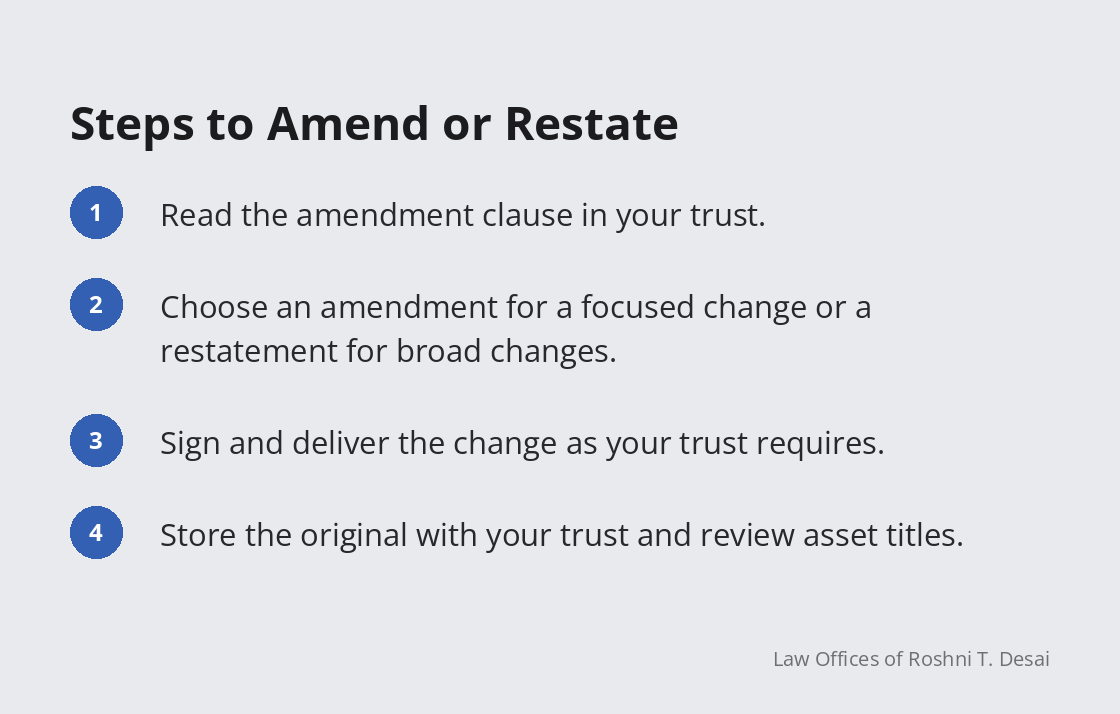
The steps below reflect the way careful planning is typically done. Each one is aimed at preventing questions later, when you may no longer be available to explain what you meant.
Read the Amendment Clause in Your Trust
Start with the trust document itself. Most trusts include a section describing how the trust may be amended or revoked, who may do it, and how the change must be delivered. Some trusts require a signed writing delivered to the trustee. Others require specific formalities, such as notarization or the signature of both spouses for certain property. Because Section 15401 allows the trust’s own method to be made exclusive, following the document’s instructions precisely is the safest approach.
Choosing Between an Amendment and a Restatement
A trust amendment changes specific provisions while leaving the rest of the trust in place. It works well for a single, focused change, such as naming a new successor trustee or adjusting a specific gift. A restatement replaces the entire set of trust terms with a new, complete document while keeping the original trust in existence, which can matter for property already titled in the trust’s name. California’s Trust Law recognizes restatements; Section 15800, for example, refers to a trust that “has been completely restated.” When a trust has accumulated several amendments or you are making broad changes, a restatement is often clearer for everyone who will read it later.
Signing, Delivering, and Storing the Change
An amendment is only as reliable as the record that proves it. Sign and date the amendment in the manner your trust requires, make sure it is delivered to the trustee if the trust or statute calls for delivery, and keep the signed original with your trust document. If you serve as your own trustee, keeping the amendment with the trust records is especially important so your successor trustee can find it. Review your asset titles at the same time; changing the terms of a trust does not automatically move new property into it, which is why many plans pair the trust with a pour-over will.
Common Mistakes That Undermine a Trust Amendment
Trust amendments often fail for reasons that have nothing to do with what the settlor wanted. A missing signature, a change scribbled in the margin, or an amendment no one can find can leave a family arguing over which version of the trust controls. Many of these problems only surface after the settlor has died, when the trust has typically become irrevocable and the person who could have clarified the change is gone.
The good news is that most of these mistakes are avoidable with a careful process and a periodic review of your plan.
Handwritten Notes and Informal Changes
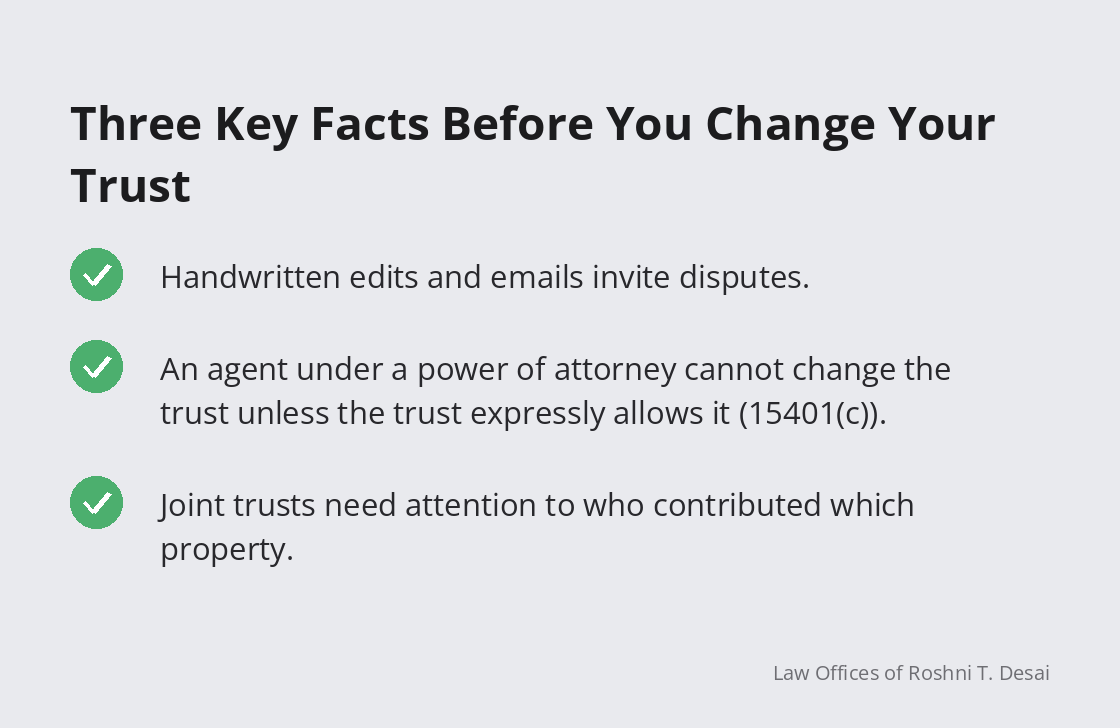
It is tempting to cross out a name on your trust and write in a new one, or to send an email describing the change you want. Informal changes like these invite disputes because they may not satisfy the method your trust requires or the signed-writing method in Section 15401. A successor trustee faced with a handwritten note may not know whether to follow it, and beneficiaries who would lose out under the change have every reason to challenge it. A formal, signed amendment that follows the trust’s instructions removes that uncertainty.
Trying to Change a Trust Through a Will or an Agent
Two shortcuts often cause trouble. First, the signed-writing method in Section 15401 specifically excludes a will, so a later will that tries to rewrite your trust may not accomplish what you intended unless your trust document allows it. Second, Section 15401(c) provides that a trust may not be modified or revoked by an attorney in fact under a power of attorney unless it is expressly permitted by the trust instrument. If you want a trusted agent to be able to make limited changes if you become unable to act, that authority must be written into the trust itself, and coordinated with your durable power of attorney.
Overlooking Joint Trusts and Capacity Concerns
Married couples frequently create a single joint trust. Under Section 15401(b), unless the trust instrument provides otherwise, when a trust is created by more than one settlor, each settlor may revoke the trust as to the portion contributed by that settlor, subject to an exception for certain community property under the Family Code. Changes to a joint trust therefore need careful attention to who contributed which property and what the document requires. Timing also matters. An amendment made when the settlor’s mental capacity is in question, or under pressure from someone who benefits, is more likely to be challenged. Making changes while you are healthy, with clear documentation, protects both your wishes and your family. Once a settlor has passed away, the options are far narrower, as we explain in our guide to changing a trust after death.
Final Thoughts
A revocable living trust is meant to evolve with your life, and California law gives you the power to change it. That power works best when you follow your trust’s amendment clause, choose the right tool for the change, sign and deliver the document properly, and keep the records where your successor trustee will find them. Small shortcuts, such as handwritten edits or relying on a will or an agent to make changes, can undo careful planning.
Reviewing your trust after major life events, such as a marriage, divorce, birth, death, move, or significant property purchase, keeps your plan aligned with your wishes and reduces the chance of disputes among the people you care about.
If you are thinking about updating your living trust, contact Law Offices of Roshni T. Desai to speak with our estate planning team in California. We’ll review your current trust, explain your options, and help you make changes that hold up when your family needs them.