




Changing a Trust After Death California: What Spouses and Beneficiaries Can Do
Changing a trust after death in California is one of the most common questions families raise once a loved one has passed. A surviving spouse may want to adjust a plan that no longer fits, or beneficiaries may agree that the original terms no longer make sense. California law does allow some changes after a settlor’s death, but the options are narrower than many people expect, and the right path depends on what the trust says, who created it, and whether every beneficiary agrees. Understanding those rules gives you real control over what happens next.
At Law Offices of Roshni T. Desai, we help surviving spouses, trustees, and beneficiaries throughout Southern California understand their options during trust administration, so you can move forward with confidence. This guide explains what actually happens to a living trust when a settlor dies, how changes can still be made, and the mistakes that most often lead to disputes.
What Actually Happens to a Living Trust When the Settlor Dies
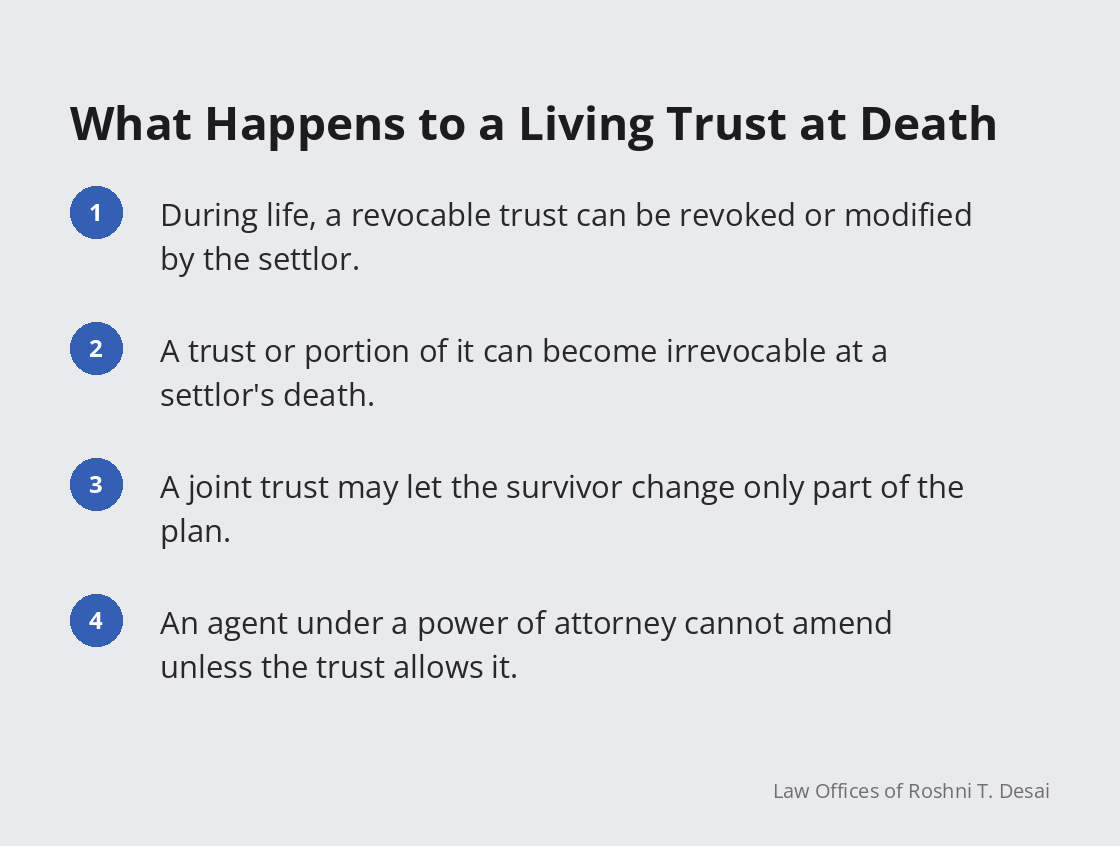
A living trust is usually built to be flexible while the person who created it is alive. California Probate Code Section 15400 provides that unless a trust is expressly made irrevocable by the trust instrument, the trust is revocable by the settlor. Section 15402 adds that, unless the trust instrument provides otherwise, a settlor who can revoke a trust may also modify it by the same procedure used for revocation. During life, that means the settlor holds most of the power to rewrite the plan. Death changes that picture, because the person who held the power to revoke or amend is no longer able to use it.
The Shift From Revocable to Irrevocable
California law treats a settlor’s death as a turning point. Probate Code Section 16061.7 requires a trustee to serve a notification when a revocable trust, or any portion of it, becomes irrevocable because of the death of one or more of the settlors. That language reflects what happens in most living trusts: the flexibility the settlor enjoyed ends when the settlor dies, and the successor trustee must follow the written terms rather than the wishes that family members believe the settlor would have had. Section 15401 also states that a written revocation must be signed and delivered to the trustee during the lifetime of the settlor or other person holding the power of revocation, which is why the method and timing of any amendment matter so much.
Joint Trusts and Surviving Spouses
Many married couples in California create a single joint trust. Section 15401(b) provides that, unless the instrument says otherwise, when a trust is created by more than one settlor, each settlor may revoke the trust as to the portion contributed by that settlor, subject to Section 761 of the Family Code. The same section allows a settlor to grant another person, including a spouse, a power to revoke that settlor’s portion that continues after the settlor’s death. Whether a surviving spouse can change part of the trust therefore depends heavily on how the document was drafted. Some joint trusts leave the survivor’s share fully revocable while locking the deceased spouse’s share in place, and others give the survivor broader authority.
Who Cannot Make Changes
Family members sometimes assume that the person who held a power of attorney for the settlor can step in and update the trust. Section 15401(c) provides that a trust may not be modified or revoked by an attorney in fact under a power of attorney unless the trust instrument expressly permits it. A successor trustee also has no general authority to rewrite the trust simply because circumstances have changed. The trustee’s job is to carry out the trust as written, and any change to the beneficiaries or the distribution plan must come from a route the law recognizes.
How Changes Can Still Be Made After Death in California
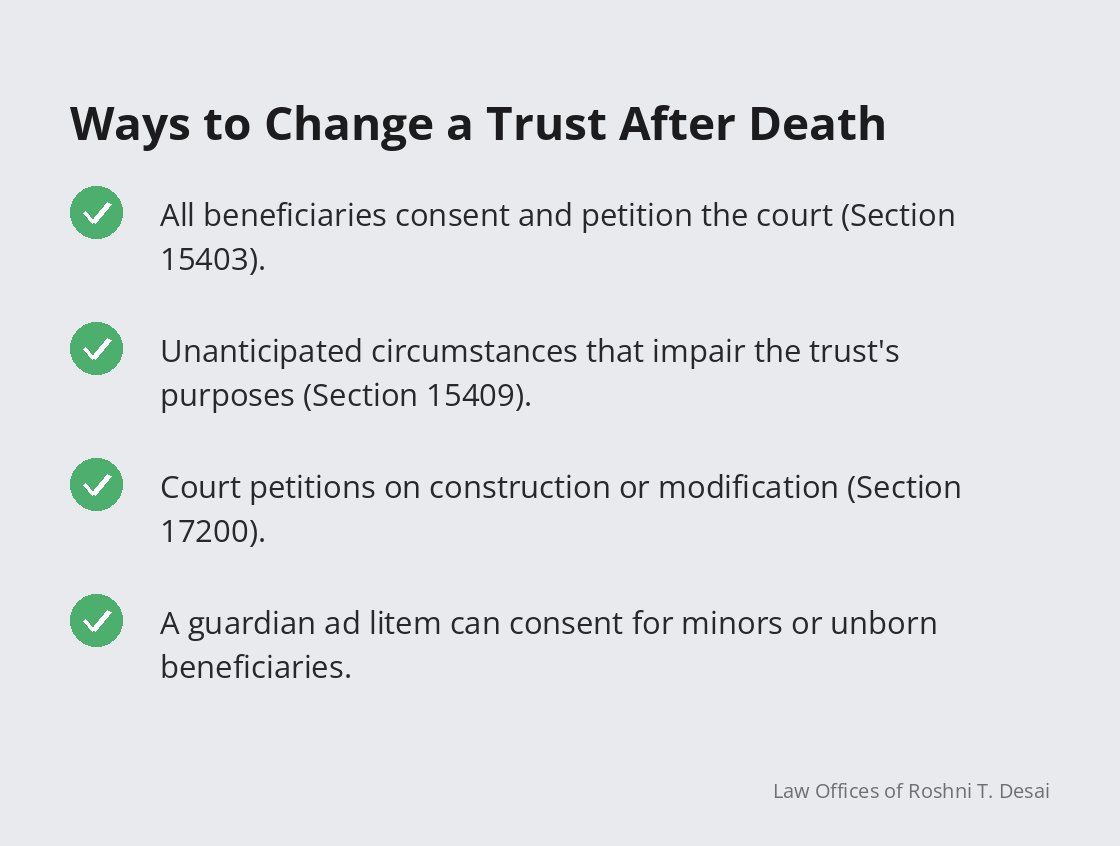
Even when a trust has become irrevocable, California law provides several paths for modification. Each one has its own requirements, and most involve the probate court. Choosing the right path depends on whether the beneficiaries agree, what the trust was meant to accomplish, and whether circumstances have arisen that the settlor never anticipated.
Modification by Consent of All Beneficiaries
Probate Code Section 15403(a) provides that if all beneficiaries of an irrevocable trust consent, they may petition the court for modification or termination of the trust. That consent must come from every beneficiary, not just a majority. Section 15403(b) adds an important limit: if continuing the trust is necessary to carry out a material purpose of the trust, the trust cannot be modified or terminated unless the court, in its discretion, determines that the reason for doing so outweighs the interest in accomplishing that material purpose. When a beneficiary lacks legal capacity, including a minor, or is unborn or not yet ascertained, Section 15405 allows consent to be given in court by a guardian ad litem where appropriate.
Changed Circumstances the Settlor Did Not Anticipate
Sometimes not every beneficiary agrees, but the trust simply no longer works. Section 15409 allows a trustee or beneficiary to petition the court to modify the administrative or dispositive provisions of a trust, or to terminate it, if, owing to circumstances not known to and not anticipated by the settlor, continuing the trust under its terms would defeat or substantially impair the accomplishment of its purposes. In that situation, the court may even order the trustee to do acts the trust instrument does not authorize or forbids, if necessary to carry out the trust’s purposes. This path focuses on honoring what the settlor was trying to achieve rather than on what the beneficiaries prefer.
Court Petitions Under Section 17200
Probate Code Section 17200 allows a trustee or beneficiary to petition the court concerning the internal affairs of a trust. The proceedings listed in the statute include determining questions of construction of a trust instrument and approving or directing the modification or termination of the trust. A construction petition can be especially useful when the real problem is unclear language rather than a desire to change the plan. Asking the court to interpret an ambiguous provision may resolve a disagreement without rewriting the trust at all. You can read more about related court tools in our guide to the Heggstad petition in California.
What Derails Trust Changes After a Death
Attempts to change a trust after death often fail for avoidable reasons. Families act informally, overlook a beneficiary, or miss deadlines that apply once the trust becomes irrevocable. Understanding these common problems can save months of conflict.
Informal Side Agreements
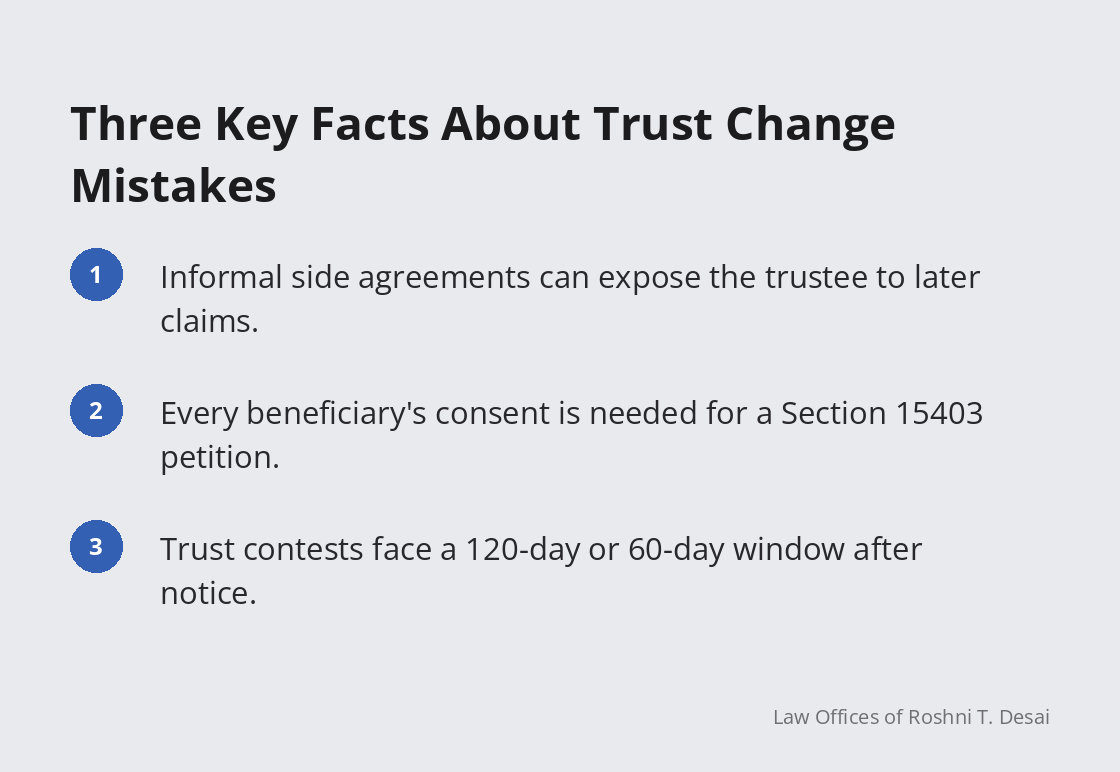
Beneficiaries sometimes agree among themselves to divide assets differently and ask the trustee to go along. Without a recognized legal route, such as a court-approved modification under Section 15403 or a distribution plan the trust itself allows, a trustee who departs from the written terms may face claims from a beneficiary who later changes their mind. Putting any agreement in writing and confirming that it fits within the trust terms or a court order protects both the trustee and the beneficiaries.
Overlooking a Beneficiary
Because Section 15403 requires the consent of all beneficiaries, leaving someone out can undermine the entire effort. Contingent beneficiaries, minor grandchildren, and people described by a class such as heirs are easy to overlook. Section 15403(c) allows the court, where a trust leaves principal to a class described only as heirs or next of kin, to limit the consenting class to beneficiaries reasonably likely to take, but that decision belongs to the court. Identify every beneficiary early and confirm who must consent before asking a court for help.
Missing the Trust Contest Window
Some family members want to change a trust because they believe the latest version is invalid. That is a contest, not a modification, and timing matters. Under Section 16061.7, when a trust becomes irrevocable because of a settlor’s death, the trustee’s notification must warn recipients that they may not bring an action to contest the trust more than 120 days from the date the notification is served, or 60 days from the date a copy of the trust terms is delivered during that 120-day period, whichever is later. Our article on the trustee notification in California explains that notice in detail.
Final Thoughts
Changing a trust after death in California is possible, but it rarely happens informally. Once a settlor dies, the trust or the deceased settlor’s portion usually becomes irrevocable, and changes generally require the consent of all beneficiaries and court approval, a showing of circumstances the settlor did not anticipate, or a petition asking the court to interpret or modify the trust. In joint trusts, the surviving spouse’s options depend on the specific language the couple used.
Before anyone signs an agreement or asks the trustee to depart from the written terms, review the trust document carefully, identify every beneficiary, and note any deadlines that may already be running.
If you are a surviving spouse, trustee, or beneficiary wondering whether a trust can be changed, contact Law Offices of Roshni T. Desai to speak with our trust administration team. We will review the trust, explain your options under California law, and help you take the next step with confidence.