




Ancillary Probate California: Handling Property Left by an Out-of-State Loved One
Ancillary probate in California comes into play when someone who lived in another state dies owning property here, such as a home, a rental, or a bank account held in a California institution. Families are often surprised to learn that opening probate in the home state does not automatically give anyone authority over California assets. A separate proceeding may be needed here, and it follows its own set of rules. Knowing how ancillary probate works gives you real control over the process and helps you avoid delays that can hold up the entire estate.
At the Law Offices of Roshni T. Desai, we help executors, families, and beneficiaries handle probate and trust administration in Southern California so you can move forward with confidence. This guide explains what ancillary probate actually is, how the process works in a California court, and the issues that most often complicate these cases.
What Ancillary Probate Actually Is in California
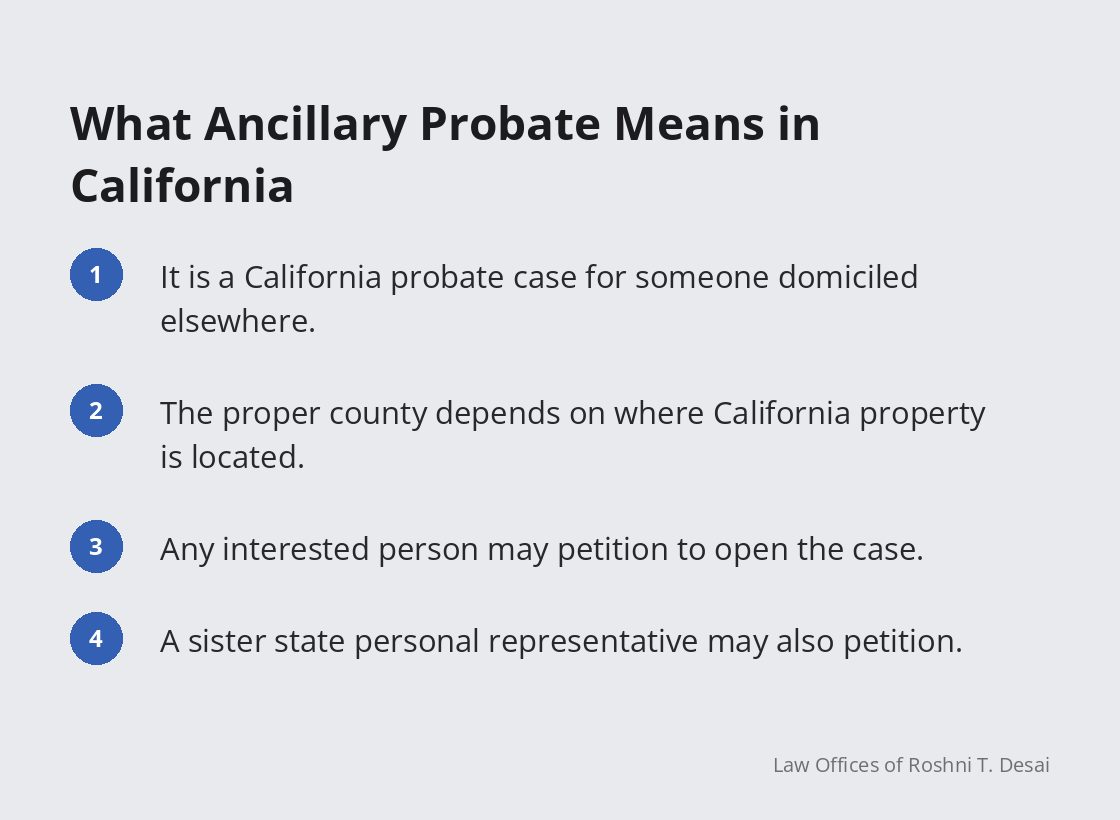
California Probate Code Section 12501 defines ancillary administration as proceedings in this state for administration of the estate of a nondomiciliary decedent. In plain terms, it is a California probate case for someone whose permanent home was somewhere else. The main probate case usually takes place in the state where the person lived, while the California case handles the property located here.
The rules for these cases appear in Part 13 of the Probate Code, which is devoted to nondomiciliary decedents. Those rules work alongside the regular California probate process rather than replacing it.
Domicile Versus Property Location
The key concept in ancillary probate is domicile, which is the place a person treats as his or her permanent home. A person who lived and was domiciled in Arizona, Nevada, or New York at the time of death is a nondomiciliary decedent for California purposes, even if that person spent part of each year in a California vacation home.
The location of the property matters just as much. California’s ancillary rules focus on property located in this state, and the proper court is chosen based on where that property is found. That is why families who inherit a California house, condominium, or rental from an out-of-state relative are often the first to encounter ancillary probate.
Which California County Handles the Case
California law sets out where an ancillary proceeding should be filed. Probate Code Section 12511 points to Section 7052 to determine the proper county. Under Section 7052, if property of the nondomiciliary decedent is located in the county where the decedent died, that county is the proper one.
If no property is located in the county where the decedent died, or if the decedent did not die in California, any county where property is located may be used. When property sits in more than one county, the proper county is the one where a petition for ancillary administration is first filed, and that court then has jurisdiction over the administration of the estate.
Who Can Start the Proceeding
Probate Code Section 12510 allows any interested person, or a personal representative appointed in a sister state or foreign nation, to start an ancillary administration by petitioning the court. The petition can ask for probate of the decedent’s will, appointment of a local personal representative, or both.
This means the executor named in the home state does not have to be the one who files. A beneficiary or another interested person can start the California case when that is more practical, though the court will still apply California’s rules about who should be appointed to serve.
How the Ancillary Probate Process Works
Once a petition is filed, an ancillary case follows much of the same path as any other California probate. There are a few important differences, however, especially when a will has already been accepted in another state.
Understanding these steps ahead of time can make the process smoother for the personal representative and for the beneficiaries waiting on distribution.
Using a Will Already Admitted in Another State
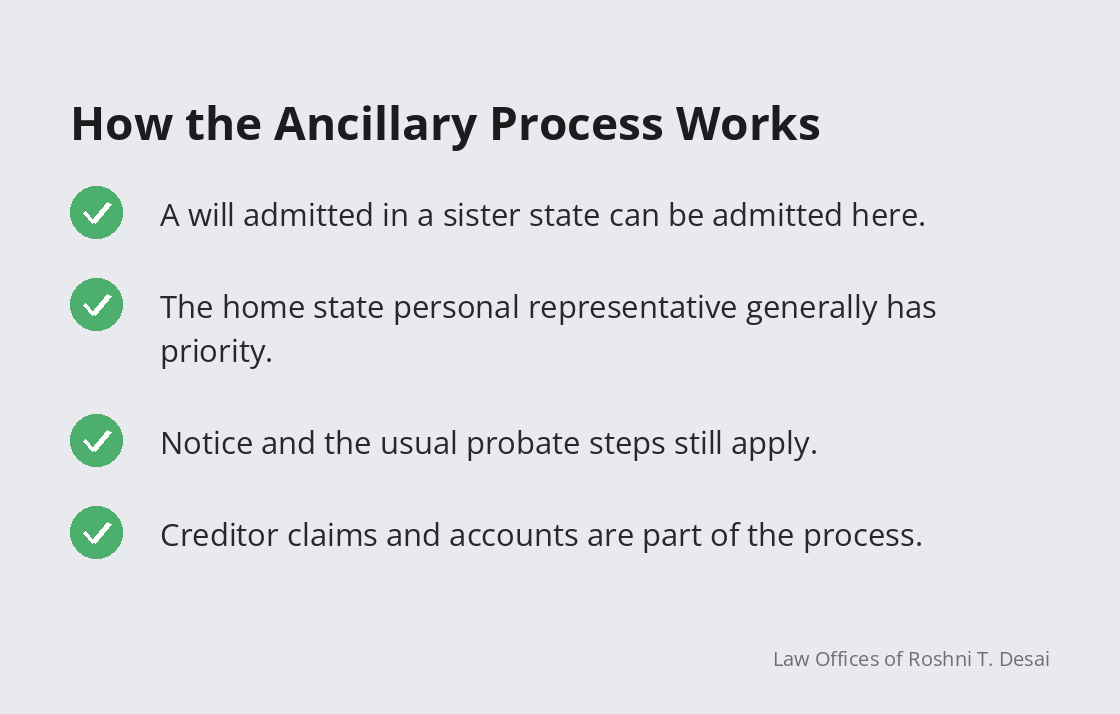
If the decedent’s will has already been admitted to probate in the home state, California offers a streamlined path. Under Probate Code Section 12521, the petition must include the will or an authenticated copy, along with an authenticated copy of the order admitting the will to probate in the other state or other evidence that the will was established or proved there.
Probate Code Section 12522 then provides that when a will was admitted to probate in a sister state, the California court shall admit the will to probate here and may not permit a contest or revocation of probate unless certain conditions are shown. This helps families avoid relitigating questions that were already decided in the home state.
Who Gets Priority to Serve
California gives the home state’s personal representative a strong position. Probate Code Section 12513 provides that if the decedent died domiciled in a sister state, a personal representative appointed by a court of the decedent’s domicile has priority over all other persons, except where the will nominates a different person to serve in California.
The sister state personal representative may also nominate another person to serve in California, and that nominee has the same priority. This can be helpful when the executor lives far away and prefers to have someone closer to the property handle the local administration.
Notice and the Normal Probate Steps
Probate Code Section 12512 requires that notice of an ancillary administration proceeding be given and, except for the special rules on wills already admitted elsewhere, that the same proceedings take place as for someone who died domiciled in California. Section 12530 adds that ancillary administration is subject to the other provisions of the Probate Code, including inventory and appraisal, creditor claims, estate management, independent administration, accounts, distribution, and closing the estate.
In practice, that means the California personal representative has real duties, from identifying and protecting California assets to handling claims. Many estates can use the streamlined authority described in our guide to the Independent Administration of Estates Act in California.
What Complicates an Ancillary Probate Case
Ancillary probate is manageable when the paperwork is in order and the two proceedings stay coordinated. Problems tend to arise when families wait too long, overlook a requirement, or assume the home state’s orders will take care of everything.
The issues below are among the most common sources of delay and frustration in these cases.
Challenges to the Out-of-State Will
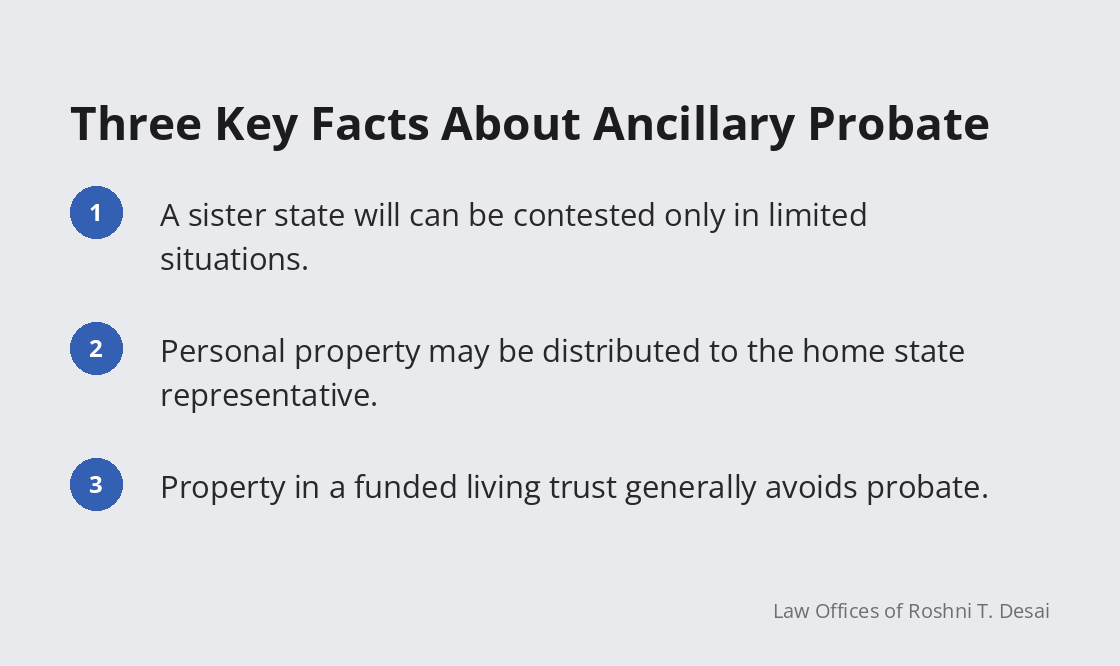
The protection in Section 12522 is not absolute. A California court may permit a contest if the sister state’s determination was not based on a finding that the decedent was domiciled there at death, if interested parties did not receive notice and an opportunity to contest in the other state, or if the other state’s determination is not final.
When any of those conditions exist, a California case can take longer and may involve questions that families thought were already settled. Reviewing the home state’s orders early helps identify whether these issues may come up.
Delaying the California Case
Families sometimes wait until the home state’s probate is nearly finished before turning to the California property. During that time, a house may sit vacant, need repairs, or require insurance and ongoing attention, and no one may have clear legal authority to act for the estate here.
Starting the California proceeding in a timely way allows a personal representative to secure property, deal with tenants or buyers, and move through the creditor claim process. Our guide to creditor claims in California probate explains why that process benefits from an early start.
Moving Personal Property Back to the Home State
Not every California asset has to be distributed directly to beneficiaries here. Under Probate Code Section 12540, when a person dies domiciled in a sister state, the court in the ancillary proceeding may order preliminary or final distribution of all or part of the decedent’s personal property in California to the sister state personal representative, if that distribution is in the best interest of the estate or interested persons.
This option can help keep the overall estate administration in one place. It requires a court order, so it should be planned for rather than assumed. Planning ahead can also reduce the need for ancillary probate altogether, since property held in a properly funded living trust generally passes outside of probate.
Final Thoughts
Ancillary probate in California can feel like a second layer of work at an already difficult time. The Probate Code provides a clear framework for nondomiciliary estates, including where to file, who may serve, how a will admitted elsewhere is recognized, and how personal property can be sent back to the home state. Understanding that framework helps families avoid surprises and keep the estate moving.
If a loved one who lived out of state left property in California, contact the Law Offices of Roshni T. Desai to discuss how ancillary probate may apply and the steps that make sense for your family.