




California Trust Tax Planning: Strategies to Maximize Benefits
California trust tax planning is one of the most overlooked areas of family wealth management. Most California families either overpay taxes on their trusts or miss critical deadlines that trigger penalties.
We at Law Offices of Roshni T. Desai have seen firsthand how the right strategies can save families thousands of dollars each year. This guide walks you through the tax rules that matter and the mistakes to avoid.
How California Trusts Are Actually Taxed
California taxes trusts based on where the trustee lives and where trust income originates, not where the beneficiaries live. A resident trust pays California income tax on all income, while a nonresident trust pays tax only on California-source income. This distinction matters enormously because California’s top tax rate reaches 13.3 percent for high-income earners, making residency status one of the most consequential tax variables in trust planning.
Revocable vs. Irrevocable Trust Tax Treatment
Revocable trusts funded during your lifetime don’t pay separate taxes-income flows to your personal return. Once you pass away, the trust becomes irrevocable and files its own return using Form 541. The difference is stark: an irrevocable trust can split income between itself and beneficiaries, potentially lowering overall tax burden if beneficiaries sit in lower brackets.
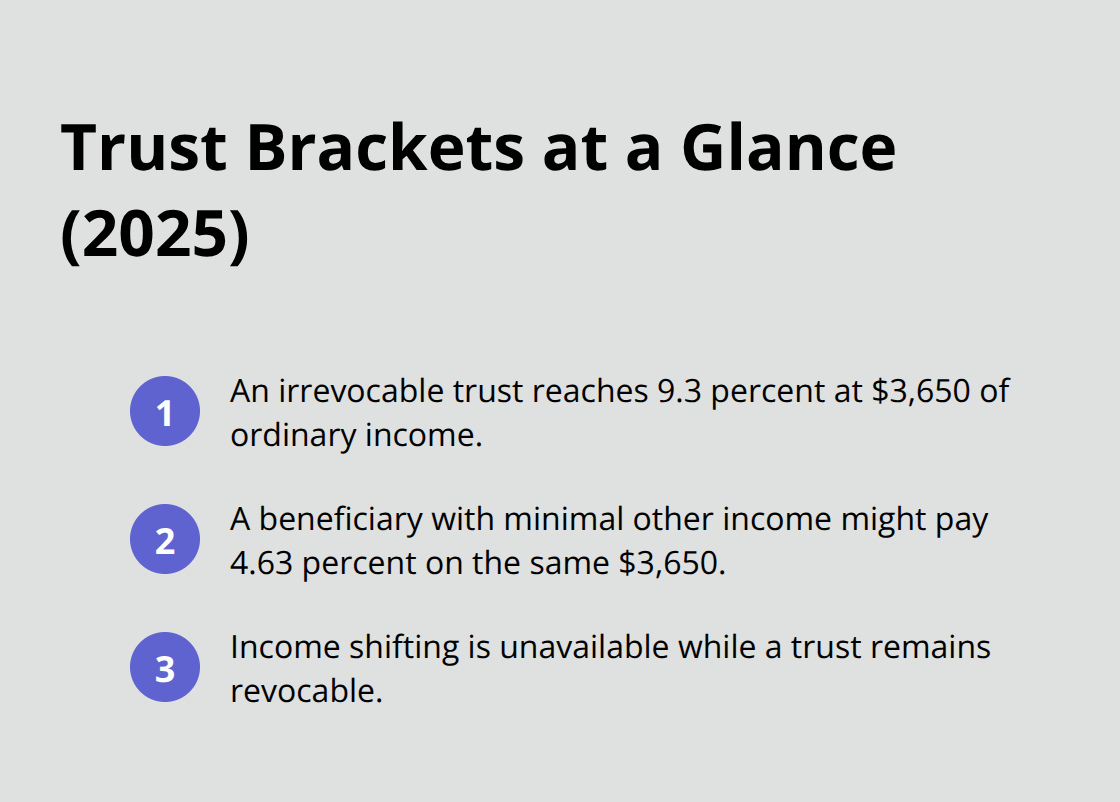
For example, trust income taxed at the trust level faces compressed tax brackets, meaning just $3,650 of ordinary income pushes an irrevocable trust into California’s 9.3 percent bracket for 2025. A beneficiary receiving the same amount might pay only 4.63 percent if they have limited other income. This income-shifting opportunity disappears entirely with revocable trusts during your lifetime.
Residency Changes Require Immediate Action
Moving to California or leaving California mid-year creates tax complications that demand quick attention. If you move to California with an out-of-state nonresident trust, that trust becomes resident for tax purposes the moment you arrive, triggering California tax on all income-not just California-source income. Many families discover this fact only after missing filing deadlines or accumulating unexpected tax bills.
The Franchise Tax Board follows residency determinations closely, and mistakes invite audits. If you own real property in California but maintain residency elsewhere, your trust still owes California tax on income from that property, requiring separate Form 541 filings and compliance with California’s use tax rules. Reviewing trust documents and tax filings whenever residency changes occur matters because the timing of that change determines which state claims jurisdiction for the entire tax year.
Income Timing and Fiduciary Accounting Income
Fiduciary accounting income differs from taxable income, and this gap creates real planning opportunities. Fiduciary accounting income includes items like interest, dividends, and rental income but excludes capital gains, which flow directly to beneficiaries under California law. A trustee can distribute fiduciary accounting income to beneficiaries, allowing them to report that income on their personal returns while the trust retains capital gains.
This separation lets you control who pays tax on different income types. If capital gains spike one year due to asset sales, the trust absorbs that tax hit while beneficiaries receive distributions of ordinary income taxed at their personal rates. Quarterly estimated tax payments on Form 541-ES become mandatory once a trust generates substantial income, with higher estimated payments required as income climbs. Missing these deadlines triggers penalties that compound quickly, often reaching hundreds of dollars for modest filing delays.
Planning Across Multiple Tax Years
The compressed tax brackets that affect irrevocable trusts create opportunities to spread distributions across multiple years. Distributing $7,300 in one year pushes the trust into the 9.3 percent bracket, but splitting that amount across two years keeps each year’s income in lower brackets. This strategy works only if the trust documents grant the trustee discretion to time distributions, and it requires careful coordination with beneficiary income levels to avoid pushing them into higher brackets themselves.
Capital gains treatment also shifts based on how long the trust holds assets. Assets held at death receive a stepped-up basis, meaning beneficiaries inherit them at fair market value with no capital gains tax on appreciation that occurred during the trust’s ownership. Understanding this timing helps trustees decide whether to sell appreciated assets during the trust’s lifetime or hold them for beneficiaries to inherit with a stepped-up basis. These decisions shape whether your family’s wealth transfer happens efficiently or triggers unnecessary tax bills that reduce what beneficiaries ultimately receive.
How to Split Trust Income Across Beneficiaries and Years
The Tax Bracket Gap Creates Real Savings
California’s compressed tax brackets for irrevocable trusts open genuine opportunities to shift income strategically. When trust income hits $3,650 for 2025, the Franchise Tax Board pushes the trust itself into the 9.3 percent bracket. A beneficiary receiving that same $3,650 might pay only 4.63 percent if they have minimal other income. This gap represents real money-distributing $10,000 to a beneficiary in a lower bracket instead of keeping it in the trust saves roughly $600 in California state tax alone.
The strategy works because you control timing and amounts through trustee discretion. If trust documents grant the trustee authority to distribute income, you can split income among multiple beneficiaries, keeping each year’s trust income below the 9.3 percent threshold. This requires knowing each beneficiary’s income level and tax bracket before making distributions.
Why Trustees Miss These Opportunities
Many trustees ignore income-splitting strategies and simply distribute whatever amount they think beneficiaries need, leaving thousands in unnecessary taxes on the table. The problem stems from a lack of coordination between trust administration and tax planning. Trustees focus on meeting beneficiary needs rather than optimizing tax outcomes, and beneficiaries rarely understand how distributions affect their personal tax liability.
Fixing this gap means trustees must request tax information from beneficiaries each year and model different distribution scenarios before year-end. A trustee who waits until January to make distributions has already lost the opportunity to split income across tax years or coordinate with beneficiary income levels.
Life Insurance Trusts Protect Your Estate From Taxation
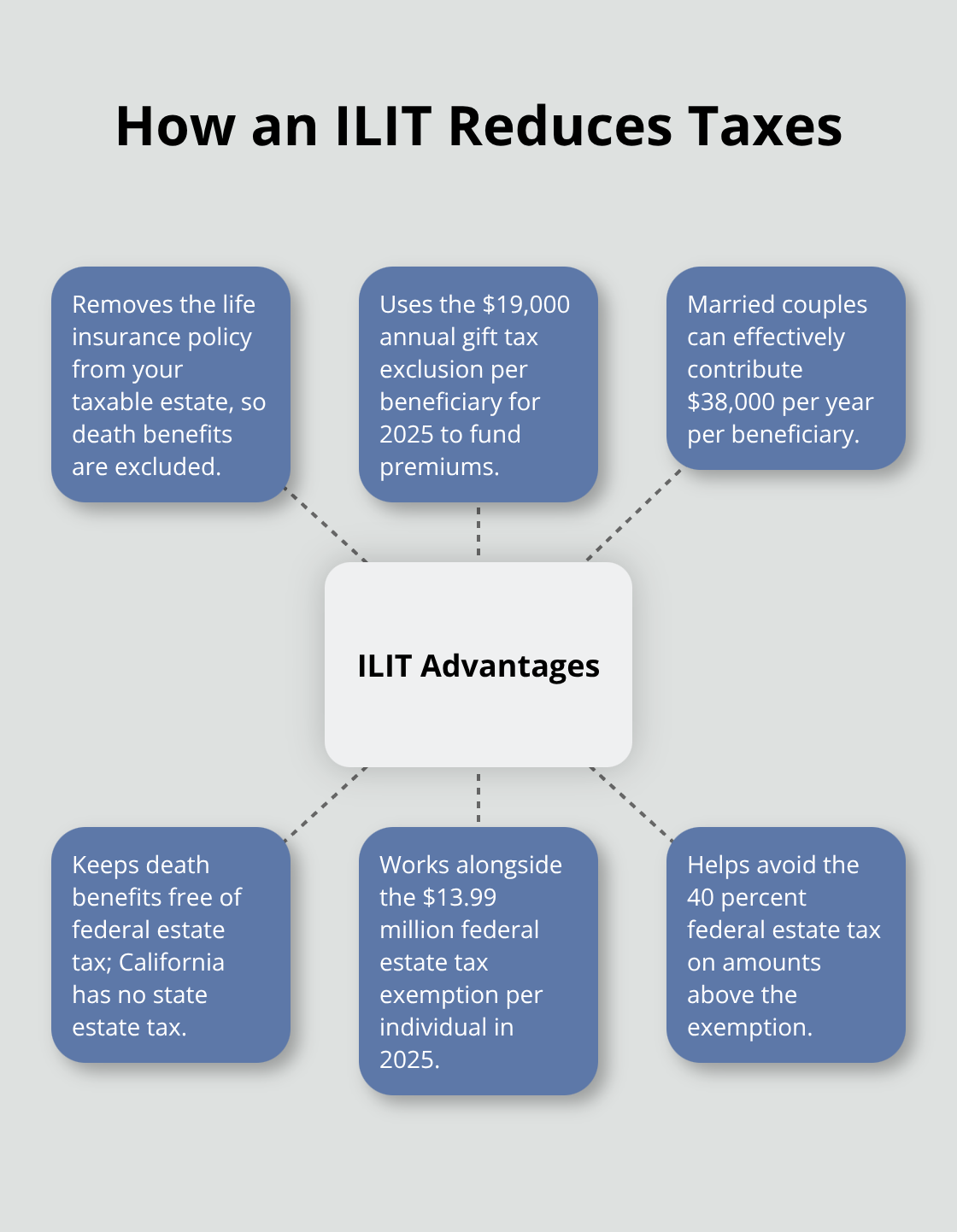
Irrevocable life insurance trusts serve a different but equally important function in California tax planning. An ILIT owns life insurance outside your taxable estate, meaning the death benefit passes to beneficiaries free of federal estate tax and California’s nonexistent state estate tax. For California residents with significant wealth, this matters because the federal exemption stands at $13.99 million per individual for 2025 according to the IRS. Married couples can effectively double that amount with proper planning, preventing insurance proceeds from inflating estate value and triggering federal tax at the 40 percent rate.
Funding an ILIT With Annual Gifts
To fund an ILIT effectively, you transfer ownership of an existing policy to the trust or have the trust purchase a new policy on your life. You then make annual premium payments to the ILIT, and those payments qualify for the $19,000 annual gift tax exclusion per beneficiary for 2025 according to the IRS. A married couple can contribute $38,000 yearly to an ILIT for a child without gift tax consequences.
The Crummey power requirement allows beneficiaries to withdraw contributions for a limited time, making the gifts tax-free. Without this structure, life insurance proceeds land in your taxable estate, potentially doubling the tax burden your family faces at death. These two strategies-income splitting and life insurance trusts-form the foundation of tax-efficient trust planning for California families.
The next section addresses how timing distributions throughout the year prevents unnecessary tax spikes and keeps your family’s wealth transfer on track.
Where California Trust Tax Plans Derail
Residency Changes Trigger Immediate Tax Consequences
Moving to California with an existing trust transforms your tax situation overnight, yet most families treat it as a simple logistical matter rather than a tax event. The moment you establish California residency, your trust’s tax status changes completely. A nonresident trust that paid tax only on California-source income suddenly becomes a resident trust owing California tax on all income, regardless of where it originates. The Franchise Tax Board does not wait for you to file paperwork to make this determination-residency happens automatically on the date you move, and Form 541 must be filed for the entire tax year reflecting your new status.
Families who fail to update trust documents or notify their trustees about the move often discover the problem years later during an audit, facing back taxes, penalties, and interest that compound across multiple years. The fix requires immediate action: notify your trustee of the residency change, review whether the trust should be restructured to remain nonresident (if possible), and file amended returns if prior years were filed incorrectly. California also imposes use tax on hand-carried goods brought into the state, with an $800 per-person exemption according to Franchise Tax Board guidance, meaning trustees must track personal property movements and account for use tax on trust assets relocated to California.
Fiduciary Accounting Income vs. Taxable Income Creates Planning Gaps
Confusion between fiduciary accounting income and taxable income trips up even conscientious trustees. Under California law, capital gains flow directly to beneficiaries, but ordinary income like interest and dividends can be retained by the trust or distributed to beneficiaries. A trustee who does not understand this split often distributes money without considering which type of income it represents, missing opportunities to shift the tax burden to lower-bracket beneficiaries or accumulating unnecessary tax at the trust level.
This distinction matters because it controls who pays tax on different income types. If capital gains spike one year due to asset sales, the trust absorbs that tax hit while beneficiaries receive distributions of ordinary income taxed at their personal rates. Trustees should request prior-year tax returns from all beneficiaries by September and model different distribution scenarios before December 31st to capitalize on this income-splitting opportunity.
Missing Deadlines Triggers Penalties That Compound Quickly
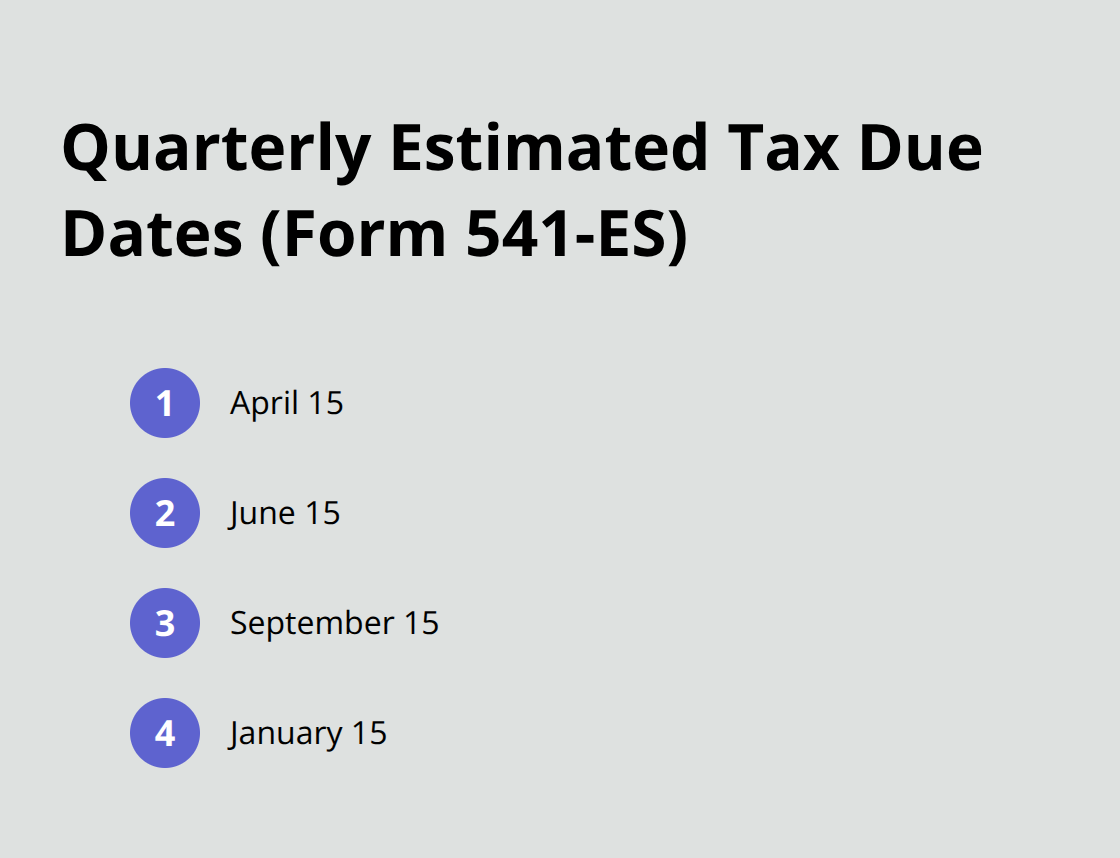
Trustees frequently miss filing deadlines for Form 541 or fail to request extensions before the April deadline, triggering penalties up to $100 per beneficiary with a maximum of $1.5 million annually according to Franchise Tax Board rules. Estimated tax payments on Form 541-ES become mandatory once trust income exceeds certain thresholds, and these quarterly payments must be made on the 15th of April, June, September, and January based on projected income.
A trustee who waits until tax season to address these obligations has already accumulated penalties and interest. The solution is straightforward: mark estimated payment deadlines on a calendar the moment a trust generates income. Expert guidance on trust administration eliminates most of the costly mistakes that plague California families managing inherited wealth.
Final Thoughts
California trust tax planning works when you coordinate residency rules, income distribution timing, and filing deadlines into a single strategy. Compressed tax brackets for irrevocable trusts create real opportunities to shift income to lower-bracket beneficiaries, life insurance trusts remove death benefits from your taxable estate, and attention to fiduciary accounting income prevents unnecessary tax at the trust level. Residency changes demand immediate action because they reshape your entire tax picture overnight.
Missing deadlines for Form 541 or estimated tax payments triggers penalties that compound quickly, turning manageable tax bills into expensive problems. We at Law Offices of Roshni T. Desai help California families implement these strategies through personalized estate planning and trust administration. Contact us today to review your current trust structure and identify which strategies apply to your family’s circumstances.