




No Contest Clause California: When a Trust or Will Challenge Triggers It
A no contest clause in California can make a family member hesitate before questioning a loved one’s will or trust. These clauses are written to discourage challenges by warning that a beneficiary who contests the document may lose what the document would otherwise give them. Many people assume that any objection, question, or court filing will trigger that result. California law is far more specific, and understanding exactly how these clauses are enforced gives you real control over your choices as a beneficiary, trustee, or person planning an estate.
At Law Offices of Roshni T. Desai, we help families throughout Orange County and Southern California work through trust and probate questions with clarity, so you can move forward with confidence. This guide explains what a no contest clause actually is, how California courts decide whether to enforce one, and the mistakes that most often create problems for beneficiaries and the people who draft these clauses.
What a No Contest Clause Actually Is
A no contest clause is a provision placed in a will, trust, or other estate planning document to discourage beneficiaries from challenging it. California addresses these clauses directly in Part 3 of Division 11 of the Probate Code, beginning with Probate Code Section 21310. Knowing the vocabulary the statute uses is the first step in understanding how much protection a clause really offers.
The Statutory Definition
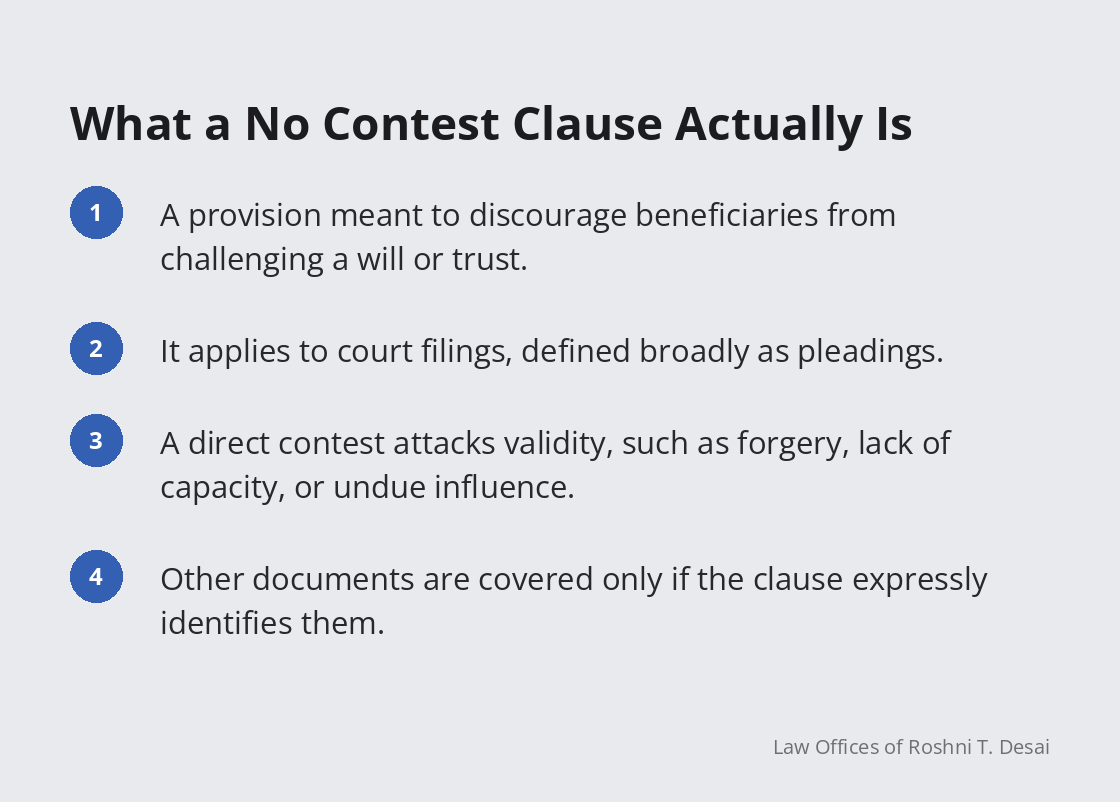
Probate Code Section 21310(c) defines a no contest clause as a provision in an otherwise valid instrument that, if enforced, would take action against a beneficiary for filing a pleading in any court. The statute defines a pleading broadly in Section 21310(d) to include a petition, complaint, cross-complaint, objection, answer, response, or claim. Section 21310(a) defines a contest as a pleading filed with the court by a beneficiary that would trigger the clause if the clause is enforced. These definitions matter because the question is never simply whether someone is unhappy with a document. The question is whether a specific court filing falls within the narrow categories the law allows a clause to reach.
What Counts as a Direct Contest
Section 21310(b) defines a direct contest as a contest that alleges the invalidity of a protected instrument or one or more of its terms based on specific grounds. Those grounds are forgery, lack of due execution, lack of capacity, menace, duress, fraud, or undue influence, revocation of the instrument under the applicable statute or procedure, and disqualification of a beneficiary under Probate Code Sections 6112, 21350, or 21380. In everyday terms, a direct contest is an attack on whether the document or a provision in it is valid at all.
Which Documents Are Protected
Under Section 21310(e), a protected instrument includes the document that contains the no contest clause. It can also include another instrument that already existed on the date the document containing the clause was signed, but only if the clause expressly identifies that other instrument, either individually or as part of an identifiable class. This rule prevents a clause from silently reaching documents the person creating the estate plan never mentioned, and it is one reason careful drafting is so important.
How California Courts Decide Whether to Enforce the Clause
Since California rewrote its no contest statutes, enforcement has been limited to a short list of situations. A beneficiary who understands those limits can evaluate a potential challenge realistically, and a person creating an estate plan can decide whether the clause in their documents will actually do what they intend.
The Three Types of Contests a Clause Can Reach
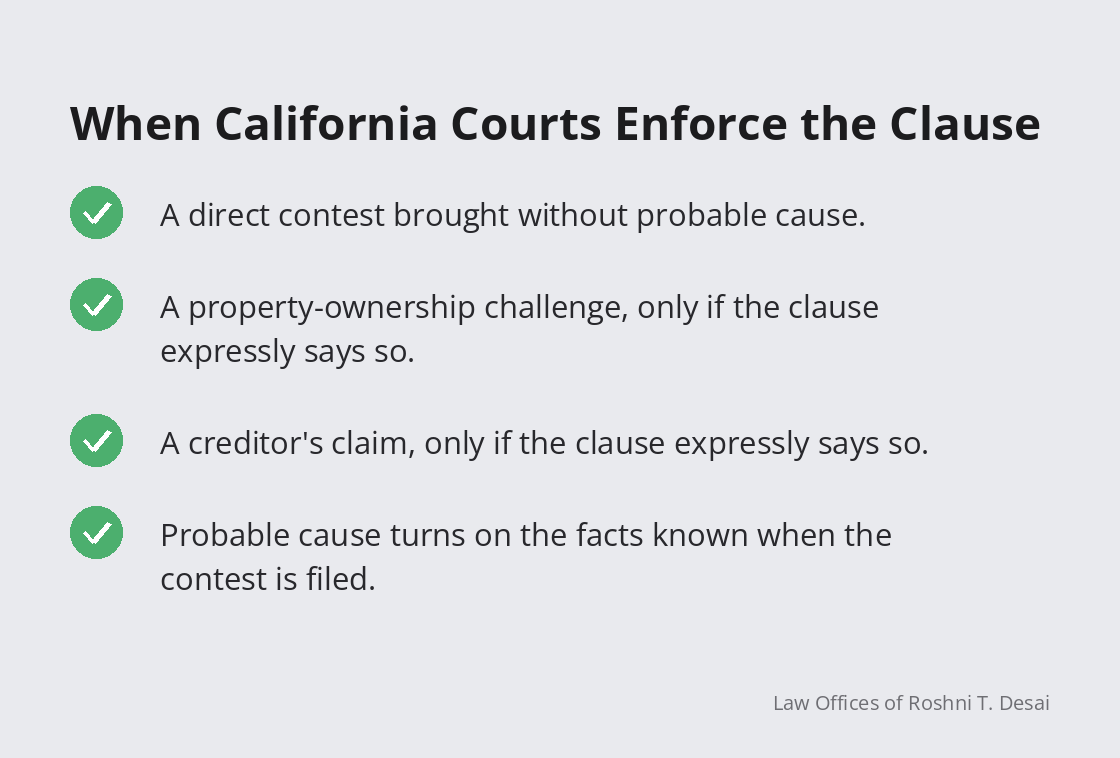
Probate Code Section 21311(a) states that a no contest clause shall only be enforced against three types of contests. The first is a direct contest that is brought without probable cause. The second is a pleading that challenges a transfer of property on the grounds that the property did not belong to the transferor at the time of the transfer. The third is the filing of a creditor’s claim or the prosecution of an action based on it. For the second and third categories, the statute adds an important condition: the clause is enforced only if it expressly provides for that application.
The Probable Cause Standard
For direct contests, the key question is probable cause. Section 21311(b) explains that probable cause exists if, at the time of filing a contest, the facts known to the contestant would cause a reasonable person to believe that there is a reasonable likelihood that the requested relief will be granted after an opportunity for further investigation or discovery. This standard looks at what the beneficiary knew when the contest was filed. It does not require certainty of winning. A beneficiary with a well-supported concern about forgery or undue influence, for example, may be able to bring a direct contest without triggering the clause, even if the contest ultimately does not succeed.
Strict Construction of the Clause
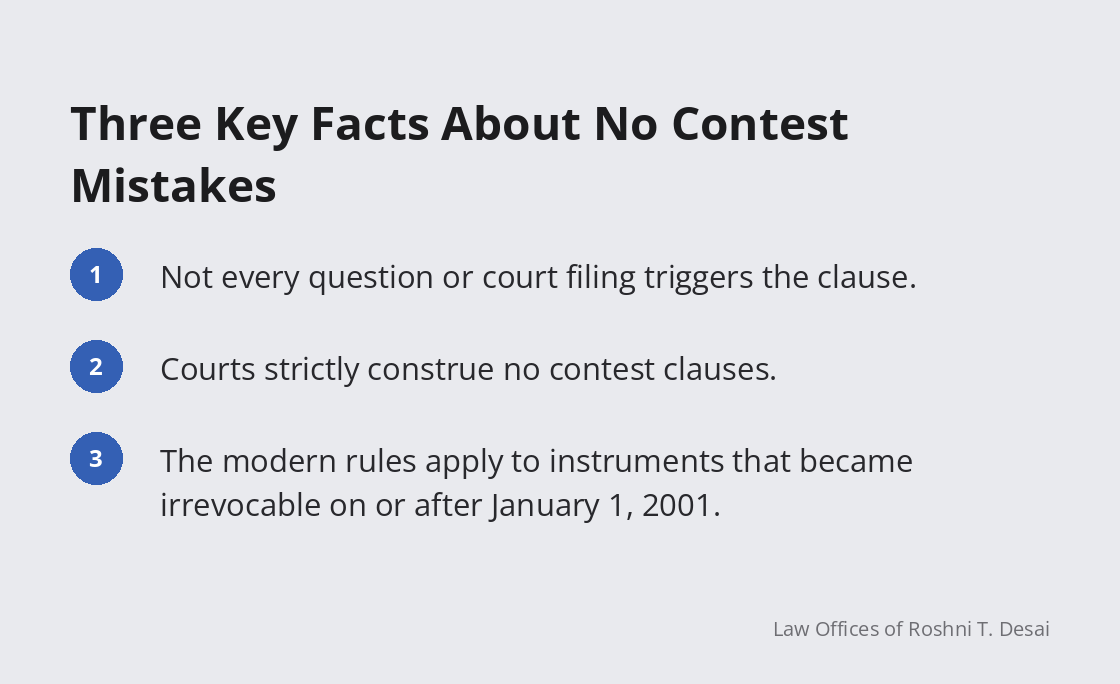
Section 21312 provides that, in determining the intent of the transferor, a no contest clause shall be strictly construed. Courts read these clauses narrowly rather than stretching them to cover filings the language does not clearly reach. Section 21313 adds that the statutory part is not a complete codification of the law, and the common law governs enforcement of a no contest clause to the extent the statute does not apply.
Which Instruments the Modern Rules Govern
Probate Code Section 21315 states that the current statutory part applies to any instrument, whenever executed, that became irrevocable on or after January 1, 2001, and does not apply to an instrument that became irrevocable before that date. Because the date an instrument became irrevocable controls which rules apply, confirming that date from the documents and the family’s history is an early step in evaluating any clause. Older instruments may be governed by different rules, so the analysis should never be assumed.
Common Mistakes With No Contest Clauses
No contest clauses create anxiety on both sides of the estate plan. Beneficiaries sometimes give up valid concerns out of fear, while people who create estate plans sometimes rely on clauses that will not work the way they expect. The following mistakes come up again and again in trust and probate matters.
Assuming Every Question Triggers the Clause
Many beneficiaries believe that asking for information, objecting to an action, or filing anything in court will automatically mean losing their inheritance. Under Section 21311, enforcement is limited to the three categories the statute lists, and the property-ownership and creditor’s claim categories apply only when the clause expressly says so. Before deciding to stay silent, it helps to review the exact language of the clause with an attorney and identify whether the filing you are considering falls into one of those categories.
Trustees and executors can make a related mistake by treating every beneficiary question as a threat. Open communication, timely information, and a clear explanation of how the estate or trust is being handled often reduce the chance that a concern turns into a formal dispute in the first place. A clause works best as a backstop, not as a substitute for careful administration.
Filing a Direct Contest Without Gathering Facts First
The probable cause standard turns on the facts known to the contestant when the contest is filed. A beneficiary who files a direct contest based only on suspicion, without first gathering available records, witness accounts, and other information, may have a harder time showing probable cause. Taking time to collect and organize the facts before filing can make a meaningful difference in whether the clause is enforced.
Relying on Vague Drafting
For people creating an estate plan, a common mistake is assuming that a broadly worded clause will block every kind of dispute. Because Section 21312 requires strict construction, and Section 21310(e) limits protection for other documents to those expressly identified, vague drafting can leave gaps. If you want a clause to apply to property-ownership challenges or creditor’s claims, Section 21311 requires the clause to say so expressly. Working with counsel to draft the clause clearly helps your plan reflect your actual intent.
Final Thoughts
A no contest clause in California is a real tool, but it is a narrow one. The Probate Code limits enforcement to direct contests brought without probable cause and, when the clause expressly says so, to certain property-ownership challenges and creditor’s claims. Courts construe these clauses strictly, and the modern rules apply to instruments that became irrevocable on or after January 1, 2001.
Whether you are a beneficiary weighing a concern about a loved one’s estate plan or a trust maker deciding how to discourage future disputes, the details of the clause and the facts behind any challenge matter. Many concerns can also be addressed without a contest at all, and our overview of probate dispute resolution explains some of those options.
If you have questions about a no contest clause in a will or trust, contact Law Offices of Roshni T. Desai to speak with our team. We’ll review the documents, explain how California law applies to your situation, and help you take the next step with confidence.