




Probate Litigation Support: Expert Assistance for Probate Court Disputes
Probate disputes can tear families apart and drain resources quickly. When disagreements arise over a will or estate, the process becomes emotionally draining and financially costly.
We at Law Offices of Roshni T. Desai understand how overwhelming probate litigation support becomes when you’re navigating court procedures alone. This guide walks you through what to expect and how professional assistance can protect your interests.
When Probate Disputes Arise
Common Reasons for Probate Court Conflicts
Probate disputes stem from concrete, identifiable problems that surface during estate administration. Will contests occur when someone questions whether the testator possessed mental capacity to sign the document, whether another person exerted undue influence, or whether the will contains forgery or technical errors in execution. The U.S. Census Bureau projects that over 70 million Baby Boomers will retire by 2035, and these households control roughly 78 trillion dollars in wealth according to Nasdaq data from August 2023. This demographic shift means more estates will enter probate, and with larger asset pools, the incentive to challenge documents increases significantly.
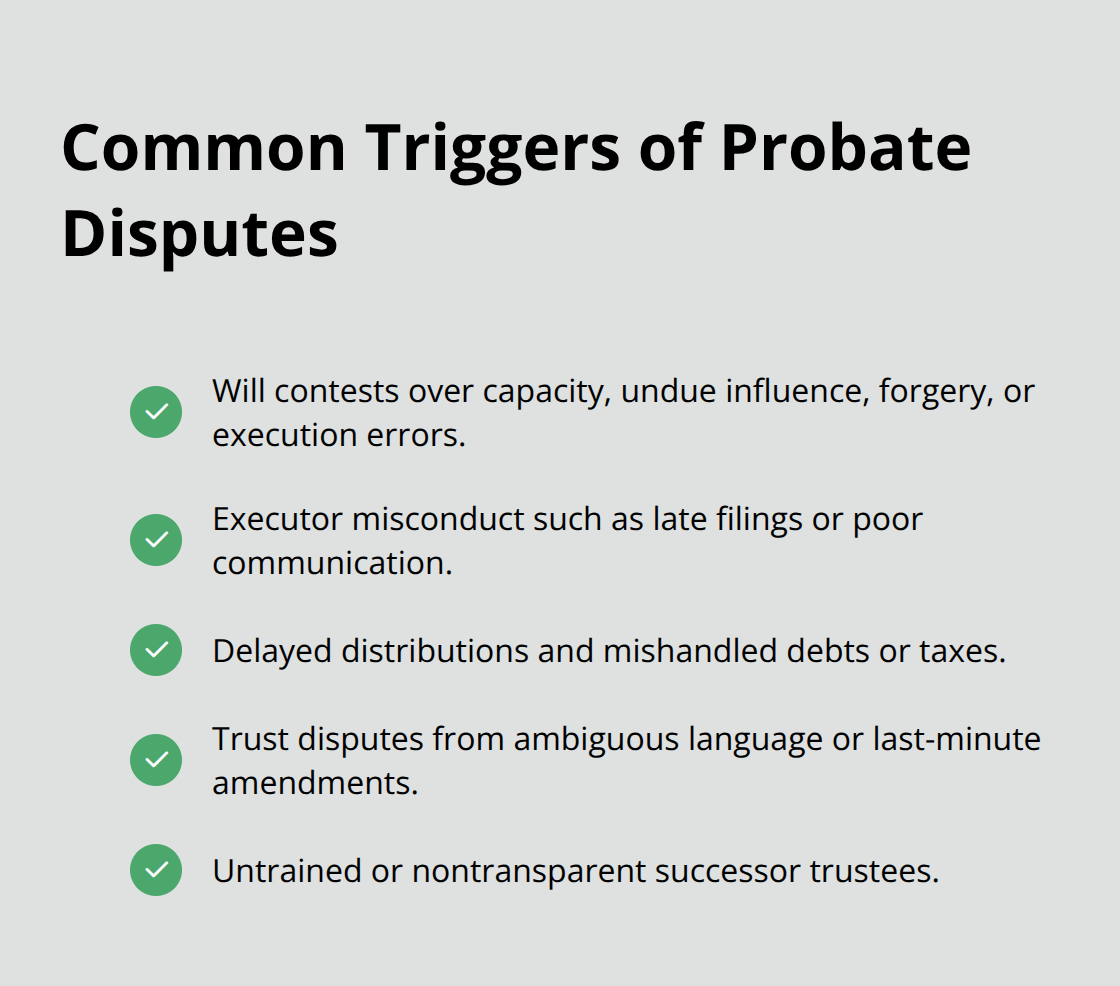
Executor misconduct also sparks disputes-when a personal representative files late, fails to communicate with heirs, delays distributions, or mishandles debts and taxes, beneficiaries file breach of fiduciary duty claims. Trust administration disputes follow similar patterns: ambiguous language in the trust document, amendments made late in life that favor one beneficiary, or a successor trustee who lacks training and transparency can all trigger litigation.
How Family Conflicts Derail Timelines
Probate timelines suffer when disputes arise because court involvement slows everything down. A straightforward probate typically takes nine to twelve months, but contested matters routinely stretch two to four years or longer. Every objection filed, every discovery request served, and every mediation session postpones distributions to beneficiaries and delays the closing of the estate. When an heir occupies the family home after the parent’s death and refuses to leave, the personal representative faces removal threats and counterclaims that freeze asset sales and prevent estate settlement. Real estate remains the litigation hotspot-the family home is often the single largest asset, and disputes over maintenance, title clarity, occupancy rights, and sale decisions consume months of legal work and court time. Disagreements among beneficiaries over asset valuations or how funds should be distributed during administration create bottlenecks that no amount of paperwork can resolve quickly.
The Price Tag of Contested Probate
Prolonged litigation drains estates fast. Court fees, attorney hourly rates, expert witness costs for appraisals and forensic accounting, and mediation expenses accumulate quickly in contested matters. A median probate dispute costs families between 3,000 and 15,000 dollars or more depending on complexity and duration, and high-asset estates regularly exceed 50,000 dollars in legal fees alone. When litigation stretches years, the costs multiply because attorneys must revisit discovery, refresh expert opinions, and prepare for trial multiple times. The Fed Reserve’s Survey of Consumer Finances notes the median U.S. inheritance sits around 46,200 dollars-meaning legal fees can consume a substantial portion of what beneficiaries actually receive.
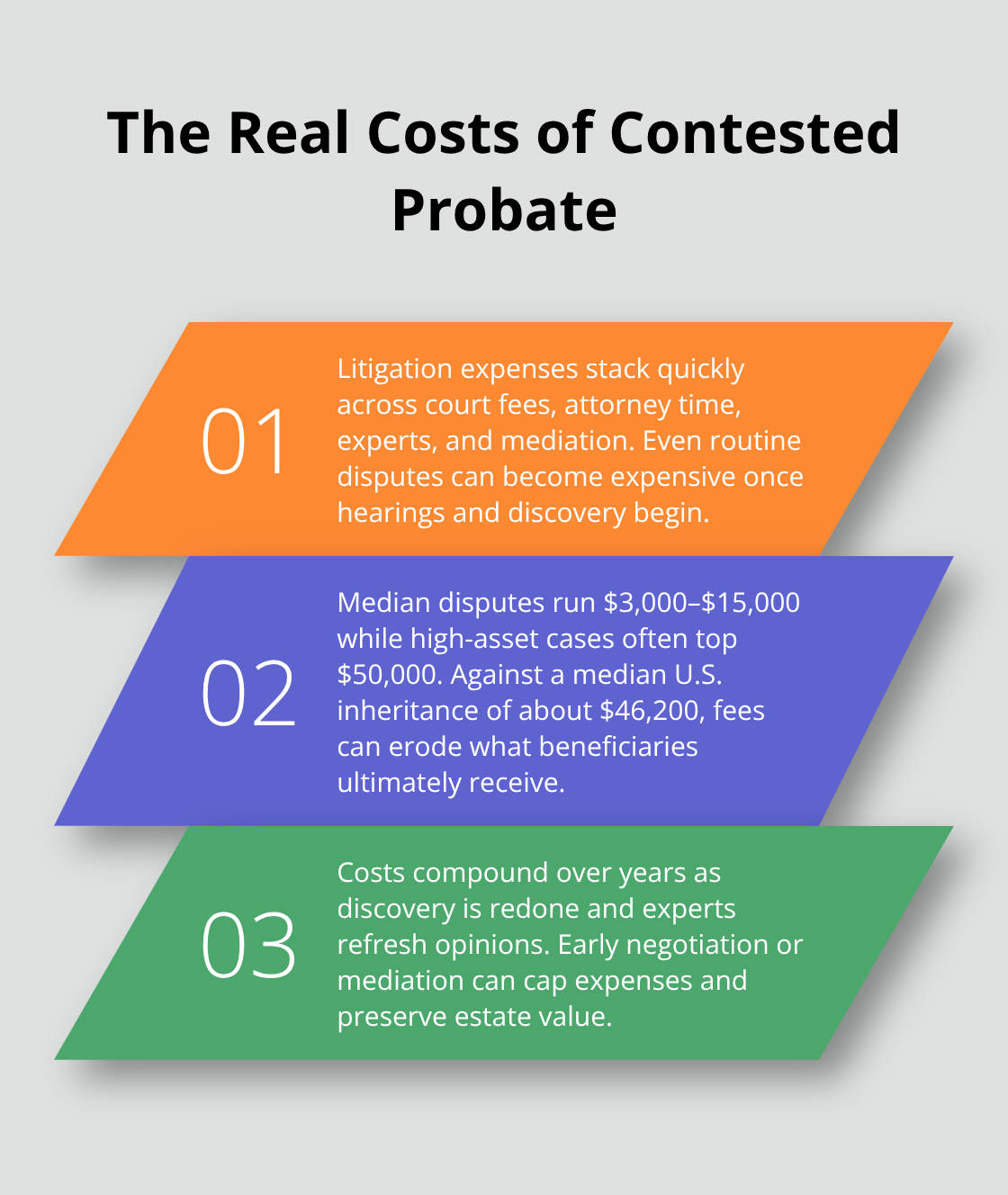
Beyond direct costs, prolonged disputes prevent the estate from generating returns on assets held in limbo, reduce the value of real property through deferred maintenance and market timing losses, and drain emotional energy from families who cannot move past the conflict. Early intervention through negotiation or mediation stops disputes from spiraling into years of litigation and protects what beneficiaries ultimately inherit.
How Professional Support Stops Probate From Spiraling
Court Deadlines Demand Immediate Action
Probate disputes require immediate action on multiple fronts simultaneously. Court deadlines do not pause for family arguments, and missing a filing window forfeits your rights entirely. The personal representative must publish creditor notices, serve notice of administration on beneficiaries, and file inventories within strict timeframes set by state law-typically 30 to 90 days depending on the jurisdiction. When disputes surface, these same deadlines remain in effect, meaning you cannot afford to negotiate slowly while the clock runs. A probate attorney coordinates all filings, tracks these critical dates, and prevents nothing from slipping through the cracks. This stops the costly scenario where a missed deadline forces you to refile petitions, restart notice periods, or face court sanctions.
Protecting Your Share and Your Reputation
Professional support preserves your actual interests in the estate. If you are a beneficiary, an attorney protects your share by identifying executor misconduct early-late filings, inadequate communication, undue delays, or self-dealing. If you are the personal representative, counsel defends you against unfounded breach of fiduciary duty claims and documents every decision to prove you acted in the beneficiaries’ best interests. Real estate disputes illustrate this urgency. When a family home sits in the estate and heirs cannot agree on whether to sell, rent, or occupy it, the property deteriorates, property taxes accumulate unpaid, insurance lapses, and the asset loses value month by month. A probate attorney can petition the court for a partition action, forcing a fair sale if consensus fails, rather than allowing the home to become a liability that consumes the entire estate’s value.
Building a Credible Record With Expert Support
The U.S. Census Bureau data shows life expectancy now exceeds 78 years, and many estates involve periods of cognitive decline before death-creating capacity disputes that require medical records, witness testimony, and professional evaluation to resolve. Professional support brings in forensic accountants, appraisers, and capacity evaluators at the right moments, building a credible record that withstands court scrutiny. These specialists reconstruct capacity from medical documentation, communications, and context, strengthening your position whether you challenge a document or defend one.
Reducing Stress Through Clarity and Control
Families trapped in unresolved probate disputes experience prolonged emotional strain because they cannot move forward-distributions remain frozen, the estate hangs in limbo, and every family gathering becomes a battleground. A probate attorney takes the adversarial burden off family members by handling negotiations, managing discovery requests, and presenting evidence to the court. Mediation and settlement discussions, when guided by skilled counsel, often resolve disputes in months rather than years and preserve family relationships that litigation destroys permanently. Transparent communication matters enormously here. Your attorney explains what documents you need, what deadlines apply, what your realistic settlement range looks like, and what trial preparation entails-eliminating the uncertainty that fuels anxiety.
Making the Financial Case for Early Intervention
The financial reality is stark: early intervention costs a few thousand dollars and resolves disputes within reasonable timeframes, while delayed action multiplies costs to tens of thousands and stretches litigation across years. A probate attorney quantifies these trade-offs upfront, helping you decide whether to settle early or prepare for trial based on concrete numbers rather than hope. The Fed Reserve’s Survey of Consumer Finances notes the median U.S. inheritance sits around 46,200 dollars-meaning legal fees can consume a substantial portion of what beneficiaries actually receive. Beyond direct costs, prolonged disputes prevent the estate from generating returns on assets held in limbo, reduce the value of real property through deferred maintenance and market timing losses, and drain emotional energy from families who cannot move past the conflict. When you understand these costs upfront, you can make informed decisions about settlement versus continued litigation. What happens next depends on your specific situation-whether you face a will contest, a trust dispute, or executor misconduct-and what evidence and witnesses you can assemble to support your position.
What to Expect During Probate Litigation
Initial Assessment and Case Strategy
Your case starts the moment you contact an attorney, and the first conversation determines whether you settle early or prepare for court. A probate attorney schedules an initial assessment to review your documents, identify the core dispute, and outline a realistic path forward with cost estimates attached. This meeting clarifies who you represent-are you a beneficiary protecting your inheritance, a personal representative defending your administration, or a trustee facing breach claims?-because your role shapes everything that follows. The attorney then builds a case strategy that accounts for your specific goals and the strength of available evidence. If you challenge a will based on lack of capacity, the attorney needs medical records from the time of signing, witness testimony about the testator’s mental state, and potentially a capacity evaluation from a physician or neuropsychologist. If you contest executor misconduct, the attorney gathers bank statements, correspondence with beneficiaries, and property maintenance records to prove negligence or self-dealing. This initial phase typically takes two to four weeks and costs between 2,000 and 5,000 dollars depending on document volume and complexity. The strategy memo produced becomes your roadmap-it shows which claims are strongest, which witnesses matter most, and where settlement leverage exists.
Discovery and Evidence Gathering
Discovery follows, and this phase consumes the bulk of litigation time and cost. Both sides exchange documents, serve interrogatories requesting written answers to specific questions, and schedule depositions where witnesses testify under oath and are recorded for trial use. In a contested estate with real property disputes, discovery often runs six to twelve months because financial records span years, property appraisals require independent specialists, and each side’s witnesses must be deposed before trial.
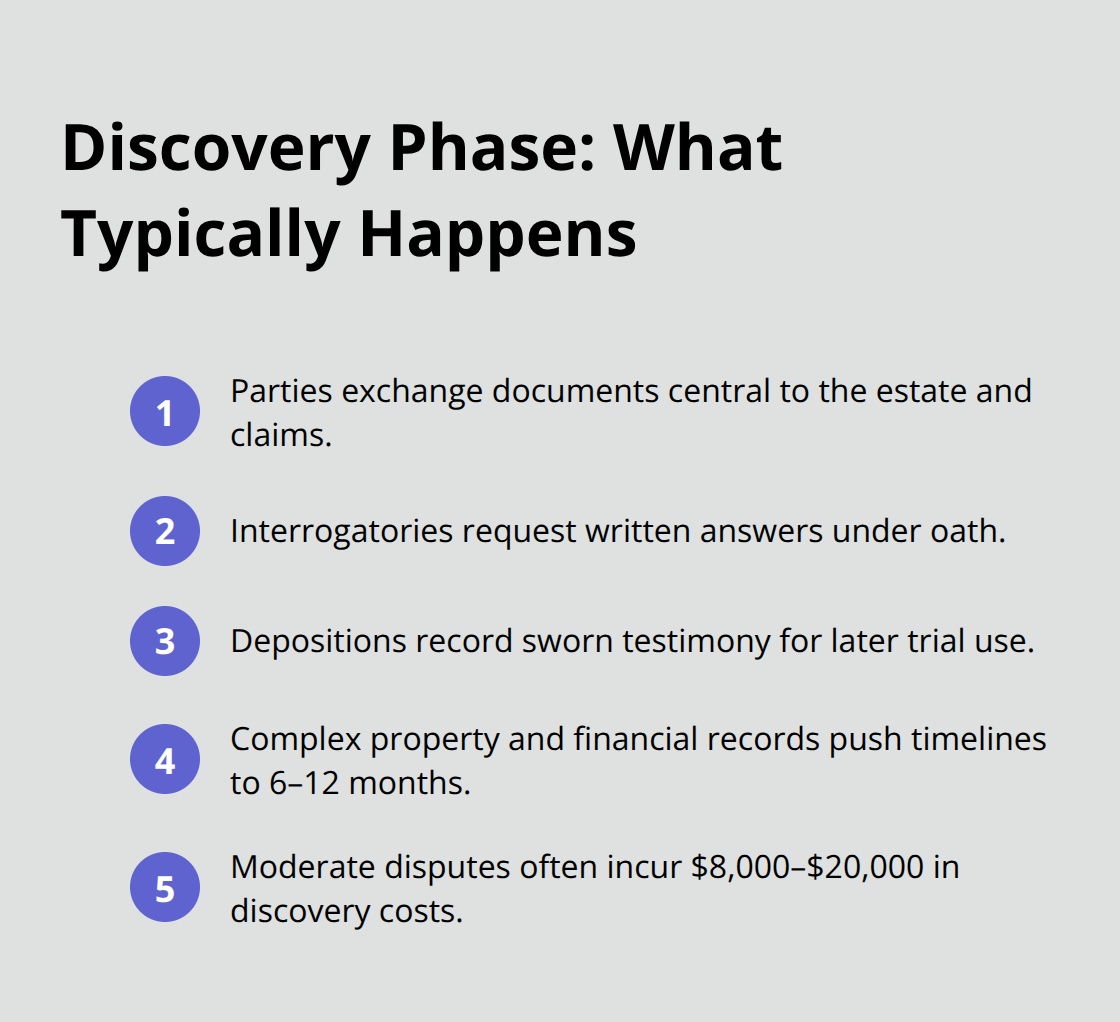
The median inheritance reaches substantial sums, yet discovery costs in moderately complex disputes easily reach 8,000 to 20,000 dollars when you factor in attorney time, court reporter fees, and expert witness preparation. An attorney manages this aggressively by identifying critical documents early and avoiding unnecessary depositions of witnesses who add no real value. Settlement negotiations run parallel to discovery-most probate disputes resolve before trial because the financial and emotional costs of a three to five day trial exceed what either side gains from winning.
Settlement Negotiations and Mediation
Mediation with a neutral third party often succeeds where direct negotiation fails because the mediator reframes positions and identifies common ground. If settlement fails and trial approaches, the attorney prepares witness statements, organizes exhibits, and conducts mock trial sessions to test your credibility and refine your presentation. Trial preparation intensifies in the final four weeks, with daily coordination between attorneys, paralegals, and any remaining specialists to ensure every piece of evidence supports your case theory.
Final Thoughts
Probate disputes demand immediate action, clear strategy, and professional guidance to protect what matters most. The financial reality is straightforward: settling early costs a few thousand dollars and resolves matters within months, while delayed action multiplies costs and stretches resolution across years. The median U.S. inheritance reaches around 46,200 dollars, meaning legal fees can consume a substantial portion of what you actually receive.
Probate litigation support transforms complex tasks from overwhelming burdens into manageable steps with realistic timelines and cost estimates. You need medical records and witness testimony to prove lack of capacity or undue influence if you challenge a will, or you must document every decision and show you acted in beneficiaries’ best interests if you defend executor conduct. Understanding these trade-offs upfront lets you make informed decisions about settlement versus trial based on concrete numbers rather than hope.
Contact Law Offices of Roshni T. Desai today to schedule your free consultation and take control of your probate dispute. We offer flexible home or office visits to discuss your specific situation and outline realistic next steps.