




Discretionary Trust Administration Tips: Managing Flexibility and Duty
Discretionary trusts give trustees significant power to make distribution decisions, but that power comes with serious legal obligations. At Law Offices of Roshni T. Desai, we’ve seen trustees struggle to balance flexibility with responsibility.
This guide covers discretionary trust administration tips that help you navigate these competing demands. You’ll learn how to make sound decisions while protecting yourself from legal challenges.
What Discretionary Trusts Actually Give Trustees Authority to Do
The Core Powers Trustees Hold
A discretionary trust places distribution decisions squarely in your hands as trustee. You decide when to distribute income and principal, how much to distribute, and to which beneficiaries-all without needing anyone’s approval. This differs fundamentally from fixed trusts, where beneficiaries hold guaranteed entitlements. Under Ontario’s Trustee Act, you hold fiduciary duty, meaning you must act honestly, with care, and exclusively in the beneficiaries’ best interests. Your decisions cannot be arbitrary; they must follow the trust deed’s language and reflect reasonable judgment about each beneficiary’s circumstances.
Investment Management and Record-Keeping Obligations
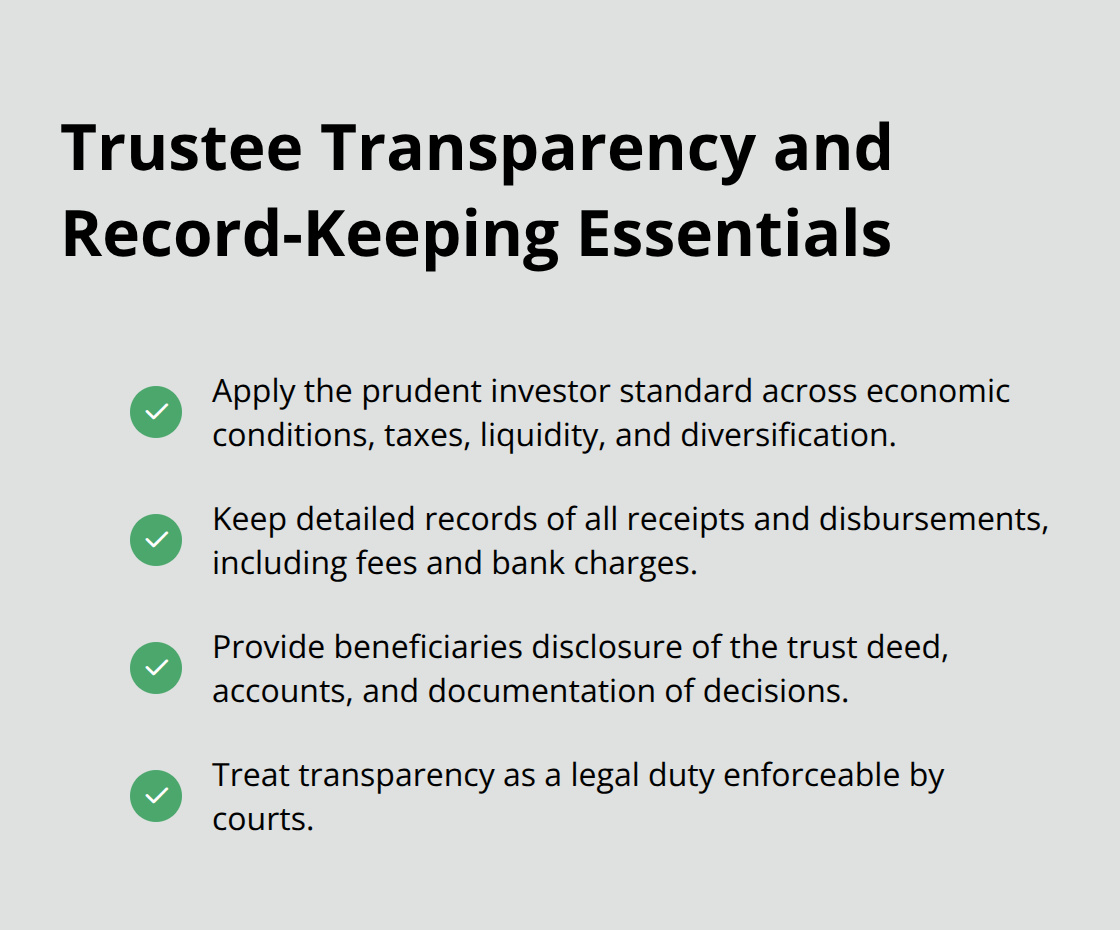
Your role includes managing investments according to a prudent investor standard, which means you consider economic conditions, inflation, tax consequences, liquidity needs, and portfolio diversification. You remain responsible for maintaining detailed records of all receipts and disbursements, including professional fees and bank charges. Beneficiaries hold a right to request disclosure of the trust deed, accounts, and documentation showing how you exercised your discretionary powers. This transparency requirement is not optional-it is a legal obligation that courts enforce.
Information Gathering and Decision-Making Standards
Courts expect you to gather relevant information before making distribution decisions, such as understanding each beneficiary’s financial needs, health status, and other resources. You cannot delegate core duties like deciding whether to distribute funds, though you may hire accountants, lawyers, or financial advisors to assist as long as you supervise their work. The even-hand duty requires you to treat all beneficiaries fairly unless the trust deed specifies otherwise.
Compensation and Legal Protections
Trustee compensation in Ontario is generally not allowed unless the trust instrument authorizes it, all beneficiaries agree, or a court orders it. Under Section 61 of the Trustee Act, if compensation is not specified in the deed, a tariff-based approach applies-roughly 2.5% of capital and income receipts and disbursements, plus 2/5 of 1% of average annual trust value for care and management. When you face uncertainty about your authority or obligations, consulting with an attorney before making significant decisions protects both the trust and beneficiaries from disputes and positions you to handle the challenges that arise in real-world administration.
What Happens When Beneficiaries Make Competing Demands
Evaluating Distribution Requests Against Trust Standards
Beneficiaries will ask for distributions, and your legal obligation to act in their best interests does not mean you must approve every request. The tension arises because discretion is real-you hold genuine authority to say no-but that authority is not unlimited. A beneficiary who needs funds for medical treatment, education, or housing stands on different ground than one asking for vacation money or investment capital. You must evaluate requests against the trust deed’s language, the beneficiary’s actual circumstances, and what the donor intended. If the trust specifies a standard like health, education, maintenance, and support (HEMS), you apply that standard consistently. If it grants you pure discretion with no limits, you still cannot act arbitrarily; courts will scrutinize whether your decision reflected reasonable judgment about the beneficiary’s needs and the trust’s resources.
Creating a Written Record of Your Decisions
You must document your reasoning in writing before you decide. Write down what the beneficiary asked for, what information you gathered about their situation, what other resources they have available, and why you approved or denied the request. This documentation becomes your defense if a beneficiary later claims you acted unfairly or outside your authority. Courts expect trustees to show their work, and contemporaneous written records demonstrate that you followed a rational process rather than acting on whim or bias.
Managing the Even-Hand Duty With Multiple Beneficiaries
When multiple beneficiaries compete for the same pool of money, your even-hand duty becomes critical. You cannot favor one beneficiary consistently without a clear reason rooted in the trust deed or the donor’s stated values. If one beneficiary receives regular distributions for living expenses while another receives nothing, the trust deed must either permit that disparity or you must point to documented differences in their circumstances-one has substantial income, the other does not; one has health needs, the other does not.
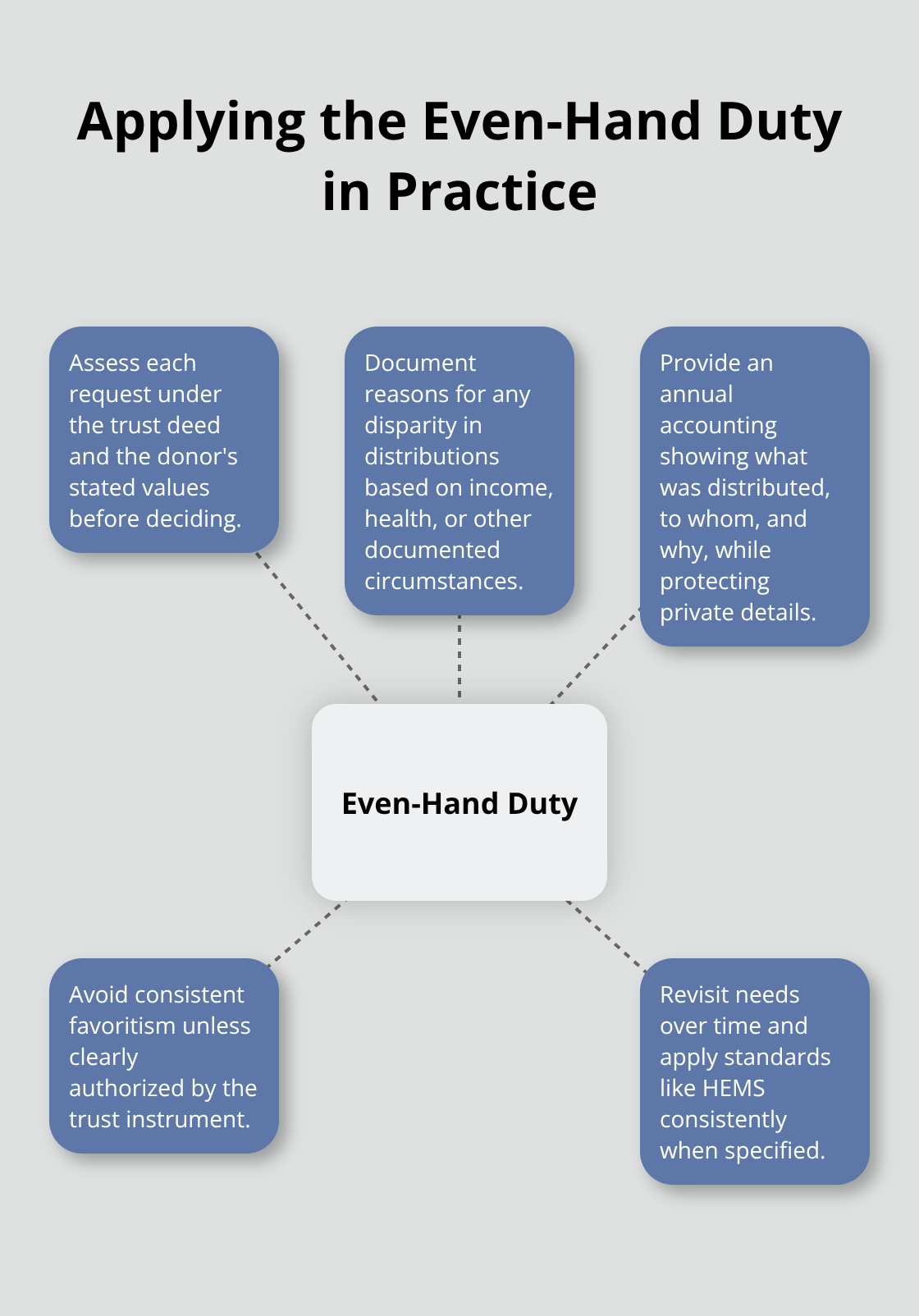
Conflicts escalate quickly when beneficiaries suspect favoritism. Transparency prevents this. You should provide each beneficiary with an annual accounting that shows what was distributed to whom and why, without revealing private details about other beneficiaries unless necessary.
Addressing Conflicts Through Proper Channels
Some trustees hesitate to share information, fearing it will trigger disputes. The opposite is true: hidden decisions breed suspicion and legal challenges. Courts will order you to produce these records anyway if a beneficiary demands them, so maintaining clear, contemporaneous documentation from day one protects you and demonstrates good faith. When conflicts emerge among beneficiaries, you should not try to mediate or negotiate a compromise that strays from the trust deed. Your job is to administer the trust as written, not to keep the peace through unauthorized distributions. If beneficiaries genuinely cannot agree on a major decision-such as whether to sell trust property or distribute a large sum-and the trust deed does not clearly authorize you to decide alone, that is when you bring in an attorney. A court can resolve the deadlock through a declaration of rights, and the cost of that proceeding typically comes from trust assets. This approach is far cheaper than years of beneficiary disputes or a lawsuit claiming you breached your fiduciary duty.
When conflicts persist despite your best efforts at transparency and fair administration, the next challenge involves protecting yourself and the trust from legal exposure while maintaining your role as a neutral decision-maker.
How to Build a Distribution Framework That Actually Works
Create a Written Policy That Guides All Decisions
The most effective trustees stop treating distribution decisions as isolated events and instead create a written framework that guides all decisions consistently. This framework outlines which beneficiary needs qualify for distributions, how much the trust can reasonably distribute each year, and what circumstances trigger larger or smaller payments. We at Law Offices of Roshni T. Desai recommend trustees draft a distribution policy document within the first six months of administration. This policy sits alongside the trust deed and becomes your operational manual.
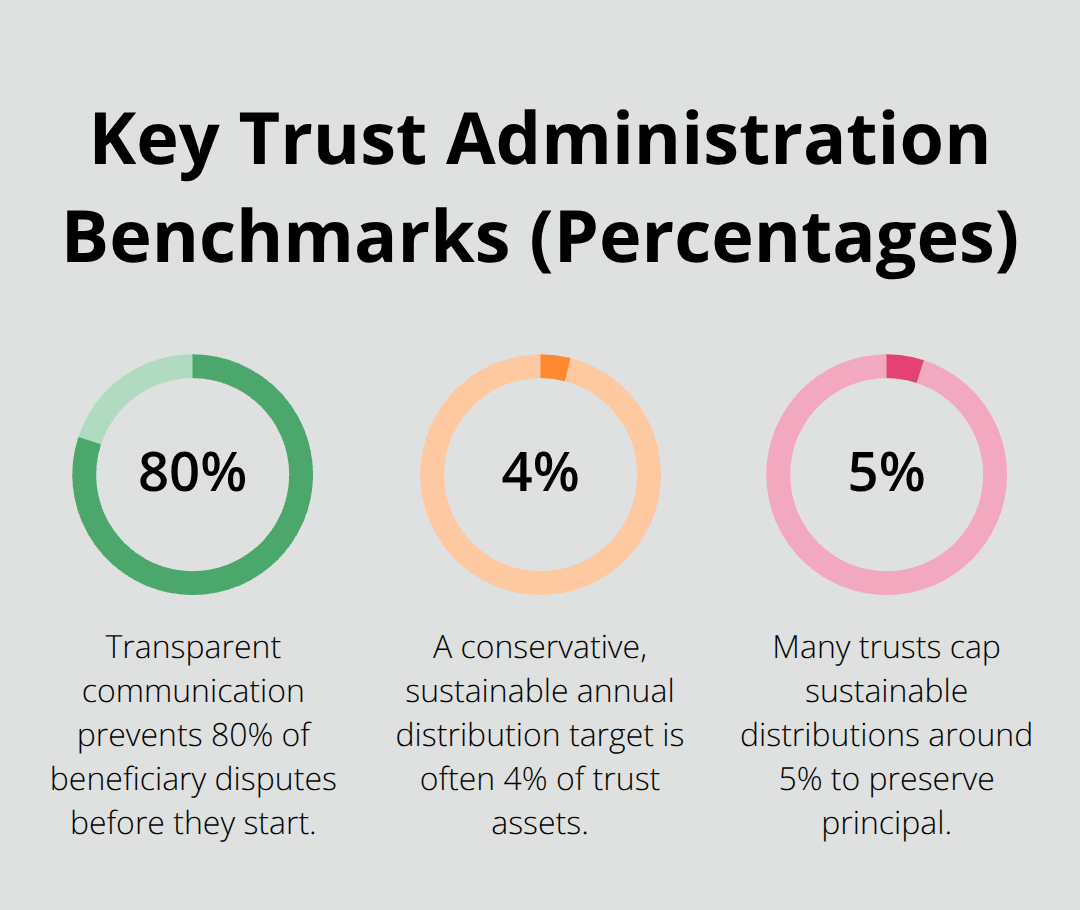
For example, if the trust benefits three adult children and two grandchildren, your policy might specify that income distributions go quarterly to adult children based on demonstrated financial need, while principal distributions for education or home purchases require documented requests and trustee approval. A trust with $500,000 in assets might establish an annual spending limit of $25,000 to $30,000 for discretionary distributions, preserving capital for the long term. This number comes from the general principle that sustainable trust distributions typically range between 4 and 5 percent of trust assets annually, though your specific circumstances may differ based on investment returns, inflation, and beneficiary needs.
Send Annual Accounting Reports to All Beneficiaries
Transparent communication prevents 80 percent of beneficiary disputes before they start. Send each beneficiary a written annual summary in plain language: what distributions were made, to whom, and the general reasoning without oversharing personal details about others. Families that receive regular, clear accounting reports experience significantly fewer legal challenges than those kept in the dark. Many trustees fear this creates conflict, but the opposite proves true in practice.
You should also establish a communication protocol that specifies how and when beneficiaries can request distributions, how long they should expect to wait for a decision, and who handles questions. Some trustees use a simple email template for requests, requiring beneficiaries to explain the purpose, amount, and timing of what they need. This forces beneficiaries to think through their request while giving you documented evidence of what they asked for.
Delegate Tasks While Retaining Final Authority
When you hire professional advisors-accountants, financial managers, or attorneys-delegate specific tasks while retaining final decision authority. Your accountant might analyze whether a distribution is tax-efficient, but you make the yes-or-no decision. A financial advisor might recommend investment changes, but you approve or reject them. This division of labor prevents you from becoming overwhelmed while keeping accountability where it belongs: with you as trustee.
Most trustees who successfully manage discretionary trusts for a decade or more report that having a clear written policy and consistent trust administration timeline reduced their stress and eliminated the sense that they were making decisions in a vacuum. The framework becomes your shield against second-guessing and your proof that you acted reasonably when beneficiaries question your choices.
Final Thoughts
Discretionary trust administration tips boil down to one core principle: you must document everything and communicate clearly with your beneficiaries. Your fiduciary duty requires you to act honestly, gather information before making decisions, and treat all beneficiaries fairly according to the trust deed’s language. When you create a written distribution policy, maintain detailed records, and send annual accounting reports, you eliminate most of the friction that leads to disputes and legal challenges.
The tension between discretion and responsibility never fully disappears-beneficiaries will push for distributions you cannot approve, investment markets will shift, and other trustees may question your choices. What separates trustees who navigate these challenges successfully from those who face legal battles is preparation, transparency, and knowing when to seek professional guidance. You should consult an attorney before making major decisions, not after problems arise (the cost of preventive legal consultation is far lower than defending yourself against a breach of fiduciary duty claim).
We at Law Offices of Roshni T. Desai understand that trust administration feels overwhelming when you handle it alone. Contact us for personalized guidance on your specific trust administration situation, and let our experience support you through the decisions ahead.