




Probate Tax Planning Considerations: Minimize Liabilities Legally
Probate tax planning considerations often catch families off guard. The federal government, individual states, and income tax rules create a complex web that can significantly reduce what your heirs actually receive.
We at Law Offices of Roshni T. Desai help families navigate these overlapping tax obligations and identify legitimate strategies to protect their assets. This guide walks through the specific thresholds, rules, and timing decisions that matter most.
Federal Estate Tax Exemptions and Strategies That Protect Your Assets
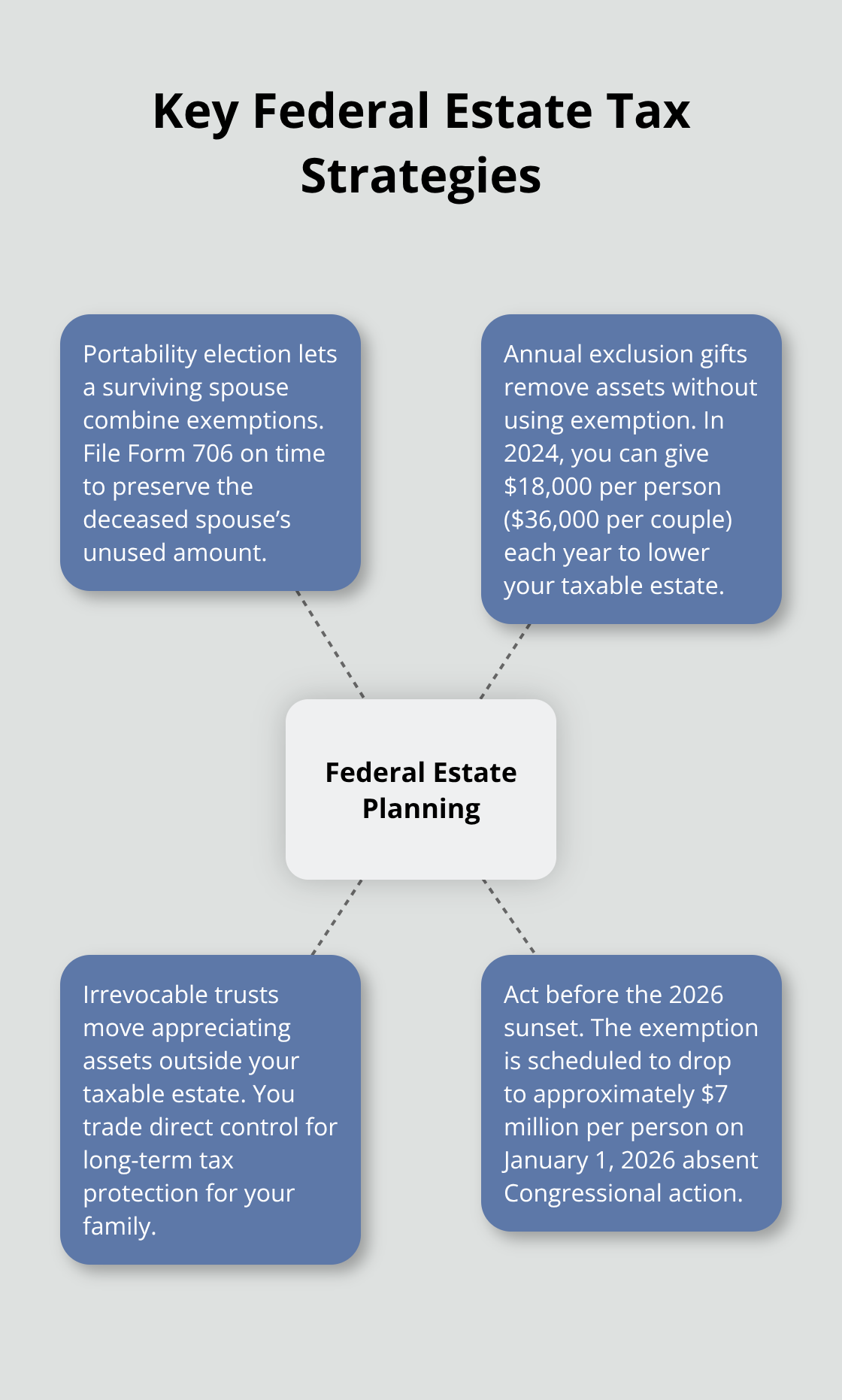
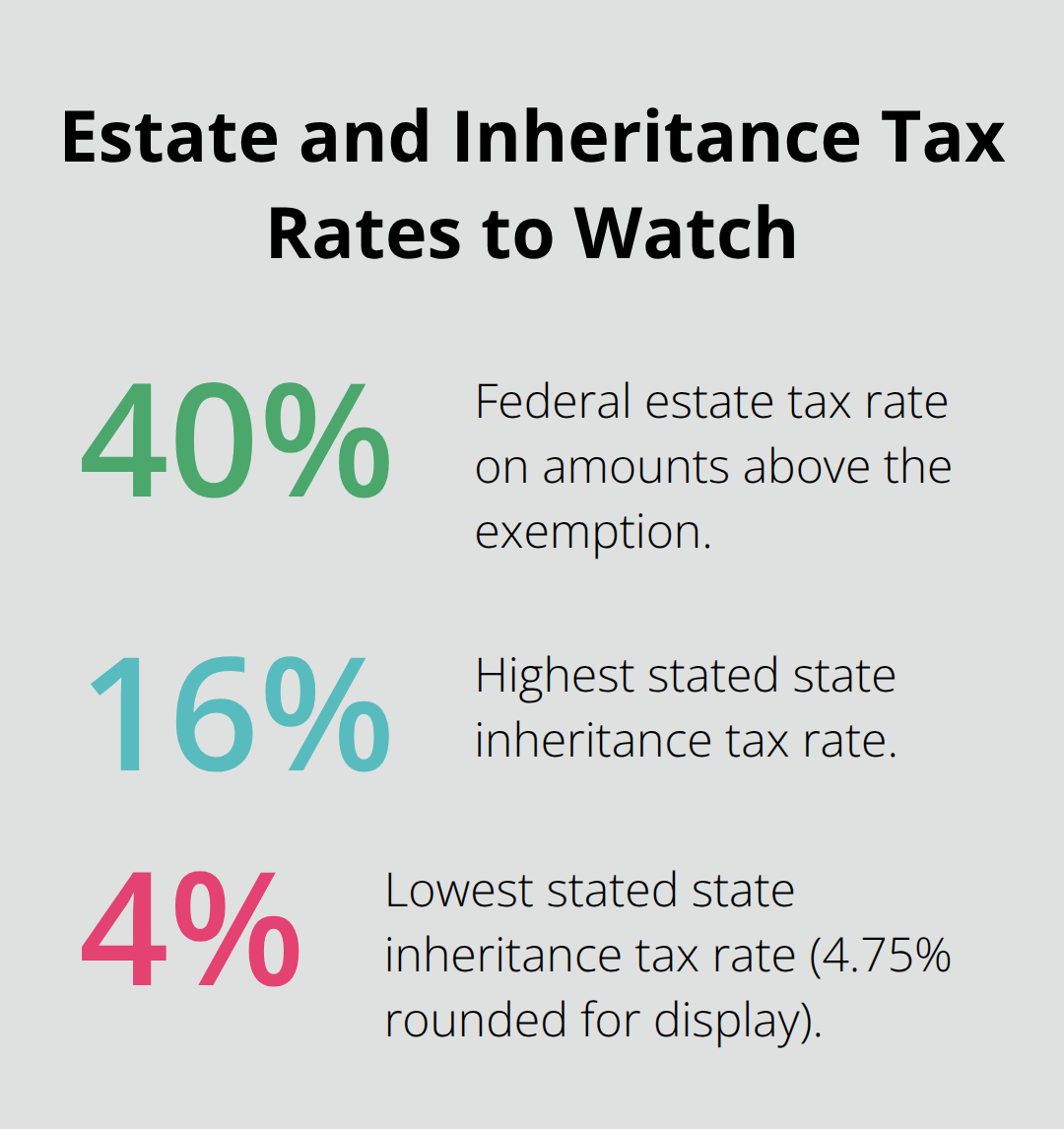
The federal estate tax exemption sits at approximately $13.61 million per person in 2026, according to current IRS rules. This threshold determines whether your estate owes federal taxes at all. Most families fall below this limit, which means federal estate tax may not be your primary concern. However, the exemption drops to approximately 7 million dollars per person on January 1, 2026, unless Congress acts. This cliff creates urgency for high-net-worth families to act now rather than wait. If your estate exceeds the exemption, the federal tax rate is 40 percent on everything above the threshold-steep enough to warrant serious planning if your assets are substantial.
Married couples can double their tax-free transfer amount
Portability elections let married couples combine their exemptions, effectively doubling the amount that passes tax-free. If your spouse dies first, you can elect portability on their estate tax return to preserve their unused exemption. This means if your spouse’s estate uses only 3 million dollars of their exemption, you can carry forward the remaining amount. The election requires filing Form 706, the federal estate tax return, even if no tax is owed. Many families skip this step because they assume they don’t need to file-that mistake costs them millions in potential tax savings. The portability election must be made on a timely filed return, so working with a qualified attorney to handle this properly is non-negotiable.
Annual gifts reduce your taxable estate without penalties
You can give away 18,000 dollars per person per year without using any of your exemption, according to 2024 IRS guidance. This annual exclusion applies to each recipient, so a married couple can give 36,000 dollars to each child annually without tax consequences. Over time, these gifts significantly shrink your taxable estate. Appreciated assets are particularly valuable to gift during your lifetime because the recipient receives a stepped-up basis only at death. Gifting appreciated property now means future growth happens outside your estate. If you gift 500,000 dollars in real estate today and it appreciates to 800,000 dollars by your death, that 300,000 dollar gain never enters your taxable estate.
Irrevocable trusts lock assets outside your estate permanently
Structured gifting through irrevocable trusts compounds these benefits by permanently removing assets from your control and your taxable estate while still allowing you to see the assets benefit your family. For assets expected to appreciate substantially, this strategy is more powerful than waiting. The trade-off is clear: you lose direct ownership, but you gain significant tax protection. These federal strategies form the foundation of sound estate planning, yet state-level taxes add another layer of complexity that many families overlook.
State and Local Tax Layers That Affect Your Estate
Federal estate taxes attract most attention, but state-level taxes often hit harder because they apply at lower thresholds and affect more families. Twelve states plus Washington D.C. impose estate taxes, and six states levy inheritance taxes on beneficiaries directly. Iowa, Kentucky, Maryland, New Jersey, Pennsylvania, and Tennessee charge inheritance taxes ranging from 4.75 percent to 16 percent depending on the beneficiary’s relationship to the deceased and the inheritance amount. These state taxes operate independently of federal rules, meaning your estate could owe nothing federally yet face substantial state liability.
State Exemption Thresholds Create Unexpected Tax Bills
New York’s estate tax exemption sits at $6.94 million per person in 2026, roughly half the federal threshold, which means many estates that escape federal tax still pay New York state tax. Massachusetts and Oregon use $1 million exemptions, catching middle-class estates entirely. Connecticut’s top estate tax rate reaches 12 percent on estates exceeding $12.92 million. If you own property or live in multiple states, these overlapping obligations create serious planning gaps that most families miss until it’s too late.
California’s Tax Advantage Requires Careful Structuring
California offers a significant advantage: no state estate tax and no inheritance tax. This makes California substantially more favorable than neighboring states for wealth preservation, but only if you structure your residency and property ownership correctly. If you maintain a primary residence in California while owning vacation property in Oregon or investment real estate in New York, your estate faces tax exposure in those states regardless of California’s favorable rules. State tax obligations follow the property itself, not your residence. Multi-state real estate requires separate planning for each jurisdiction. A property in Pennsylvania may need a Pennsylvania-specific trust or deed strategy, while California property can use simpler structures.
Coordinate State and Federal Planning to Prevent Tax Gaps
The solution is identifying which state claims tax authority over each asset based on location and ownership type, then using state-specific tools like transfer-on-death deeds or state-appropriate trusts to minimize exposure in high-tax jurisdictions. This coordination between federal and state planning prevents the costly scenario where you’ve optimized federal taxes but ignored state liabilities that ultimately consume more of your estate. Income tax complications during probate administration add yet another dimension to this picture.
How Probate Income Taxes Reshape What Your Beneficiaries Actually Receive
The Step-Up in Basis Eliminates Capital Gains Taxes for Heirs
The step-up in basis at death stands as one of the most powerful and misunderstood tax benefits available to your heirs. When you die, the IRS automatically adjusts the cost basis of your assets to their fair market value on the date of death. If you purchased stock for $50,000 and it grew to $300,000 by the time you pass away, your heirs inherit it with a $300,000 basis. They can sell it immediately without owing capital gains tax on the $250,000 appreciation that occurred during your lifetime.
IRS Publication 559 explains this clearly: beneficiaries receive a stepped-up basis equal to fair market value on the date of death, not the original purchase price. This single rule eliminates hundreds of thousands or millions in capital gains taxes for families with appreciated real estate, investment portfolios, or business interests. The step-up applies regardless of whether assets pass through probate or trusts, so proper valuation at death becomes critical.
An undervalued appraisal means your heirs lose the full tax benefit they’re entitled to, while an inflated valuation triggers IRS scrutiny. Professional appraisals for significant assets before or immediately after death lock in the stepped-up basis amount and document it clearly for tax returns.
Distribution Timing Determines Estate and Beneficiary Tax Liability
The timing and structure of distributions from the estate to beneficiaries directly determines how much income tax the estate and beneficiaries owe. When an executor or trustee distributes assets within the first year after death, beneficiaries typically owe minimal income tax. However, distributions that stretch beyond that window cause the estate itself to accumulate income tax liability on undistributed earnings.
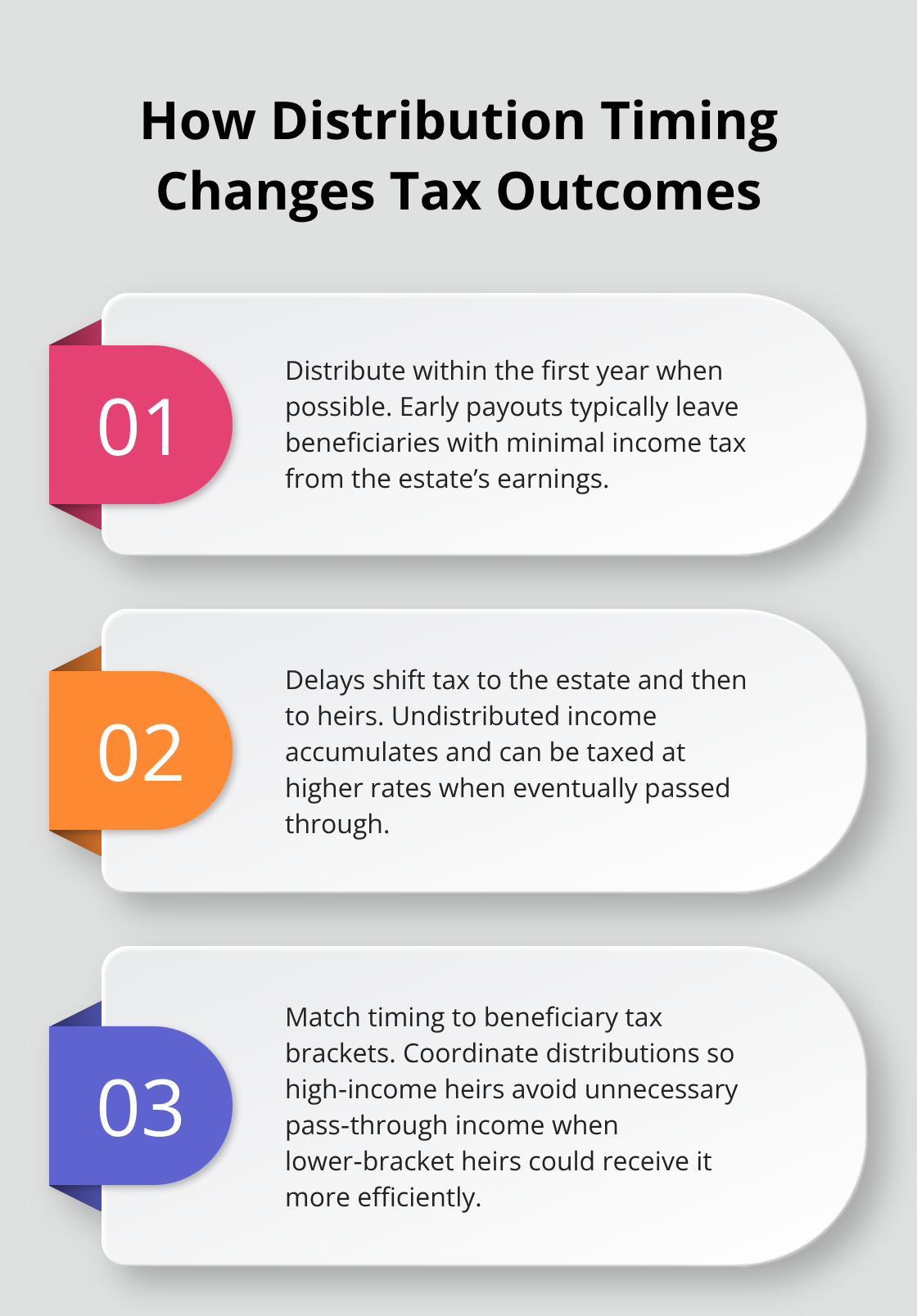
An estate can deduct approximately $1,500 of distributable net income in 2024 before beneficiaries must report their share of earnings, according to IRS rules. Once that threshold is exceeded, both the estate and beneficiaries face tax on the income. A beneficiary receiving $500,000 in cash immediately pays zero income tax, but that same $500,000 sitting in the estate earning 5 percent annually creates $25,000 in taxable income that flows to beneficiaries at higher rates than the estate itself would pay.
Accelerate Distributions to Minimize Tax Exposure
The practical solution involves accelerating distributions of appreciated assets and cash within the first 12 to 18 months while retaining income-producing assets temporarily if the estate faces lower tax brackets. This strategy requires coordinating with the beneficiaries’ personal tax situations-a high-income beneficiary might owe more tax on distributed income than a retired beneficiary in a lower bracket.
Executors and trustees who delay distributions without legitimate reasons essentially transfer tax liability to heirs rather than reducing it. The difference between a 12-month distribution timeline and a three-year timeline can amount to tens of thousands of dollars in unnecessary taxes that your family pays.
Final Thoughts
Probate tax planning considerations span federal exemptions, state-level taxes, and income tax timing-three separate systems that interact in ways most families don’t anticipate. Federal portability elections preserve unused exemptions for surviving spouses, annual gifting removes assets before appreciation occurs, and state tax planning requires identifying which jurisdiction claims authority over each property. Step-up in basis protections depend on proper valuation at death, while distribution timing determines whether your estate or beneficiaries absorb income tax liability.
None of these strategies work in isolation. A portability election that ignores state taxes leaves your family exposed to inheritance taxes in Pennsylvania or New York. Aggressive gifting without considering step-up in basis timing might accelerate taxes unnecessarily, and delaying distributions to manage estate income tax could trigger higher beneficiary-level taxes if your heirs are high earners.
We at Law Offices of Roshni T. Desai work with families to coordinate these overlapping obligations and build estate plans that protect what you’ve built. Contact us to discuss your probate tax planning needs and schedule a free consultation to review your current situation.