




Property Owner Probate: A Guide For Real Estate Investors And Families
Property owner probate can feel overwhelming when you’re facing it for the first time. Whether you’re managing an inheritance or planning ahead, understanding how real estate moves through probate matters for your financial future.
We at Law Offices of Roshni T. Desai have helped families and investors navigate this process. This guide walks you through what happens to property, how to avoid probate entirely, and what costs you’ll actually face.
What Happens to Your Property When Probate Begins
The Court’s Role and the Personal Representative’s Duties
When someone passes away with real estate in their name alone, that property enters probate immediately. The court appoints a personal representative to manage the estate, and this person carries significant responsibilities that directly affect your property’s value and timeline. The personal representative must identify what the deceased owned, determine its value, pay any debts against it, and eventually transfer it to heirs or beneficiaries. This process requires paperwork, court filings, and often professional appraisals. For real estate specifically, the personal representative needs to understand the property’s current market value, any mortgages or liens attached to it, and ongoing costs like property taxes and insurance that continue accumulating during probate.
Valuation and Timeline Realities
The American Bar Association notes that typical probate timelines average 6–9 months, though complex cases involving multiple properties or disputes between heirs stretch significantly longer. Real estate valuation in probate presents challenges because market conditions fluctuate, location matters enormously, and property condition affects price. An accurate appraisal early prevents problems later-heirs deserve fair distribution, and creditors need to know what assets exist to satisfy claims. Debts and liens do not disappear during probate; they must be paid before anyone inherits anything. If the deceased had a mortgage, property taxes in arrears, or mechanic’s liens from repairs, these obligations take priority over inheritance distributions.
Managing Ongoing Property Costs
The personal representative carries ongoing financial responsibility while probate moves forward. Property taxes must be paid on schedule, insurance premiums continue, and necessary maintenance cannot be deferred without risking property deterioration. If someone still occupies the property (a surviving spouse or adult child, for instance), utilities and basic upkeep become the estate’s obligation. If the property needs repairs and the personal representative delays addressing them, the estate could lose value and face liability issues. Many families treat probate property as frozen in time, but it is not. The court expects active management.
Navigating Multiple Heirs and Competing Interests
When multiple heirs exist, decisions become harder because the personal representative must act in everyone’s interest, not favoring one beneficiary over another. If heirs disagree about selling versus keeping the property, the personal representative may need court approval to proceed. This is where having clear guidance matters. The reality is that probate property costs money to maintain, and those costs reduce what heirs ultimately receive. Starting with accurate inventory and valuation prevents surprises and disputes down the road. Understanding these costs and responsibilities sets the stage for exploring how to sidestep probate altogether through strategic planning.
How to Keep Real Estate Out of Probate
Probate delays property transfer and drains estate value through court fees, appraisals, and prolonged holding costs. The smart move is preventing probate altogether through planning that starts before death. Three proven structures accomplish this, and each works differently depending on your situation, family dynamics, and state law.
Revocable Living Trusts: Maximum Control and Flexibility
A revocable living trust holds real estate in the trust’s name rather than your personal name, allowing the property to transfer directly to beneficiaries after death without court involvement. You maintain full control during your lifetime, can modify or revoke the trust anytime, and avoid the 6–9 month probate timeline that the American Bar Association documents as standard. When you die, a successor trustee you’ve named simply distributes the property according to your instructions-no judge approval needed. The upfront cost runs $1,500 to $3,000 for professional drafting, but this pays for itself immediately by eliminating probate court fees, which typically consume 3–7% of estate value in many states. A revocable living trust also keeps property transfers out of public court records, protecting your privacy and simplifying administration if you own multiple properties across different states.
Joint Tenancy and Life Estate Deeds: Simpler Alternatives
Joint tenancy with survivorship allows property to pass automatically to the surviving owner outside probate, making it attractive for spouses or long-term partners. However, this approach carries tax consequences and ownership complications if relationships change. A life estate deed transfers property to a named beneficiary after your death while you retain the right to live there and control it during your lifetime, another valid probate-avoidance mechanism that works well for family homes but requires careful structuring to avoid unintended tax burdens. Transfer-on-death deeds in states that permit them function similarly, letting you name a beneficiary who receives the property automatically after death.
Choosing the Right Strategy for Your Situation
Joint tenancy works best for straightforward situations with one other owner, while life estate deeds suit specific scenarios like protecting a family home while ensuring a child inherits it later. For most real estate owners, a revocable living trust offers maximum flexibility and simplifies administration across multiple properties. The timing matters-these structures must be in place before death to work. Waiting until illness or advanced age complicates implementation and may trigger gift tax reporting or Medicaid planning issues. State law varies significantly, so Colorado probate thresholds differ from Oklahoma’s, and what avoids probate in one state may not work identically in another.
Planning Now Prevents Costly Delays Later
The cost of planning now is minimal compared to the expense and delays heirs face when probate becomes unavoidable. Each strategy requires different implementation steps, and selecting the right one depends on your property holdings, family structure, and state residence. Understanding these options positions you to make informed decisions before circumstances force your hand. The next section examines what probate actually costs when you cannot avoid it, helping you quantify the financial impact of delaying this planning.
Probate Costs and How They Impact Real Estate Value
Court Fees, Attorney Costs, and Professional Expenses
Probate drains real estate value through multiple cost layers that most families underestimate until they commit to the process. Court fees alone range from $500 to $2,000 depending on your state and estate complexity, but that represents only the start. Attorney fees typically consume 1–3% of total estate value, which translates to $5,000 to $15,000 or more for moderately sized estates. If your real estate needs appraisal during probate, add another $500 to $1,500 per property. These costs accumulate whether the property sells or transfers to heirs, and they all come directly from the estate before anyone inherits a dollar.
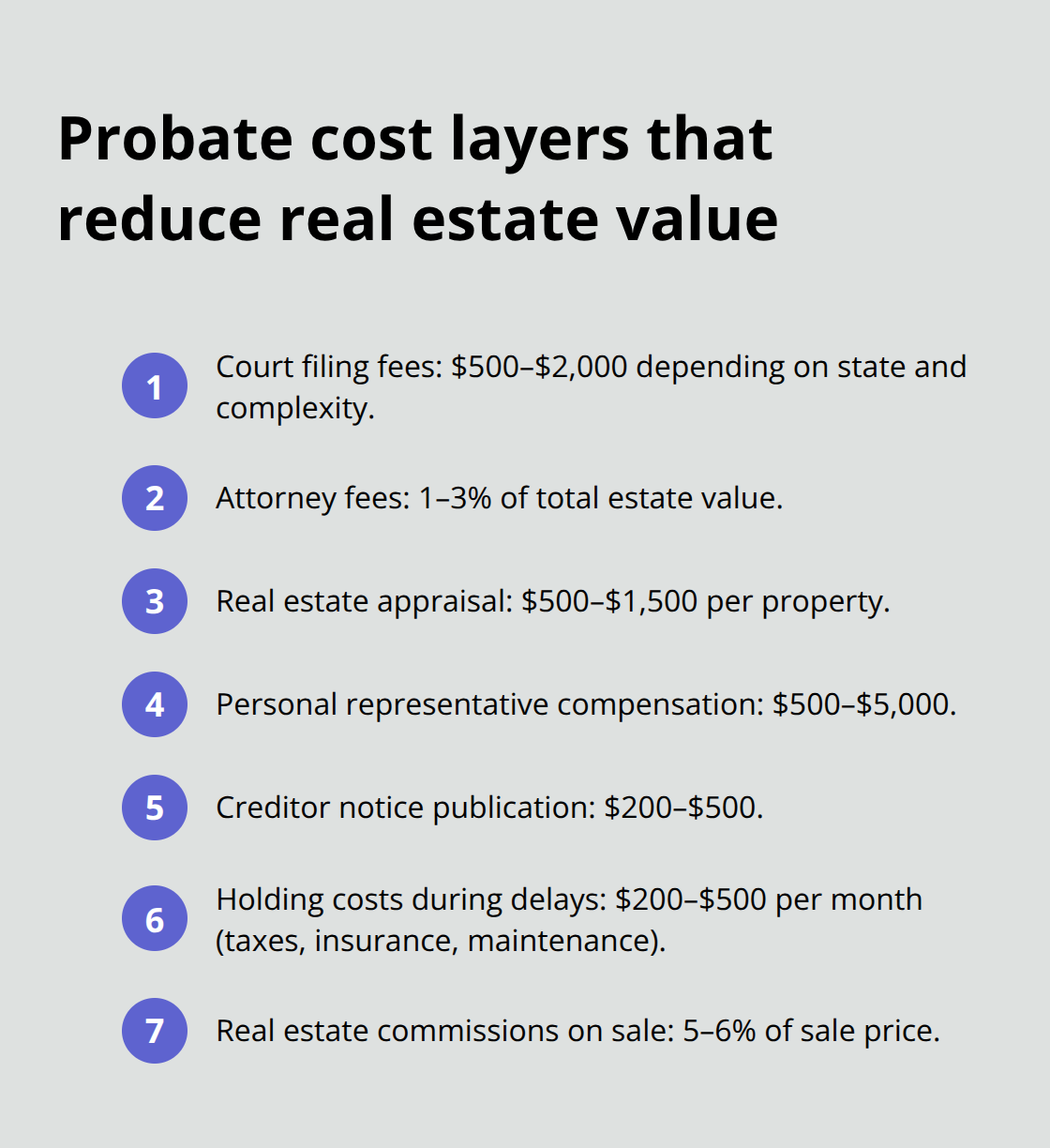
Personal representative fees add another layer-courts often approve compensation ranging from $500 to $5,000 depending on the estate’s complexity and the representative’s time commitment. Publication costs for creditor notices run $200 to $500. If probate extends beyond the standard 6–9 month timeline that the American Bar Association documents as typical, holding costs multiply substantially. Property taxes, insurance, and maintenance continue accruing monthly while probate moves through the court system, easily adding $200 to $500 monthly for an average residential property.
Real Estate Commissions and Sale Expenses
When real estate actually sells during probate, real estate commissions hit at 5–6% of the sale price-exactly what you’d pay in a normal transaction, but now the heirs absorb this cost while waiting months longer for court approval. A $500,000 property sale generates $25,000 to $30,000 in commissions that reduce the inheritance directly. The extended timeline means additional carrying costs that wouldn’t exist in a standard sale, further eroding the net proceeds heirs ultimately receive.
Tax Implications and Estate Value Reduction
Federal estate taxes apply if the estate exceeds approximately $13.61 million in 2024 according to current IRS thresholds, but state-level estate taxes in states like California trigger at much lower thresholds. Income tax on estate gains matters too-if the property appreciated significantly, heirs may owe capital gains tax unless they receive a stepped-up basis at death, a tax benefit that requires proper planning to maximize. Colorado and Oklahoma have specific probate thresholds and rules that affect whether estates qualify for simplified procedures that cost less, so understanding your state’s requirements matters enormously.
The Real Financial Impact
The cumulative impact proves substantial: a $400,000 estate with moderate complexity easily costs $12,000 to $20,000 in probate expenses, reducing inheritance by 3–5% before distribution happens. This is precisely why revocable living trusts costing $1,500 to $3,000 upfront pay for themselves immediately-they eliminate these probate costs entirely while providing complete control during your lifetime and seamless transfer after death. For property owners with significant real estate holdings or multiple properties across state lines, the savings multiply exponentially. Understanding these actual costs helps you make informed decisions about whether probate avoidance strategies make financial sense for your situation.
Final Thoughts
Property owner probate costs 3–7% of estate value and stretches 6–9 months minimum, tying up real estate while heirs wait for court approval. You now understand what happens inside probate, how much it actually costs, and three concrete strategies that eliminate it entirely through planning. Acting now, before illness or age complicates implementation, transforms probate from your heirs’ problem into your planning opportunity.
State law matters enormously-Colorado probate thresholds differ from Oklahoma’s, and what works in one jurisdiction may not translate identically elsewhere. We at Law Offices of Roshni T. Desai help property owners across Southern California structure their estates to avoid probate entirely, combining legal knowledge with real estate insight to streamline transactions and reduce costs. The first step is a conversation to review your specific property holdings, family structure, and state circumstances.
Contact us for a free consultation to protect your real estate from probate and secure your family’s financial future. We offer flexible scheduling with home or office visits because estate planning should fit your life, not the other way around. Your years of building wealth and security deserve protection through the right guidance in place.