




Southern California Probate Planning: Proactive Steps for Your Estate
Most Southern California families don’t realize probate can take 18 months or longer and cost thousands in court fees. Without a plan, your loved ones face delays, expenses, and public court proceedings that could have been avoided.
We at Law Offices of Roshni T. Desai help families build solid estate plans that keep assets out of probate and protect what matters most. This guide walks you through the documents and strategies that work in California.
What Probate Actually Costs Your Family
Probate in California isn’t just a minor inconvenience-it’s a financial and time drain that catches families off guard. California processes roughly 38,000 probate cases annually, with projections showing 3 to 5 percent growth each year, potentially exceeding 50,000 cases within five years. This surge stems directly from California’s senior population, which will grow by about 60 percent by 2034. Los Angeles, Orange, and San Diego counties will experience sharper increases due to their larger populations of older adults. When your estate enters probate court, attorney fees and personal representative fees are calculated as a percentage of your gross estate value. A $500,000 estate can easily incur $15,000 to $25,000 in fees alone, not counting court costs, publication fees, and the months of waiting. Real estate complicates matters further-Southern California homes frequently exceed the $184,500 probate threshold, automatically triggering court involvement. Probate proceedings are public record, meaning your family’s financial details become open information accessible to anyone.
The Real Price Tag of Court Involvement
Probate fees add up fast because they’re tied to your estate’s total value, not the complexity of the case. Court costs, publication fees, and bond requirements drain additional funds before your beneficiaries receive anything. The longer probate takes, the more your family pays in attorney time and court appearances. Some families also face appraisal fees, accounting costs, and creditor claims that probate requires them to address through the court system. These expenses come directly from the estate, reducing what your heirs actually inherit.
Why Southern California Families Face Longer Delays
Ventura County illustrates the real problem: it has only one probate court handling an entire county’s caseload. Courts across Southern California are increasingly digital, but implementation varies by county and creates bottlenecks. The minimum timeline for an uncomplicated estate hovers around nine months, though contested cases regularly stretch to 18 months or beyond. During this wait, your family cannot access funds for immediate needs, cannot sell property without court permission, and cannot distribute assets to beneficiaries. Blended families and complex ownership structures make delays worse-when multiple heirs dispute the will or when properties are titled incorrectly, probate becomes a grinding legal battle.
How Planning Bypasses These Problems Entirely
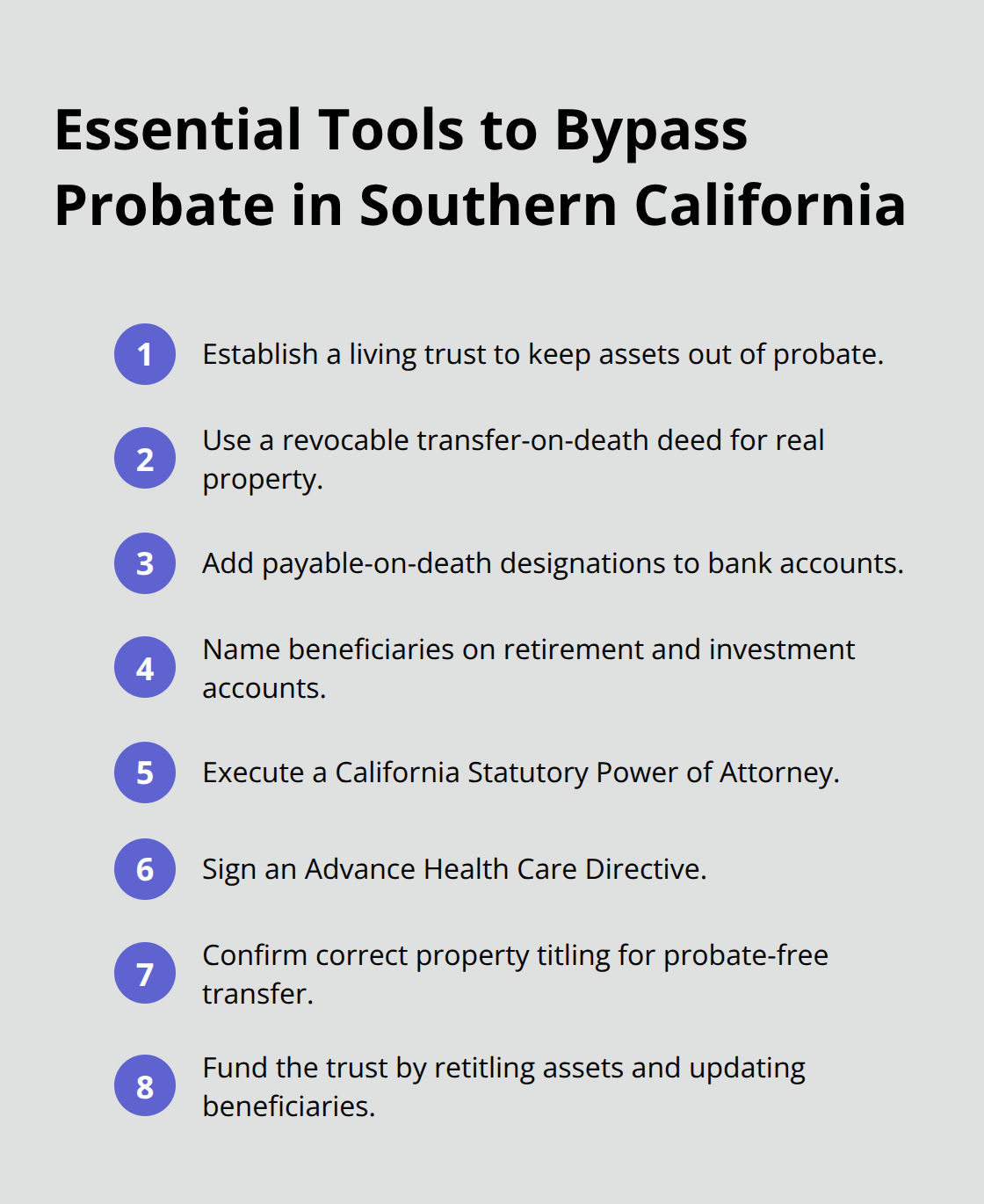
The alternative is straightforward: plan now using trusts, transfer-on-death deeds, and clear beneficiary designations so your assets bypass court entirely. These tools transfer property directly to your beneficiaries without probate involvement. A living trust holds your assets during your lifetime and distributes them after your death according to your wishes (without court approval). Transfer-on-death deeds let you name beneficiaries for real property; they take effect only after you pass away, and you retain full control while living. Payable-on-death accounts work similarly for bank funds, passing directly to named beneficiaries. When your assets are structured correctly from the start, your loved ones inherit smoothly without months of court appearances or unexpected fees draining the estate. The documents and strategies that protect your family start with understanding which tools fit your specific situation-which is exactly what the next section covers.
Essential Documents Every Southern California Estate Needs
A will alone won’t protect your Southern California estate from probate. Many families create a will thinking they’ve solved the problem, only to discover years later that their loved ones still faced court delays and fees. The truth is that a will must go through probate to transfer real property-it names your heirs but doesn’t automatically transfer assets outside the court system. A living trust holds your assets during your lifetime and distributes them directly to beneficiaries after your death without any court involvement. This matters enormously in Southern California, where home values typically exceed the $184,500 probate threshold. If your primary asset is real estate, a living trust bypasses probate entirely for that property.
Transfer-on-Death Deeds and Payable-on-Death Accounts
A revocable transfer-on-death deed offers another practical route for real property. You sign a form in front of a notary, have two witnesses sign, and record it with your County Recorder within 60 days. After your death, your heirs file a simple affidavit to claim the property, and the transfer receives favorable tax treatment as inheritance rather than a gift. Payable-on-death accounts work the same way for bank funds, passing directly to named beneficiaries without probate involvement. The choice between these tools depends on your asset mix and family situation-but combining a living trust with TOD deeds for real property and POD accounts for cash creates a comprehensive shield against probate.
Powers of Attorney and Healthcare Directives Protect You Now
Estate planning isn’t only about what happens after death; it covers what happens if you become unable to manage your affairs today. A California Statutory Power of Attorney lets you appoint someone to handle your finances if you’re incapacitated, avoiding the need for a costly conservatorship court process. An Advance Health Care Directive names someone to make medical decisions on your behalf and documents your preferences for end-of-life care. These documents take effect immediately if you become unable to act, and your chosen agents can pay bills, access accounts, and make healthcare decisions without court approval. Many families overlook these documents and later face months of conservatorship proceedings just to pay a hospital bill or access a parent’s bank account. Setting up both documents costs far less than fighting through court-supervised conservatorship, which can run $3,000 to $5,000 or more in legal fees and court costs.
Beneficiary Designations and Property Titles Matter More Than You Think
Beneficiary designations on retirement accounts, life insurance policies, and investment accounts bypass probate automatically-the funds pass directly to whoever you name. Check your deed to confirm how you hold title to your home; if it’s held as joint tenants with right of survivorship or community property with right of survivorship, it transfers automatically to the surviving owner without probate. Incorrect titling is one of the most common mistakes that forces families into unnecessary court proceedings. The specific combination of tools that fits your situation depends on your assets, family structure, and long-term goals-which is why understanding how to organize your trust and structure these tools strategically ensures maximum protection.
Protecting Your Family and Assets Through Trust Planning
A living trust is the foundation of serious probate avoidance in Southern California, and frankly, most families should have one. A living trust holds your assets during your lifetime and distributes them directly to beneficiaries after your death without any court involvement whatsoever. You maintain complete control while living-you can buy, sell, and modify assets held in the trust at will. The moment you pass away, your successor trustee (the person you name) distributes assets according to your instructions, and probate never enters the picture.
Why Living Trusts Work in Southern California
This matters intensely in Southern California because your home alone likely exceeds the $184,500 probate threshold. If you own real property, business interests, or multiple investment accounts, a living trust eliminates court costs, public disclosure of your finances, and the nine-month minimum waiting period that plagues probate cases. An irrevocable trust serves a different purpose entirely-it reduces estate taxes and protects assets from creditors, but it requires you to surrender control of those assets permanently. Irrevocable trusts make sense only if you have a taxable estate (currently over $13.61 million for federal purposes in 2024, though California has no state estate tax) or if you’re specifically protecting assets from creditors or long-term care costs. For most Southern California families, the living trust handles the heavy lifting; irrevocable trusts are specialized tools for narrow situations.
Funding Your Trust Prevents Costly Mistakes
The structure of your trust matters more than the type-if you fail to fund it properly by transferring assets into the trust’s name, the trust becomes worthless. We at Law Offices of Roshni T. Desai see families who created trusts but never actually moved their property, accounts, or investments into them, leaving their estates fully exposed to probate anyway. Real property requires transfer via deed; bank accounts and investment accounts require title changes; retirement accounts need beneficiary designation updates pointing to the trust or your beneficiaries directly. This funding process takes time and attention, which is why working through the details carefully prevents costly mistakes later.
Tax Advantages and Creditor Protection
Proper trust structure reduces taxes and court involvement by controlling when and how beneficiaries receive distributions. A well-drafted trust can include provisions that delay distributions to young beneficiaries, protect inheritances from beneficiaries’ creditors or divorces, and minimize income tax consequences. If you own real property that will appreciate significantly, your trust structure affects whether your heirs receive a step-up in basis at your death-a tax advantage that can save thousands. Southern California’s high real estate values make this planning essential; a home purchased for $400,000 that appreciates to $900,000 creates substantial capital gains tax exposure for heirs who inherit without proper planning.
Business Succession Through Your Trust
If you own a small business, your trust can name a successor to manage or sell the business, specify buyout terms, and prevent forced liquidation by creditors during probate. The trust document can direct your successor trustee to continue operating the business, sell it to a designated buyer, or distribute it to family members who want to run it. Without this planning, a business owner’s death often triggers probate, disrupts operations, and forces heirs to either liquidate quickly at fire-sale prices or navigate months of court-supervised business management. Ms. Desai’s dual licensure as an attorney and real estate professional streamlines these property and business succession considerations, reducing costs, delays, and communication gaps when your estate involves real estate transactions or business transitions.
Final Thoughts
Southern California probate planning works best when you act now, not when a crisis forces your family into court. The documents and strategies covered in this guide-living trusts, transfer-on-death deeds, powers of attorney, and clear beneficiary designations-separate a smooth asset transition from months of expensive court proceedings that drain your estate. Your family’s financial security rests on decisions you make today while you’re healthy and able to think clearly about your wishes.
California probate cases climb toward 50,000 annually within five years, and Southern California counties face the sharpest increases. Your home alone likely exceeds the probate threshold, which means without planning, your loved ones will face court involvement, public disclosure of your finances, and a nine-month minimum wait before accessing funds. A $500,000 estate can lose $15,000 to $25,000 in probate fees alone-costs that come directly from what your heirs inherit.
We at Law Offices of Roshni T. Desai help Southern California families build estate plans that protect what matters most. Contact us today to schedule your free consultation and take the first step toward protecting your family and assets.