




Family Trust Planning Strategies: Securing Your Legacy
A family trust is one of the most powerful tools for protecting your assets and controlling how they pass to the next generation. Many California families overlook trusts, relying only on wills-a decision that often costs them time, money, and privacy during probate.
At Law Offices of Roshni T. Desai, we help families build family trust planning strategies that actually work. This guide walks you through what trusts do, how to set them up correctly, and the mistakes that derail most families.
What a Family Trust Actually Does for Your Estate
A family trust holds your assets during your lifetime and distributes them to your beneficiaries after you pass away, all outside the probate system. Unlike a will, which becomes public record and requires court approval to transfer assets, a trust keeps your financial details private and moves money directly to your family without delays. The probate process in California typically takes nine months to two years, during which your assets remain frozen and your family cannot access funds.
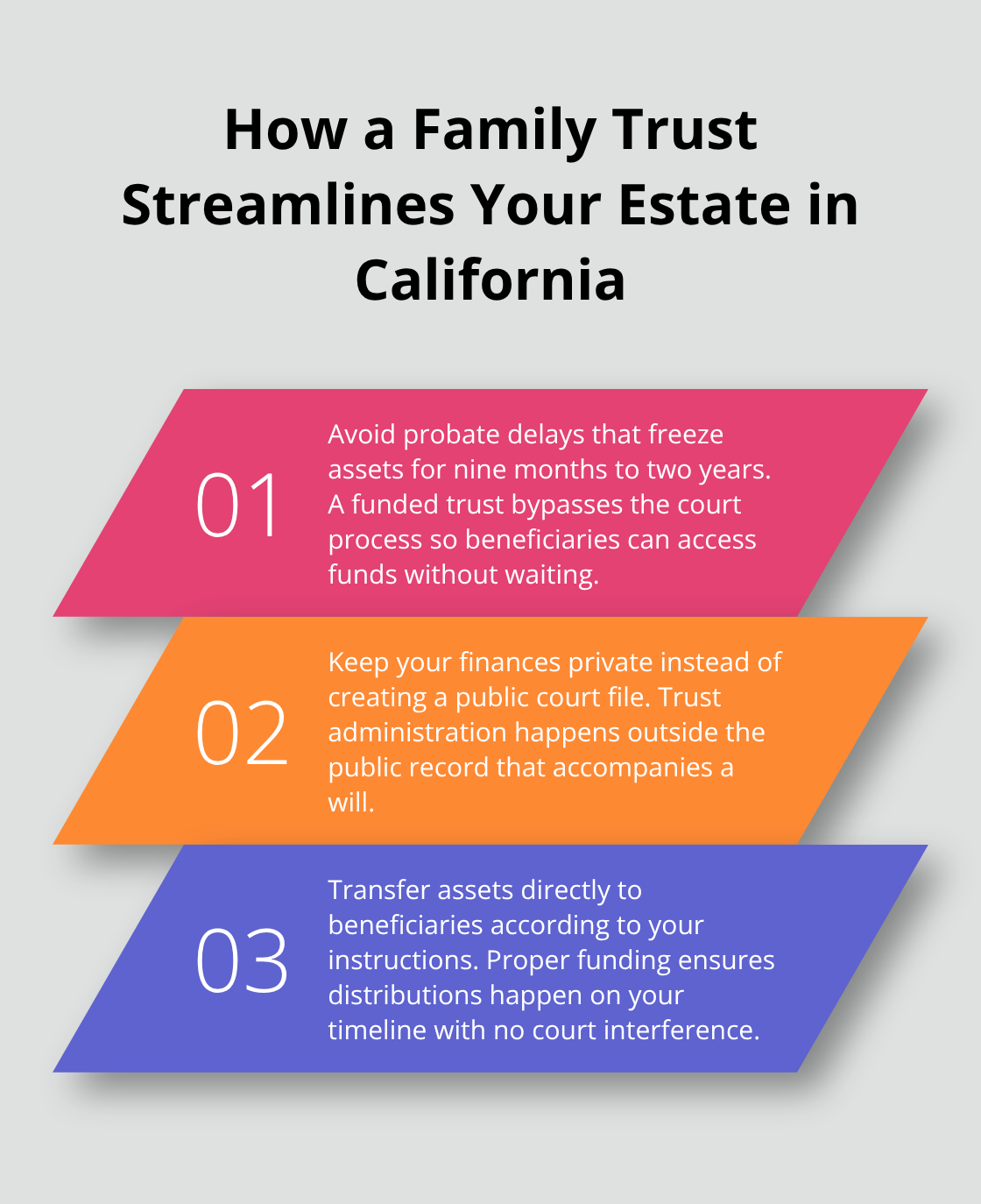
A properly funded trust eliminates this waiting period entirely.
Maintaining Control While You’re Alive
You retain complete control over the trust while alive-you can change beneficiaries, add or remove assets, or modify distribution terms whenever your situation changes. This flexibility matters most when your family circumstances shift, such as a divorce, a new grandchild, or a significant increase in wealth. The trustee you name (often yourself initially) manages the trust assets and follows your instructions exactly as written, which means no surprises and no court interference. When you pass away, your successor trustee takes over and distributes assets according to your specific wishes-whether that means giving everything to your spouse immediately, splitting funds among adult children, or setting aside money for grandchildren’s education.
The Real Cost Difference
The cost of setting up a trust typically runs between $1,500 and $3,000, while probate costs often consume 3 to 7 percent of your estate’s total value. For a $500,000 estate, that difference is substantial. Trusts also shield your privacy from public view; probate records are accessible to anyone, meaning creditors and distant relatives can learn exactly what you owned and who inherited it. A trust keeps all of this information confidential.
Why Trusts Beat Wills for Most California Families
Wills serve a purpose, but they only direct how assets are distributed after probate completes. If you own real estate, investment accounts, or a business, a will alone forces your family through court proceedings that drain both time and money. Trusts avoid probate entirely by transferring ownership of assets to the trust during your lifetime. This means your family receives their inheritance quickly and privately.
Many California families also use trusts to protect assets from creditors and to provide guidance for managing money on behalf of younger beneficiaries. A spendthrift trust prevents a beneficiary from spending inherited funds recklessly or losing them to creditors, while still providing regular income or lump-sum distributions according to your timeline. Irrevocable trusts offer even stronger protection by removing assets from your taxable estate, which can significantly reduce or eliminate estate taxes. For 2026, the federal estate tax exemption is $15 million per person, meaning most California families won’t owe federal estate taxes, but state estate planning still matters for asset protection and family control.
Control and Continuity Beyond Your Lifetime
The real advantage of trusts is control and continuity-you decide exactly when and how your beneficiaries receive money, and a professional trustee carries out those decisions faithfully even after you’re gone. Wills cannot offer this level of control or protection. This is where the strategy shifts from simply transferring assets to actively shaping how your family manages wealth across generations, which brings us to the specific strategies that make trust planning work.
Making Your Trust Work: The Three Decisions That Matter Most
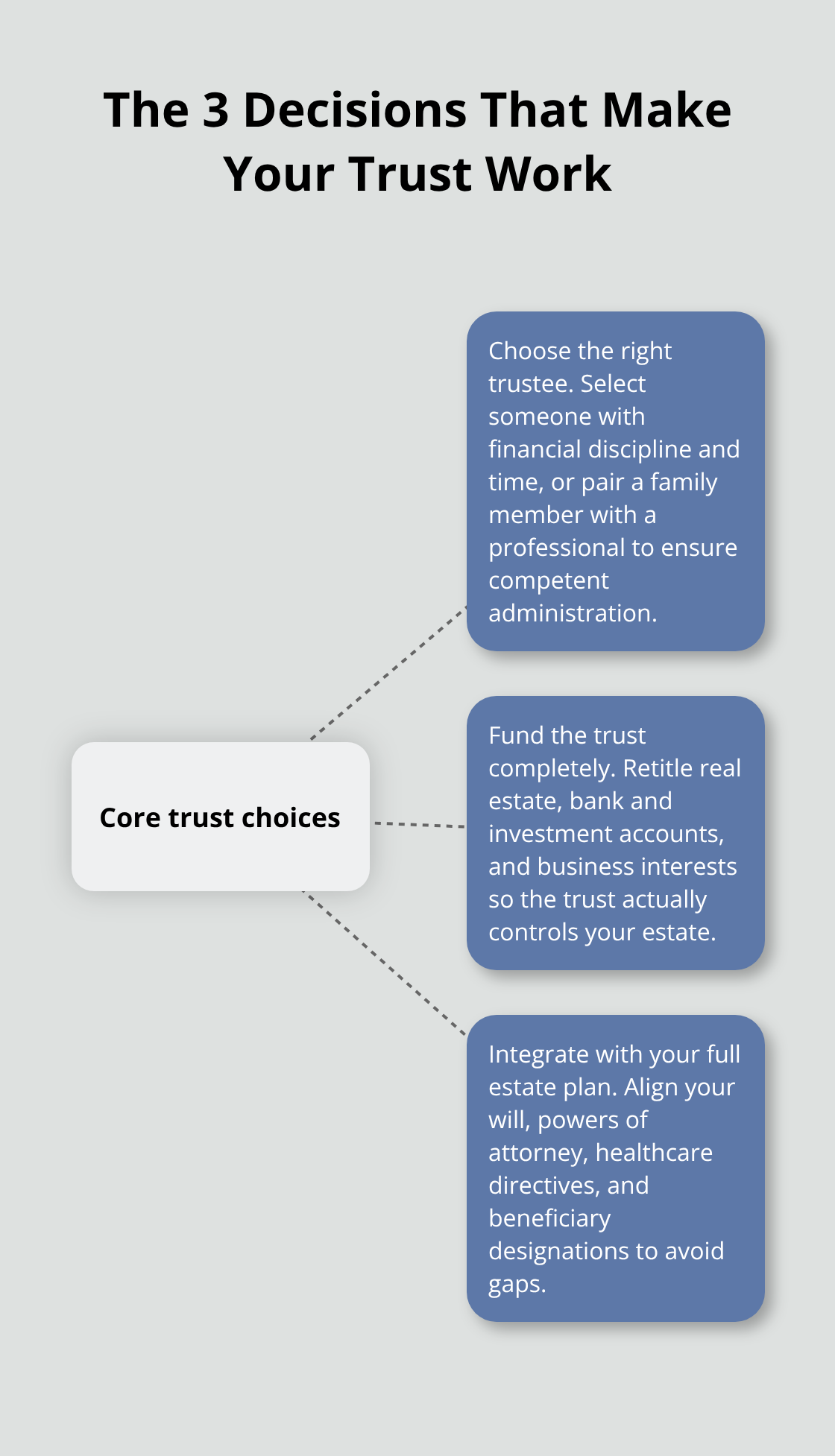
The gap between a trust on paper and a trust that actually protects your family comes down to three concrete decisions. Get these wrong, and your trust becomes a useless document gathering dust in a drawer. Get them right, your family avoids probate, keeps assets private, and receives their inheritance on your timeline. Families make these decisions incorrectly far too often, which is why understanding each one with specific, actionable guidance matters far more than generic trust templates.
Who Manages Your Trust During and After Your Lifetime
Choosing a trustee requires finding someone capable of managing money, following complex instructions, and staying organized through years of administration-not simply someone who loves you. Most families choose a spouse or adult child, but this choice fails when that person lacks financial discipline, has creditor problems of their own, or simply lacks the time to manage trust assets properly. If your trustee is disorganized or makes poor financial decisions, your beneficiaries suffer directly through delayed distributions, poor investment choices, or mismanaged assets.
Professional trustees, family members paired with professional co-trustees, or trust companies remove family conflict entirely and guarantee competent administration. Your successor trustee must understand their legal duties, which means you need to communicate these duties clearly before you pass away. Too many families name someone to this role without ever discussing what it entails, leading to confusion, mistakes, and sometimes litigation after death.
Sit down with your potential successor trustee and explain that they will manage investments, prepare tax returns for the trust, track all distributions, and potentially handle real estate or business assets. If they hesitate or seem overwhelmed, that signals you should choose someone else. The successor trustee also needs written instructions on your values-not just the legal mechanics of distributions, but your intent. Should they prioritize growth or income? Should they help a struggling beneficiary with extra funds, or stick rigidly to the trust document? These conversations prevent your trustee from second-guessing themselves after you are gone.
Funding Your Trust With the Assets That Actually Matter
A funded trust is the only trust that works; an unfunded trust is just paperwork. Funding means transferring ownership of your real estate, investment accounts, bank accounts, and business interests into the trust’s name during your lifetime. Most families fund their trust incompletely, leaving major assets out-sometimes intentionally because they think certain assets should pass outside the trust, and sometimes through simple oversight.
Real estate held in your individual name goes through probate unless you title it in the trust. Investment accounts with named beneficiaries pass outside the trust to those beneficiaries, which might be what you want, but often it is not-especially if a beneficiary is a minor or financially irresponsible. Bank accounts in your individual name trigger probate. A business interest in your sole name creates chaos for your family if you pass away before transferring it to the trust.
Make a complete inventory of everything you own-real estate, brokerage accounts, retirement accounts, bank accounts, life insurance policies, and business interests-and then systematically transfer each one into the trust. This takes effort and sometimes involves paperwork with financial institutions that move slowly, but it is the only way to guarantee your trust actually controls your estate. One critical exception exists: retirement accounts like IRAs and 401(k)s should generally stay in your individual name with named beneficiaries, because transferring them to a trust can trigger unwanted tax consequences. A financial advisor or tax professional can clarify which accounts need special handling.
Life insurance deserves particular attention. If you own a policy in your individual name, the death benefit becomes part of your taxable estate. An irrevocable life insurance trust holds the policy and keeps the proceeds out of your estate entirely, reducing taxes and ensuring the funds are available to pay estate costs without forcing your family to sell assets.
Connecting Your Trust to Your Full Estate Plan
A trust does not stand alone-it works alongside a will, powers of attorney, healthcare directives, and potentially other documents. Your will should contain a pour-over clause that catches any assets you forgot to transfer into the trust and directs them into the trust after probate, preventing those assets from passing outside your intended plan. A durable financial power of attorney lets someone manage your financial accounts and make legal decisions if you become incapacitated before death, which is critical because a trustee has no power to act until you pass away or become unable to manage the trust.
A healthcare power of attorney and living will direct your medical care if you cannot make decisions yourself. These documents work together as a system; without all of them, gaps appear that force your family into court or leave major decisions unmade. Review your beneficiary designations on life insurance policies, retirement accounts, and transfer-on-death accounts to confirm they align with your trust and overall plan. Many families name an ex-spouse or outdated beneficiary by accident, which overrides the trust entirely.
A complete estate plan audit every three to five years catches these misalignments before they cause problems. State law governs how trusts must be set up and funded, which is why consulting an attorney matters far more than using a generic online template-California has specific requirements for trust validity, funding procedures, and tax treatment that vary significantly from other states. Once you understand these three decisions and implement them correctly, the real work shifts to protecting your plan against the mistakes that derail families after you pass away.
Where Trust Planning Actually Fails
Outdated Trusts Create Expensive Problems
Most families create a trust and then abandon it. Life changes-a child marries, a grandchild arrives, your net worth climbs, a marriage ends, or a trusted family member develops financial problems-yet the trust sits unchanged in a drawer for ten or fifteen years. The trust document you signed reflects decisions that made sense in 2015, but your life in 2026 is fundamentally different. California courts see the consequences of outdated trusts constantly: beneficiaries who should have been removed years ago still control distributions, assets acquired after the trust was created pass through probate anyway, and successor trustees who are now deceased or incapacitated cause chaos when the original trustee passes away.
Fidelity Viewpoints recommends reviewing your estate plan every three to five years, and this is not generic advice-it is the minimum threshold to catch major misalignments before they create expensive problems. If you experienced a divorce, welcomed a new child or grandchild, sold a business, inherited significant assets, or moved to a different state since your trust was last reviewed, your plan almost certainly needs updating.
One client had named his brother as successor trustee in 1998; the brother had since developed a serious gambling addiction and accumulated significant debt. The trust had never been updated, meaning this unsuitable trustee would have taken over if the client passed away, potentially placing family assets at risk. The fix took one afternoon and a single amendment, but the cost of not making this change would have been years of family conflict and possibly litigation.
Incomplete Funding Defeats the Purpose
Incomplete funding creates a second category of failure that catches families off guard. You sign a beautiful trust document that supposedly protects everything, then you leave your brokerage account in your individual name, fail to retitle your real estate into the trust, and keep your bank accounts registered personally. When you pass away, these unfunded assets bypass the trust entirely and go through probate-the exact outcome the trust was supposed to prevent.
Many families fund their trust partially: they transfer real estate but forget investment accounts, or they move bank accounts but leave life insurance policies in their individual name. The probate court then controls these unfunded assets, your family waits months for access, and your privacy vanishes as court records become public.
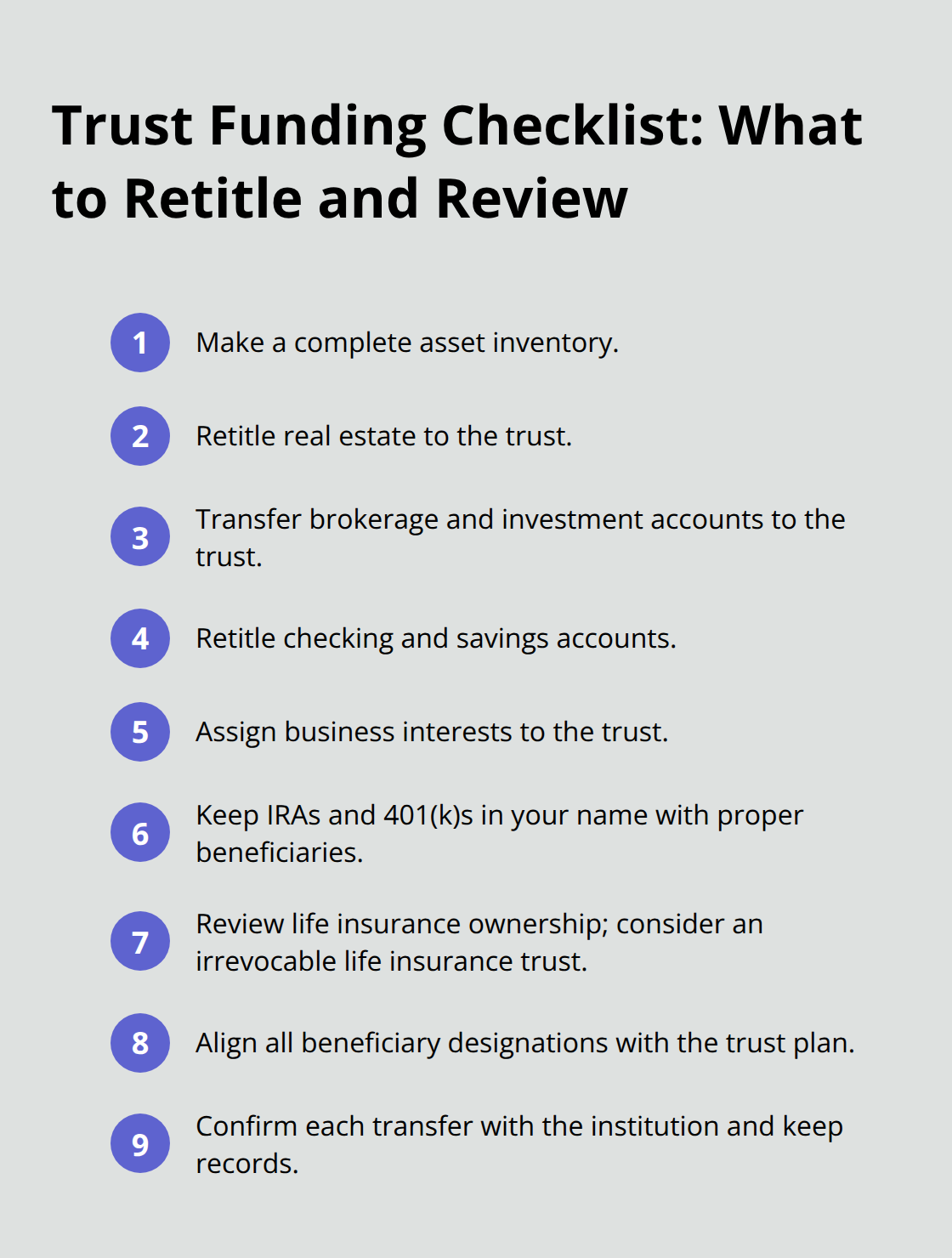
A comprehensive asset inventory prevents this problem, but families often skip this step because it feels tedious. Make a complete list of every account you own-checking and savings accounts, investment accounts, real estate, business interests, life insurance policies, and retirement accounts-and then methodically verify that each one is titled in the trust or has a proper beneficiary designation that aligns with your plan. Properly funding your trust takes a few hours but eliminates the most common reason trusts fail to deliver what families expect.
Unprepared Trustees Create Chaos After Death
Naming a trustee without preparing that person for the role creates disaster. You decide your adult son should be successor trustee because he is responsible and you trust him completely, but you never explain what the role actually requires. After you pass away, your son discovers he must file tax returns for the trust, manage investments, track every distribution, calculate beneficiary shares, and handle potential disputes among siblings-all while grieving and managing his own life.
Many successor trustees make costly mistakes during this learning curve, and some freeze entirely, unable to make decisions without guidance. The solution is simple: sit down with your named successor trustee well before you pass away and walk through their specific duties. Explain that they will need to understand your investment preferences, communicate regularly with beneficiaries, keep detailed records, and possibly hire professional help from an accountant or attorney.
If that conversation reveals your chosen trustee lacks the temperament, time, or financial knowledge for the role, change your decision now rather than setting up your family for problems later. A professional co-trustee or trust company can work alongside a family member, dividing responsibilities so your loved one handles family communication while a professional manages investments and tax compliance. This hybrid approach appears increasingly common because it balances family involvement with professional competence, preventing both the emotional distance of a complete stranger trustee and the chaos of an unprepared family member acting alone.
Final Thoughts on Securing Your Legacy
Start your family trust planning strategies by listing everything you own-real estate, bank accounts, investment accounts, business interests, and life insurance policies. This inventory becomes your roadmap for transferring assets into the trust correctly. Next, identify who should serve as your successor trustee and have an honest conversation with that person about what the role demands. If they hesitate or lack financial discipline, choose someone else now rather than creating problems for your family later.
The trust planning process itself moves quickly when you work with an attorney who understands California law and your specific situation. You will meet to discuss your goals, review your current assets and beneficiaries, and identify any gaps in your existing plan. Your attorney will then draft a trust document tailored to your circumstances, guide you through the funding process, and coordinate with your other estate planning documents to create a complete system. This process typically takes four to eight weeks from initial consultation to a fully funded trust, depending on how many assets you own and how quickly financial institutions process the paperwork.
Many families delay this work because they assume it will be complicated or expensive, but the cost of setting up a trust pales against the probate expenses and delays your family will face without one. We at Law Offices of Roshni T. Desai help Southern California families build estate plans that work and protect assets across generations. Contact us to start your family trust planning today and stop worrying about whether your assets will pass to your family the way you intended.