




Probate Fee Expectations: Planning Costs for Your Estate
Probate costs catch many families off guard. Court fees, attorney charges, and administrative expenses add up quickly, often consuming 3–7% of an estate’s value in California.
We at Law Offices of Roshni T. Desai help clients understand probate fee expectations before they face them. This guide breaks down exactly what you’ll pay and how smart planning cuts those costs significantly.
What Does California Probate Court Cost?
California probate court fees are tiered by estate value, starting at $435 for estates under $10,000 and climbing to $1,300 for estates exceeding $5 million. These filing fees alone represent only the opening bill-counties also charge separate fees for certified copies of court orders, typically $5 to $20 per document depending on the county. Los Angeles County, Riverside County, and San Diego County all follow California’s statewide fee schedule, so your location within Southern California won’t change the base court costs, though some counties add local administrative charges that can range from $50 to $150. Beyond filing fees, you’ll encounter publication costs for legal notices in local newspapers, which typically run $300 to $800 depending on the publication’s rates and how many times the court requires the notice to appear.
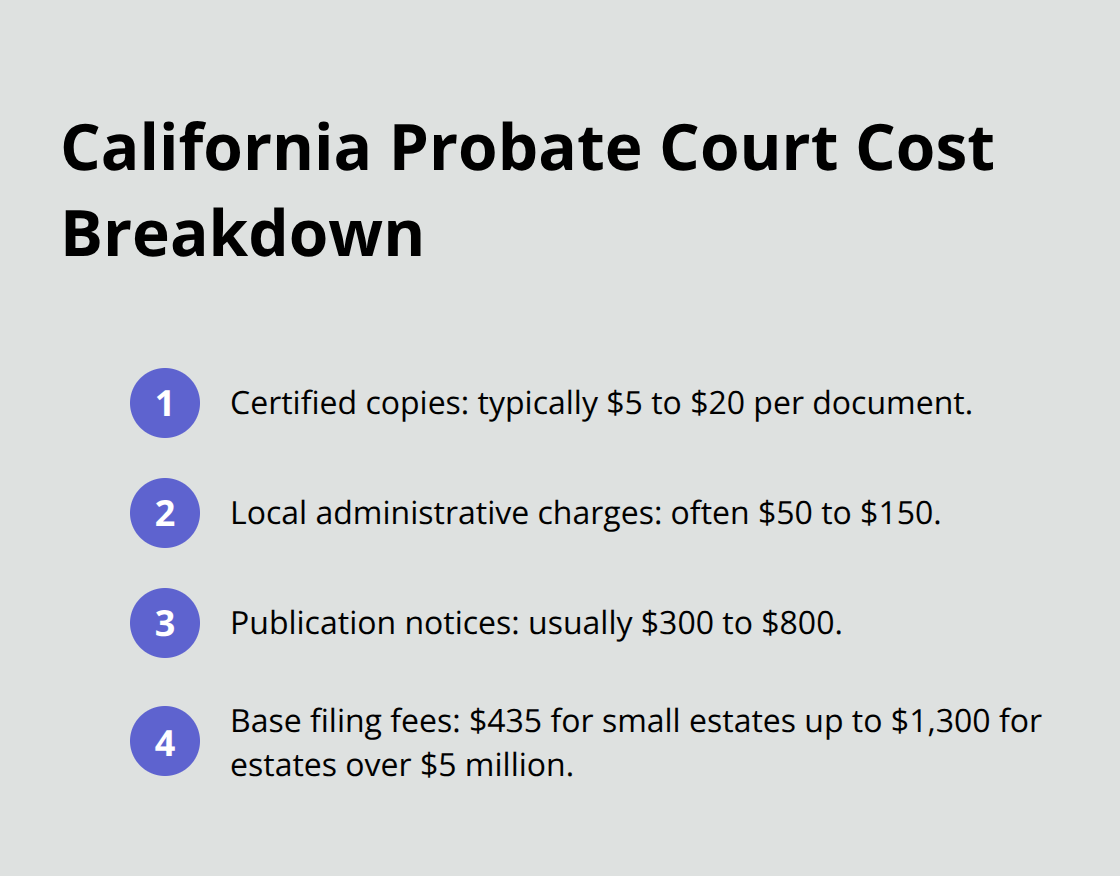
These notices announce the probate to creditors and interested parties, and the court demands proof of publication before finalizing the estate.
Bond Costs Add Up Faster Than You Think
California requires executor bonds in most probate cases unless the will explicitly waives the bond requirement. The bond premium typically costs 0.5% to 1% of the estate value, meaning a $500,000 estate could require a $2,500 to $5,000 bond premium upfront. Many executors overlook this cost until the probate process begins and the court demands it. If your estate includes real property, the court may also order appraisals to establish fair market value for tax and distribution purposes-appraisal fees range from $500 to $5,000 depending on property complexity and location.
Petition Fees and Hidden Expenses
Petition filing fees for specific probate actions, such as petitions to fix executor compensation or requests to sell real estate, add another $200 to $400 per petition. These costs accumulate when the estate involves multiple properties or contested decisions. Certified copies of court documents (needed for banks, title companies, and other institutions) cost $5 to $20 each, and most estates require several copies. Court-ordered appraisals, publication notices, and petition filings combine to create substantial ancillary expenses that many families don’t anticipate until probate is underway. Understanding these layered costs helps you prepare for what comes next-the attorney fees that often dwarf court costs themselves.
Attorney Fees and Administration Expenses
California’s statutory fee structure gives attorneys a clear framework but leaves room for negotiation that most families never pursue. California law allows probate attorneys to charge either according to the statutory schedule-which runs 4% of the first $100,000 of estate value, 3% on the next $100,000, 2% on the next $800,000, 1% on the next $9 million, and 0.5% above that-or they can request the court approve reasonable fees based on hourly work and the estate’s complexity. This dual system means you have options, but understanding which path costs less requires actual numbers from your attorney before you commit.
Flat Fees versus Hourly Billing
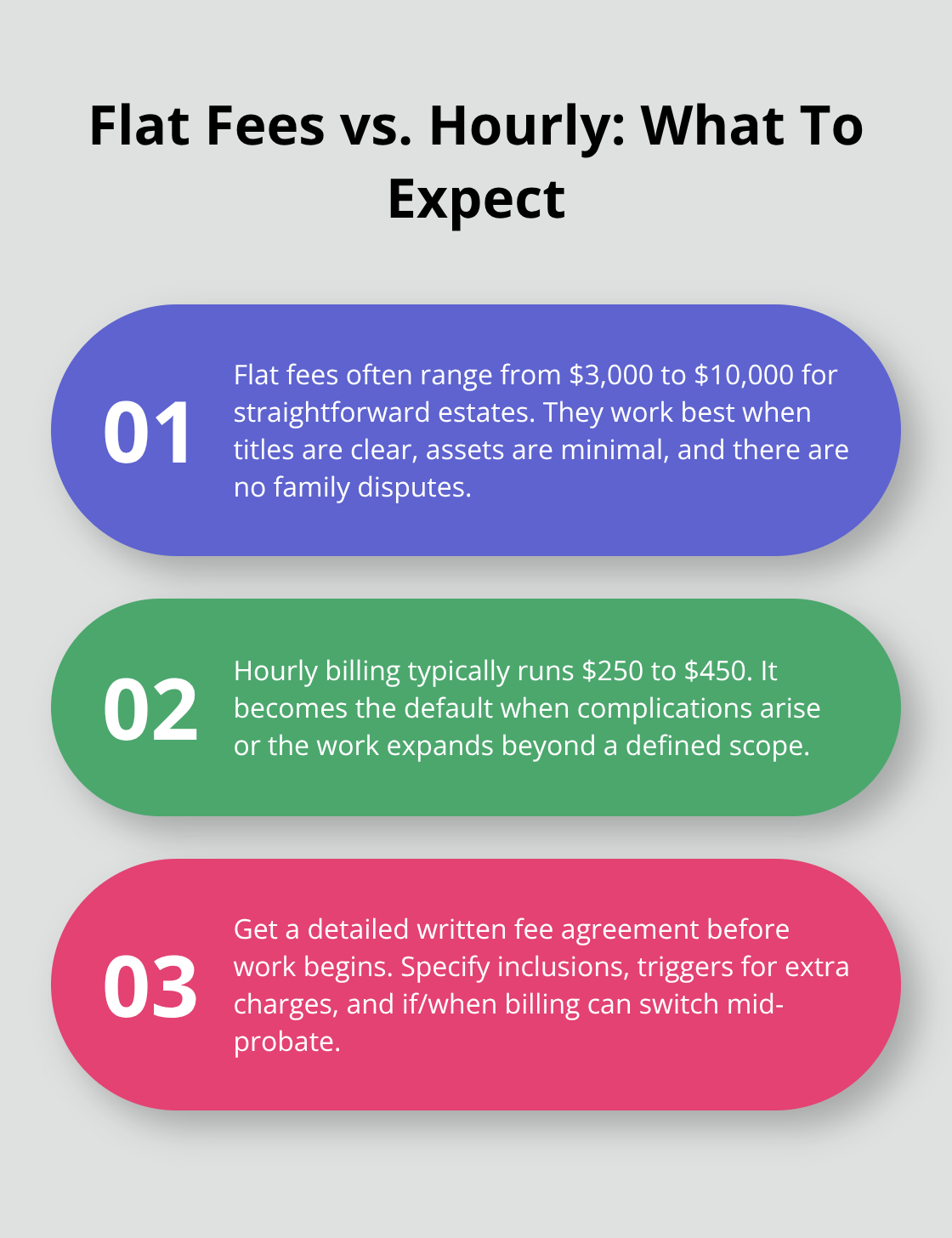
Many attorneys quote flat fees ranging from $3,000 to $10,000 for straightforward estates, while others charge hourly rates between $250 and $450. The flat-fee approach works best when your estate has clear title, minimal assets, and no family disputes. The moment complications arise-contested claims, multiple properties, or beneficiary conflicts-flat fees evaporate and hourly billing takes over, often without warning. Get written fee agreements upfront that specify what’s included, what triggers additional charges, and whether the attorney will switch billing models mid-probate.
What Executor Compensation Actually Costs
Executor compensation represents a separate cost that surprises many families because they assume the person handling the estate does it unpaid. California law allows executors to claim statutory compensation using the same tiered percentages as attorneys, meaning a $500,000 estate executor can legally request $11,500 in compensation. Many executors waive this fee, but when they don’t, it comes directly from estate assets and reduces what beneficiaries receive.
Additional Professional Costs
Appraisal costs during probate administration-often required for real property and valuable personal property-range from $500 to $5,000 depending on the property’s complexity. These fees combine with court costs, publication notices, and bond premiums to create a total probate expense that frequently reaches 5–7% of the estate value in California.
How to Avoid These Costs Entirely
The most effective cost reduction happens before probate starts. A revocable living trust funded during your lifetime transfers property outside probate entirely, eliminating attorney fees, executor compensation, and court involvement altogether. Properties titled in the trust, retirement accounts with named beneficiaries, and assets in joint ownership with right of survivorship bypass probate and its associated costs completely. Understanding these cost-avoidance strategies positions you to make informed decisions about which tools fit your situation-a topic we’ll address in the next section.
How to Cut Probate Costs Before They Start
Revocable Living Trusts Eliminate Probate Entirely
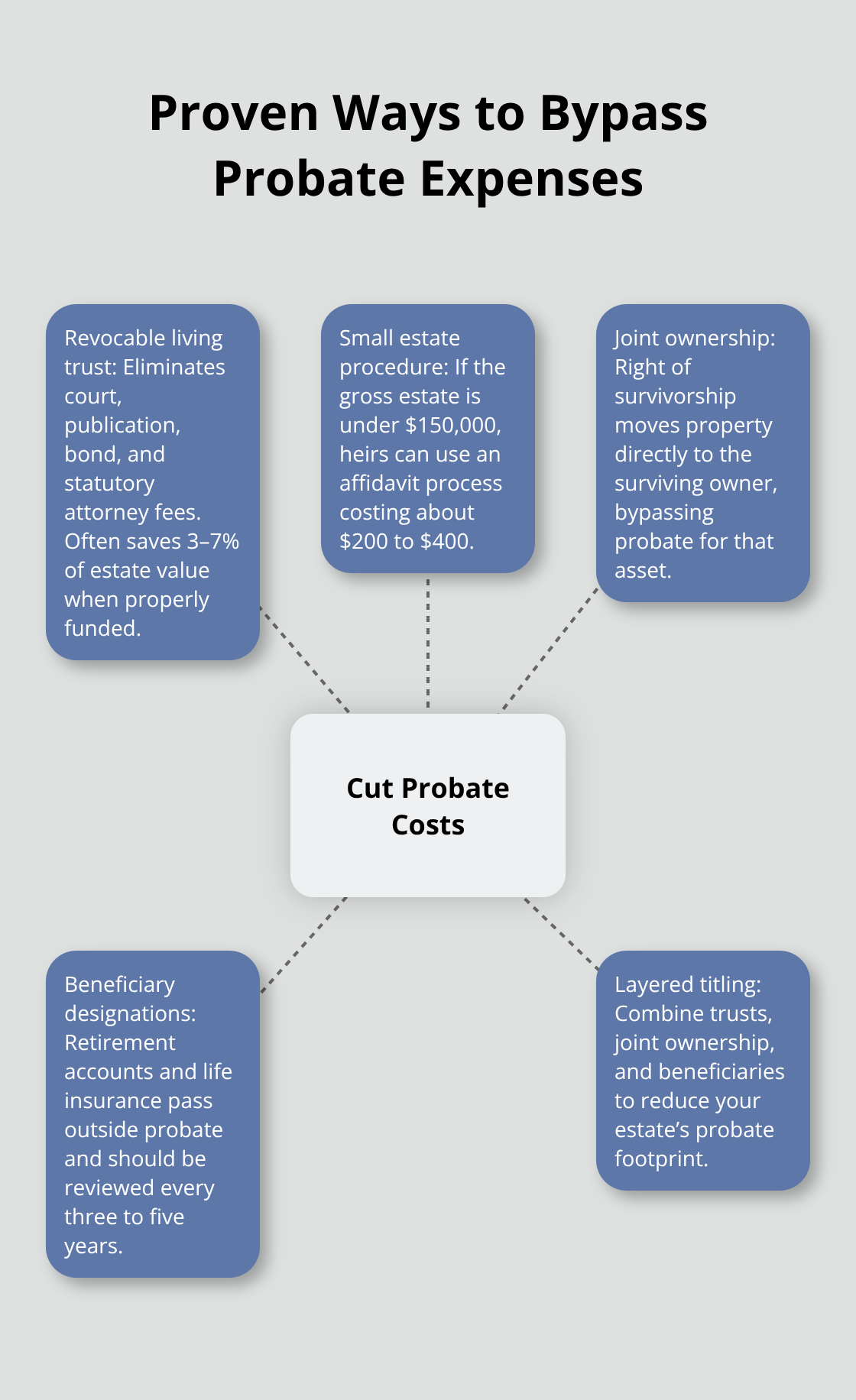
A revocable living trust funded during your lifetime eliminates probate entirely, which means zero court filing fees, zero publication costs, zero executor bonds, and zero statutory attorney fees. This single tool removes 3–7% of estate value from the probate system completely. The trust costs between $1,500 and $3,000 to set up with an attorney, but that upfront investment pays for itself on estates over $150,000 because you avoid the tiered fees that California law allows probate attorneys to charge.
When property sits in a trust rather than in your individual name, it transfers to beneficiaries outside the courthouse, keeping the process private and fast. The catch is that trusts only work if you actually fund them-retitling assets into the trust’s name requires paperwork that many people delay or skip entirely, which defeats the whole purpose.
Bypass Trusts for High-Value Estates
Bypass trusts, also called credit shelter trusts, serve a different function for married couples by protecting assets from estate taxes while still providing for a surviving spouse. These work best for estates exceeding $13.61 million in 2024 (the federal estate tax threshold), which applies to relatively few California families, but they require careful drafting and ongoing administration. For smaller estates, simpler strategies work better and produce faster results without the complexity that bypass trusts demand.
Small Estate Procedures and Simplified Probate
California’s small estate procedure applies when the gross estate falls below $150,000, allowing heirs to skip formal probate and collect assets through an affidavit process that costs roughly $200 to $400 instead of thousands in court and attorney fees. This streamlined path saves time and money for families with modest estates and no significant disputes among heirs.
Joint Ownership and Beneficiary Designations
Property titled jointly with right of survivorship transfers automatically to the surviving owner upon death, bypassing probate for that specific asset-this works well for primary residences and bank accounts but creates complications if relationships change. Beneficiary designations on retirement accounts, life insurance policies, and transfer-on-death accounts bypass probate entirely and require review every three to five years because outdated designations override your will and can contradict your actual wishes.
Layered Asset Titling Reduces Probate Exposure
Proper asset titling during your lifetime-placing some assets in a trust, others in joint ownership, and still others with named beneficiaries-creates a layered approach that minimizes probate exposure without requiring a single tool to do all the work. This combination of strategies reduces your estate’s probate footprint significantly and gives your family faster access to their inheritance.
Final Thoughts
Probate fee expectations typically range from 3–7% of your estate’s value in California when you account for court filing fees, attorney charges, executor compensation, and administrative costs. A $500,000 estate could easily cost $15,000 to $35,000 in probate expenses alone, money that disappears into the system rather than reaching your beneficiaries. Strategic planning cuts these costs dramatically or eliminates them entirely.
A revocable living trust funded during your lifetime removes probate from the equation completely, saving thousands in court fees, publication costs, and statutory attorney charges. Joint ownership with right of survivorship and beneficiary designations on retirement accounts and life insurance policies bypass probate for those specific assets without requiring complex trust administration. Layering these tools together creates a comprehensive approach that protects your assets, speeds up the transfer to your heirs, and keeps your family’s financial information private.
The time to address probate fee expectations is now, not after death when your family faces urgent deadlines and mounting bills. We at Law Offices of Roshni T. Desai offer free consultations to review your situation and recommend the right combination of planning tools for your specific circumstances. Contact us with flexible scheduling at your home or office, and let’s build a plan that protects what matters most to you.